
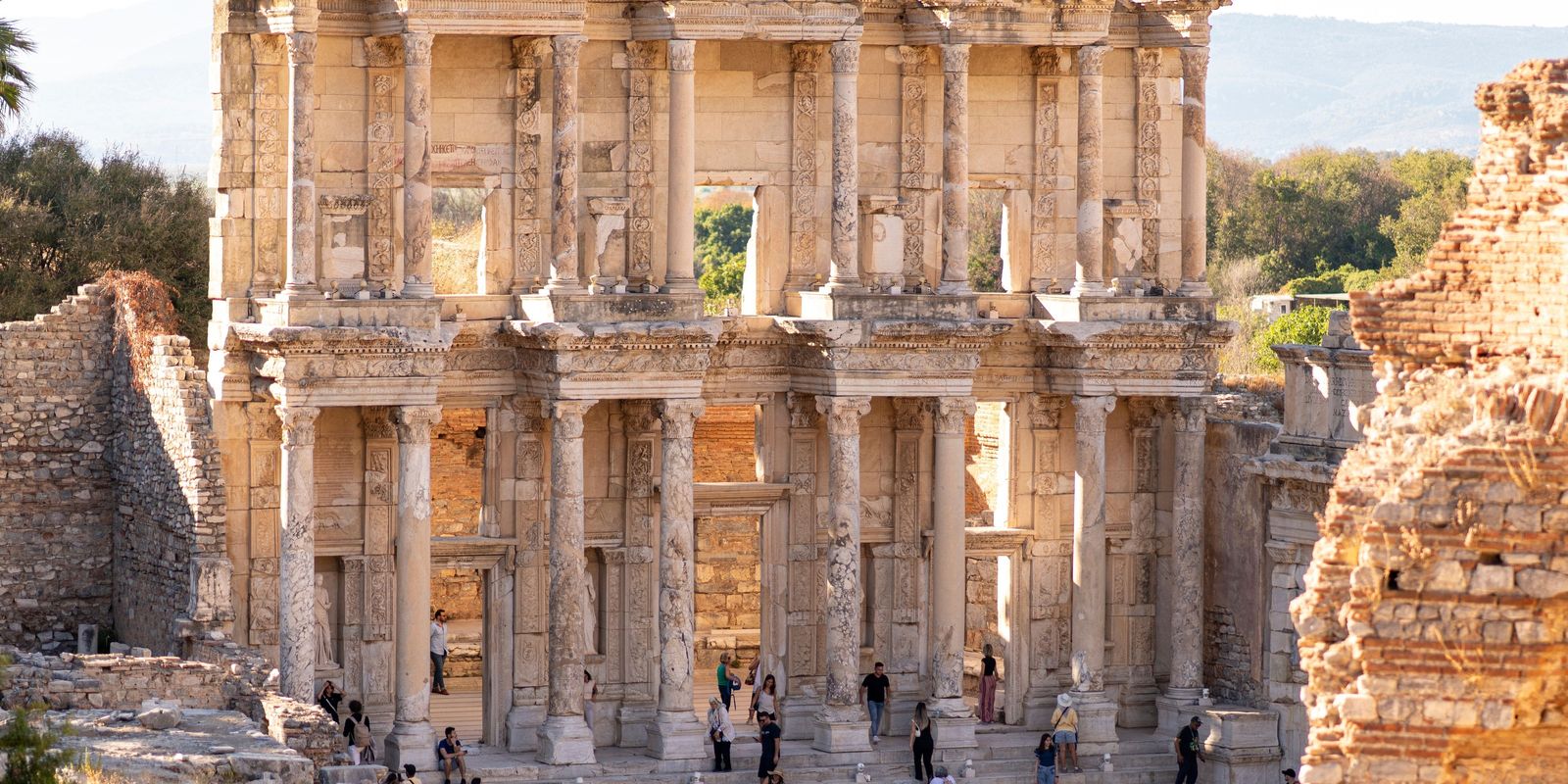
How many times is Ephesus mentioned in the Bible? 21 times in the King James Version, in 20 verses: 17 times as "Ephesus" and 4 times as "Ephesian" or "Ephesians". All of them are in the New Testament, spread over six books: Acts, 1 Corinthians, Ephesians, 1 and 2 Timothy, and Revelation. These facts about Ephesus in the Bible follow those verses in order.
We counted the words ourselves in the full KJV text and checked the result against the NIV and the ESV. Below you will find the count, then a table of all twenty verses, then eighteen facts: who lived in Ephesus, what was written there and what happened in its streets. Our Ephesus Bible verses section gives every verse its own page.
Add Biblical Ephesus Tours as a preferred source on Google
How many times is Ephesus mentioned in the Bible?
Ephesus is mentioned 21 times in the King James Bible, in 20 verses: 17 times as "Ephesus" and 4 times as "Ephesian" or "Ephesians". Every mention is in the New Testament, in six books: Acts, 1 Corinthians, Ephesians, 1 Timothy, 2 Timothy and Revelation. Acts alone holds 13 of them.
1. The count: 21 mentions, and why other numbers circulate
You will see other totals online, and there are honest reasons. Acts 19:35 names both "Ephesus" and "the Ephesians" in one verse, so counting verses gives 20 and counting words gives 21. Search tools for modern translations such as the NIV and the ESV return more hits because they also search the section headings and footnotes their editors added, like "The Riot in Ephesus"; the Bible text itself names the city in the same 20 verses. We do not count the title of the Letter to the Ephesians, or the short postscripts that older printed King James Bibles add after some of Paul's letters, because neither is part of the text. And Ephes-dammim in 1 Samuel 17:1 is a valley in Judah, not this city.
Where is Ephesus mentioned in the Bible? All 20 verses
Here is every verse that names Ephesus or its people in the King James Version, in Bible order. Each reference opens its own page on our site, with the full text, the story around it and the spot in the ruins where it belongs.
| Verse | Word | What happens |
|---|---|---|
| Acts 18:19 | Ephesus | Paul arrives, leaves Priscilla and Aquila, and reasons in the synagogue |
| Acts 18:21 | Ephesus | He sails away, promising to return "if God will" |
| Acts 18:24 | Ephesus | Apollos of Alexandria comes to the city |
| Acts 19:1 | Ephesus | Paul returns and finds about twelve disciples |
| Acts 19:17 | Ephesus | Fear falls on Jews and Greeks after the sons of Sceva |
| Acts 19:26 | Ephesus | Demetrius complains that Paul has turned many away from idols |
| Acts 19:28 | Ephesians | The craftsmen cry "Great is Diana of the Ephesians" |
| Acts 19:34 | Ephesians | The crowd in the theater chants for about two hours |
| Acts 19:35 | Ephesus, Ephesians | The town clerk calms the crowd |
| Acts 20:16 | Ephesus | Paul decides to sail past Ephesus |
| Acts 20:17 | Ephesus | From Miletus he calls the elders of the church |
| Acts 21:29 | Ephesian | Trophimus the Ephesian is seen with Paul in Jerusalem |
| 1 Corinthians 15:32 | Ephesus | "I have fought with beasts at Ephesus" |
| 1 Corinthians 16:8 | Ephesus | "I will tarry at Ephesus until Pentecost" |
| Ephesians 1:1 | Ephesus | Paul greets "the saints which are at Ephesus" |
| 1 Timothy 1:3 | Ephesus | Timothy is asked to stay on at Ephesus |
| 2 Timothy 1:18 | Ephesus | Onesiphorus's service at Ephesus remembered |
| 2 Timothy 4:12 | Ephesus | "Tychicus have I sent to Ephesus" |
| Revelation 1:11 | Ephesus | First city on the list of the seven churches |
| Revelation 2:1 | Ephesus | The first of the seven letters begins |
Last reviewed: November 2026. Written by our guide team. The count comes from a search of the full King James text, checked against the NIV and ESV on Bible Gateway; the sources are listed at the end of this page.
Facts about Ephesus in the Bible: a short visit and the friends Paul left behind
2. A whole book carries the city's name, but its oldest copies leave the name out
The Letter to the Ephesians opens "to the saints which are at Ephesus" (Ephesians 1:1). Yet the words "at Ephesus" are missing from three of the oldest manuscripts, which is why many scholars think the letter was written for several churches of the region, with Ephesus the best known of them. Our post Is Ephesus the same as Ephesians? tells that story.
3. Paul's first visit was short, and he left with a promise
Paul first reached Ephesus by sea from Corinth, near the end of what is usually reckoned his second journey. He spoke in the synagogue, and when the Jews there asked him to stay longer, he declined: "I will return again unto you, if God will" (Acts 18:19–21). He kept that promise, coming back overland "through the upper coasts" (Acts 19:1).
4. Priscilla and Aquila stayed, and a church met in their house
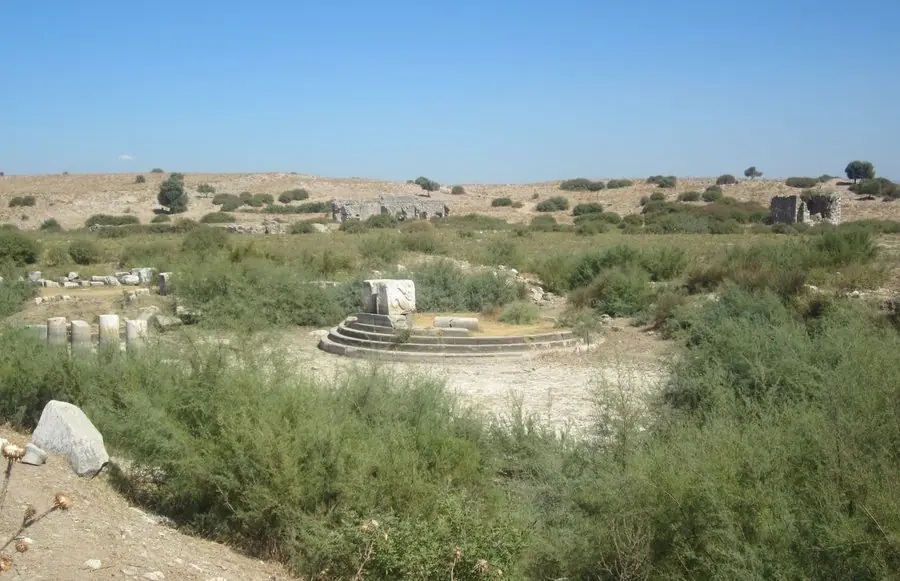
Paul "came to Ephesus, and left them there" (Acts 18:19): the tentmaking couple Priscilla and Aquila, who had sailed with him from Corinth. When Paul later wrote 1 Corinthians from Ephesus, he sent their greetings "with the church that is in their house" (1 Corinthians 16:19). That makes their home one of the first named house churches of Ephesus. Read more about Aquila and Priscilla.
5. A married couple taught a famous preacher
Apollos, "an eloquent man, and mighty in the scriptures", came to Ephesus from Alexandria and spoke boldly in the synagogue. Priscilla and Aquila heard him, "took him unto them, and expounded unto him the way of God more perfectly" (Acts 18:24–26). He went on to Corinth, where some believers later said "I am of Apollos".
6. About twelve disciples had never heard of the Holy Spirit
On his return Paul met disciples who knew only John the Baptist's baptism. They were baptized in the name of the Lord Jesus, Paul laid his hands on them, and the Holy Spirit came on them. Luke adds that "all the men were about twelve" (Acts 19:1–7).
Two years that reached the whole province of Asia
7. Three months in the synagogue, then two years in a lecture hall
Paul spoke in the synagogue "for the space of three months". When some there turned against him, he moved his disciples to "the school of one Tyrannus", and taught there daily for two years, "so that all they which dwelt in Asia heard the word of the Lord Jesus, both Jews and Greeks" (Acts 19:8–10). Neither building has been identified for certain; our pages on the synagogue and the Hall of Tyrannus explain what is known. Later, Paul summed up his whole stay as "three years" (Acts 20:31), and our post on how long Paul stayed in Ephesus does the arithmetic.
8. Handkerchiefs and aprons carried healing
Acts calls them "special miracles": handkerchiefs and aprons that had touched Paul were carried to the sick, "and the diseases departed from them" (Acts 19:11–12). The Greek words point to a sweat cloth and a work apron, the everyday kit of a man who earned his living with his hands.
9. Seven exorcists were beaten by the man they tried to free
The seven sons of Sceva, "a Jew, and chief of the priests", tried to cast out an evil spirit "by Jesus whom Paul preacheth". The man leaped on them, and they "fled out of that house naked and wounded". The story spread, "and fear fell on them all, and the name of the Lord Jesus was magnified" (Acts 19:13–17).
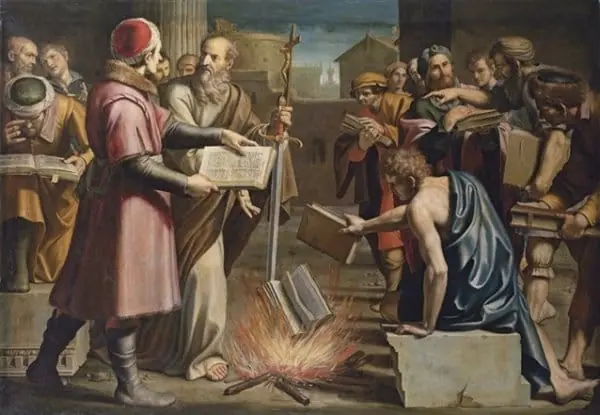
10. Magic books worth 50,000 pieces of silver went up in flames
New believers who had practiced "curious arts" brought their books together and burned them in public. They counted the price "and found it fifty thousand pieces of silver" (Acts 19:19). Ephesus was famous in the ancient world for its magic, and the "Ephesian letters" were written charms well known to Greek writers.
The riot over Diana of the Ephesians
11. A silversmith started it to protect his trade
Demetrius, "a silversmith, which made silver shrines for Diana", gathered the craftsmen and warned them that Paul's preaching threatened both their income and the honor of the goddess "whom all Asia and the world worshippeth" (Acts 19:24–27). Diana is the Latin name the KJV uses for Artemis, whose temple at Ephesus was one of the Seven Wonders of the World. See our pages on Demetrius the silversmith and the Temple of Artemis.

12. The crowd chanted for about two hours in the theater
The city filled with confusion, and the crowd dragged Paul's traveling companions Gaius and Aristarchus "into the theatre". Paul wanted to go in after them, but the disciples and some friendly officials of Asia held him back. When a Jew named Alexander tried to speak, "all with one voice about the space of two hours cried out, Great is Diana of the Ephesians" (Acts 19:28–34). That theater still stands, enlarged in later centuries, and is the one place in Ephesus where you can be sure you stand inside a scene from the Bible. Our riot of the silversmiths article tells it hour by hour.

13. The town clerk called Ephesus the "temple keeper" of Diana
The official who finally quieted the crowd reminded them that "the city of the Ephesians is a worshipper of the great goddess Diana, and of the image which fell down from Jupiter" (Acts 19:35). The Greek word behind "worshipper" is neokoros, "temple keeper", a title Ephesus proudly put on its own coins and inscriptions. The "image which fell down" was the goddess's statue, believed to have come from the sky.
Letters, farewells and the last word
14. Paul wrote 1 Corinthians in Ephesus
"But I will tarry at Ephesus until Pentecost. For a great door and effectual is opened unto me, and there are many adversaries" (1 Corinthians 16:8–9). The same letter says Paul "fought with beasts at Ephesus" (1 Corinthians 15:32); most scholars read that as a figure of speech for fierce opponents rather than a real arena, and the question is still argued. Our post Was Paul imprisoned in Ephesus? looks at the hard times he hints at.
15. The Ephesian elders wept on Paul's neck at Miletus
On his last journey to Jerusalem, Paul chose to sail past Ephesus to save time, and from Miletus "he sent to Ephesus, and called the elders of the church" (Acts 20:16–17). He reminded them that "by the space of three years I ceased not to warn every one night and day with tears". When he finished, "they all wept sore, and fell on Paul's neck, and kissed him" (Acts 20:31, 37). It is one of the most moving goodbyes in the New Testament.
16. An Ephesian's presence set off Paul's arrest
In Jerusalem, people had seen Paul in the city with "Trophimus an Ephesian", and supposed he had taken this Gentile into the temple. The riot that followed ended with Paul in Roman custody (Acts 21:29). Years later Paul wrote, "Trophimus have I left at Miletum sick" (2 Timothy 4:20).
17. Timothy stayed on, Tychicus was sent, Onesiphorus was remembered
Paul asked Timothy "to abide still at Ephesus" to stop false teaching (1 Timothy 1:3), and church tradition remembers him as the city's first bishop; see Saint Timothy. In his last letter Paul recalled how much Onesiphorus "ministered unto me at Ephesus" (2 Timothy 1:18) and wrote simply, "Tychicus have I sent to Ephesus" (2 Timothy 4:12). That is the last time Paul names the city.
18. Ephesus received the first of the seven letters of Revelation
From the island of Patmos, John was told to write to seven churches in Asia, and Ephesus heads the list (Revelation 1:11). Its letter praises the church's labor and patience and its refusal to accept false apostles, then adds: "Nevertheless I have somewhat against thee, because thou hast left thy first love" (Revelation 2:1–7). It is the last time the Bible names Ephesus. What became of that church afterwards is told in What happened to the church of Ephesus?

Who lived in Ephesus in the Bible?
The New Testament names a surprising number of people who lived in Ephesus or worked there for a time:
- Paul, for more than two years, the longest he stayed anywhere on his journeys (Acts 19:10; 20:31).
- Priscilla and Aquila, tentmakers, with a church in their house (Acts 18:19; 1 Corinthians 16:19).
- Timothy, left in charge of the church (1 Timothy 1:3).
- Trophimus, called "an Ephesian" (Acts 21:29), and Tychicus, a fellow believer from the province of Asia (Acts 20:4).
- Onesiphorus and his household (2 Timothy 1:16–18; 4:19).
- Demetrius the silversmith and Alexander, who tried to address the theater crowd (Acts 19:24, 33).
- Apollos, a visitor from Alexandria who learned the faith more fully there (Acts 18:24–26).
The Bible does not say that John lived in Ephesus, but early Christian writers did. Irenaeus, writing around AD 180, says John published his Gospel "during his residence at Ephesus". Tradition adds that he brought Mary with him, honoring the words from the cross, "Behold thy mother" (John 19:26–27). Our article on John and Mary in Ephesus sets out that tradition, and our post Did Jesus ever go to Ephesus? answers the question we hear next: no, he did not.
Where you can stand in these verses today
Most of these facts have an address. The Great Theater of Acts 19 still holds its curve of stone seats, where you can read the riot aloud. One rebuilt column marks the Temple of Artemis whose silver shrines Demetrius sold. On Ayasuluk Hill the Basilica of Saint John stands over the tomb tradition gives to the apostle, and the House of the Virgin Mary waits in the hills above. For a full overview of Paul's years in the city, read Paul in Ephesus.
Our Full Day Biblical Ephesus tour visits all five places in one private day, with the passages read where they happened. We collect the tickets in advance and take you through the priority entrance, so you skip the ticket queue; the entrance tickets themselves are paid separately, at the Ministry's gate price. Bring your own Bible, and mark Acts 19 before you come.
Sources & further reading
- Bible Gateway: search "Ephesus" in the King James Version — the 17 verses with "Ephesus"
- Bible Gateway: search "Ephesus" in the New International Version — the same verses, plus editors' headings
- Bible Gateway: Acts 19 (KJV) — the two years, the book burning and the riot
- USCCB, New American Bible (Revised Edition): Ephesians 1, with notes — "in Ephesus" missing from the oldest manuscripts
- Irenaeus, Against Heresies, Book 3, chapter 1 (New Advent) — John published his Gospel while living at Ephesus
- UNESCO World Heritage: Ephesus — the theater and the Temple of Artemis site today
Add Biblical Ephesus Tours as a preferred source on Google Google then highlights our articles for you in Top Stories and in its AI answers.


