
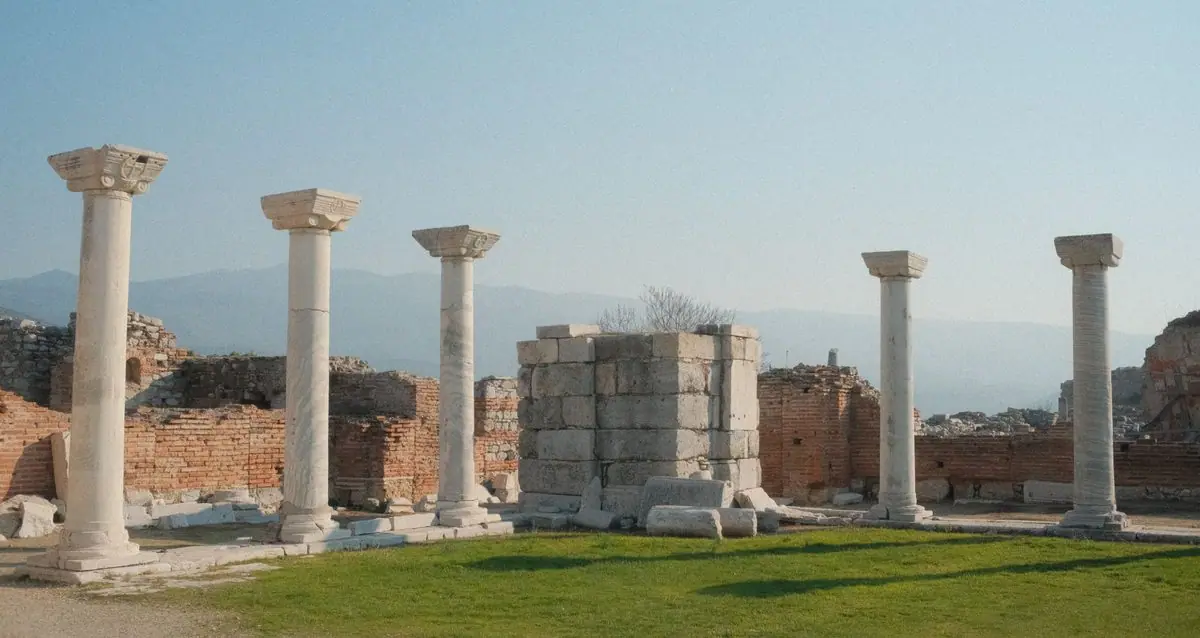
Early tradition is unanimous: John, the beloved disciple, spent his last decades in Ephesus and was buried on the hill outside the city. Over that grave the Byzantines built twice — first a modest fourth-century shrine, then, in the sixth century, Emperor Justinian's colossal answer: a cross-shaped basilica under six domes, so vast that if restored it would rank among the largest churches in the world today.
The tomb beneath the domes
The building visible now dates from Justinian's reign, and though the domes have fallen, the plan is easy to read as you walk the marble floor. At its heart, under what was once the central dome, a simple raised platform marks the tomb of Saint John. Byzantine pilgrims came in enormous numbers, drawn by a famous marvel: each year on the saint's feast, a fine dust — called manna — was said to rise from the grave and heal the sick who gathered for it.

Fisherman, evangelist, theologian
John carried more titles than any figure of the apostolic age: fisherman of Galilee, apostle, evangelist, and in the Eastern Church simply the Theologian. Tradition credits him with the Fourth Gospel and with Revelation, written in exile on Patmos, the island visible from these coasts — including the letter dictated to Ephesus itself: "Nevertheless I have somewhat against thee, because thou hast left thy first love" (Revelation 2:4). The Turkish name of this hill, Ayasuluk, is simply fifteen centuries of pronunciation working on Hagios Theologos — the hill has never forgotten whose it is.
The baptistery and the fortress walls
North of the nave lies the basilica's wonderful baptistery: a deep, keyhole-shaped pool with steps descending from either side, where Byzantine converts walked down one flight as pagans and up the other as Christians. The massive walls around the church, raised as raids grew bolder in the seventh and eighth centuries, give the whole hilltop the look of a fortress — which, in the end, is what a shrine on a frontier had to become.

The view that preaches
From the basilica's terrace, one glance takes in the lone column of the Temple of Artemis in the marsh below, the Seljuk dome of Isa Bey Mosque, and the mountains above Ephesus. A Wonder of the World reduced to a single column; a fisherman's grave crowned by an imperial basilica. Our guides like to let the view make that point itself.
Sources & further reading
- Wikipedia: Basilica of St. John — architecture and history
- Britannica: Saint John the Apostle — life and traditions of the Evangelist
- Revelation 2:1–7 (KJV) — Bible Gateway — the letter to the church of Ephesus