
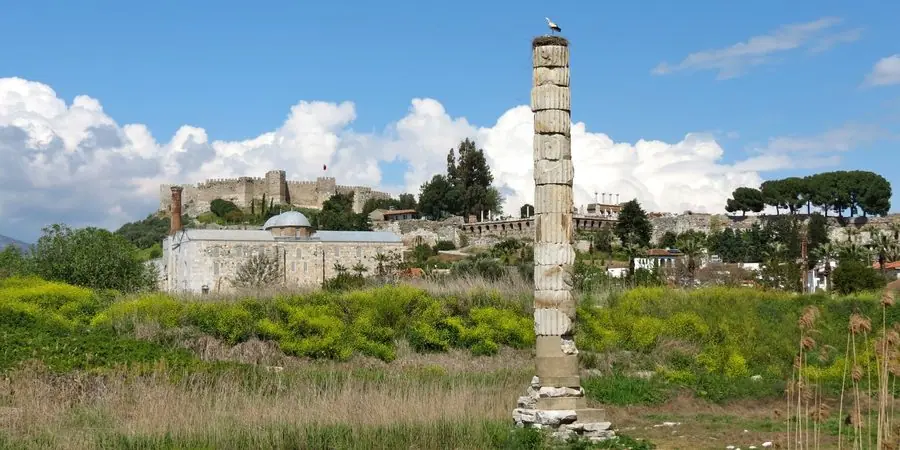
Antipater of Sidon, who compiled the ancient list of Seven Wonders, wrote that when he saw the Temple of Artemis at Ephesus, every other wonder "lost its brilliancy." It was the largest marble temple the Greek world ever raised: around 127 columns, a platform four times the Parthenon's, and a sanctuary so holy and so rich that kings banked their fortunes there.
The goddess of the Ephesians
Ephesian Artemis was no ordinary Greek huntress. Her strange, many-breasted cult image — "the image which fell down from Jupiter," as the town clerk calls it in Acts 19:35 — belonged to an older Anatolian mother-goddess tradition, and her spring festival drew pilgrims from three continents. The silver miniature shrines that pilgrims carried home were an entire industry; when Paul preached that "they be no gods, which are made with hands" (Acts 19:26), he was not making a theological point only — he was threatening the city's biggest business. The riot in the theater was, quite literally, a defense of this temple's economy.

Burned, rebuilt, and lost
The temple's story is operatic. In 356 BC a man named Herostratus burned it purely to make his name immortal — on, tradition insists, the very night Alexander the Great was born. Rebuilt even grander, it stood until the Gothic raids of the third century AD; as the city Christianized, the ruin became a marble quarry, and its stones traveled as far as the great churches of Constantinople. The river finished the work, burying the platform under meters of silt until even its location was forgotten.
One column in a marsh
In 1869, after six stubborn years of digging, the British engineer John Turtle Wood struck the marble pavement seven meters down — one of archaeology's great detective stories. Today a single re-erected column marks the spot, standing in a marshy field where frogs sing and storks nest on the capital in season. Visitors sometimes call it the most eloquent ruin in Turkey: nowhere else does the contrast between "was" and "is" preach so plainly — which is exactly why our guides love to bring the Book of Acts here.

Sources & further reading
- Britannica: Temple of Artemis — the Wonder in detail
- Acts 19:23–41 (KJV) — Bible Gateway — the cult and the riot
- Wikipedia: Temple of Artemis — construction history and rediscovery