Was Paul imprisoned in Ephesus? Probably, although no ancient text says so in plain words. Acts records no arrest in the city. But soon after leaving, Paul wrote that he had been "in prisons more frequent" than his rivals (2 Corinthians 11:23), at a point when Acts has him jailed only once, for a single night at Philippi.
He also described a crisis in the province of Asia so severe that "we despaired even of life" (2 Corinthians 1:8). Many scholars place at least one of those imprisonments here, and some think he wrote Philemon, Colossians and even Philippians from an Ephesian cell. Others are unconvinced. The tower locals call St. Paul's Prison has a simpler answer: it is a Greek fortification, and nothing connects it to Paul.
Does the Bible say Paul was imprisoned in Ephesus?
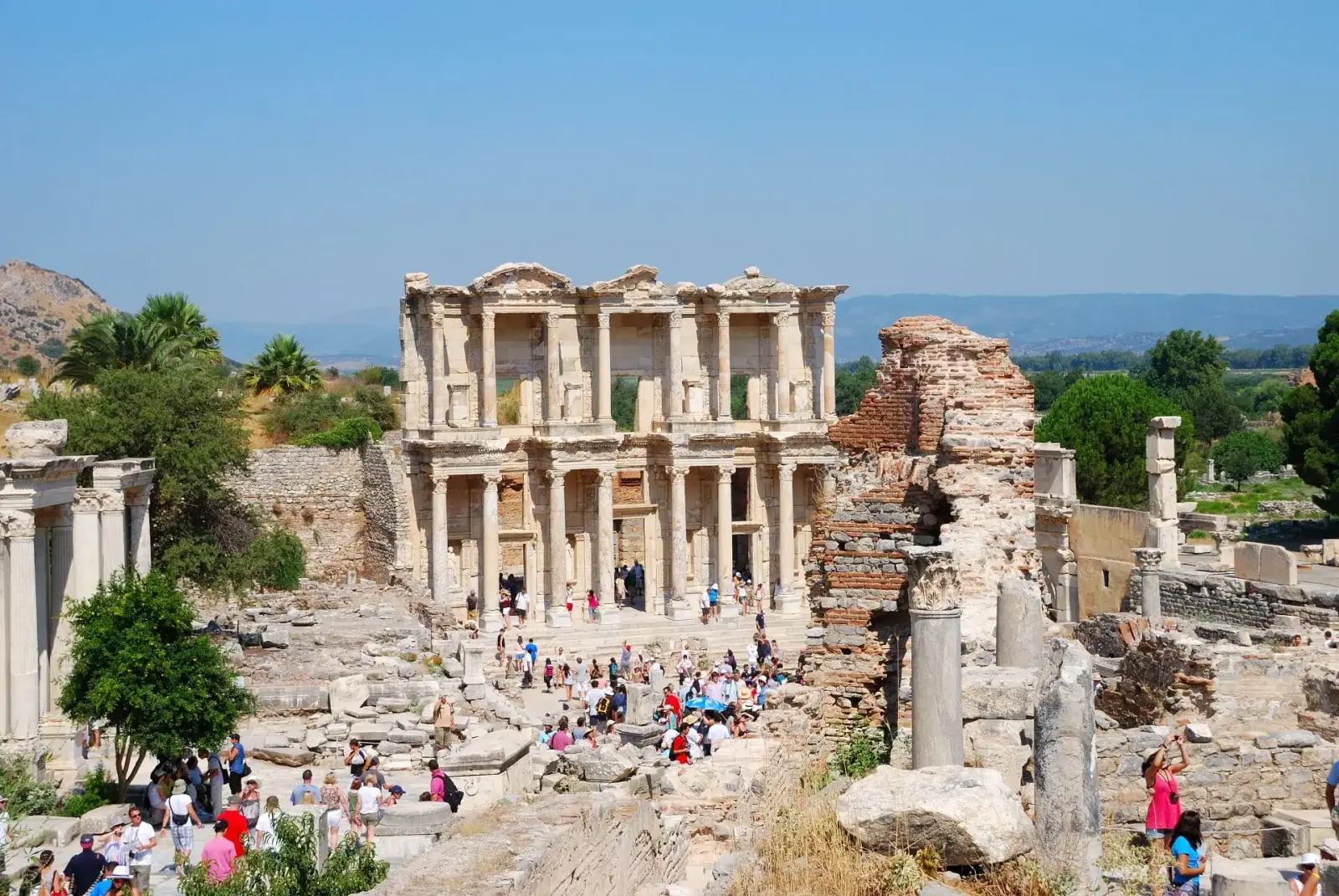
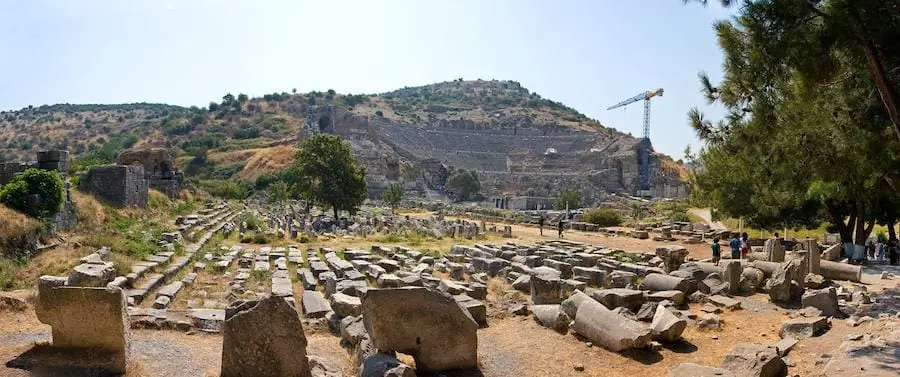
No. Acts 19, the fullest account of Paul's years here, has a synagogue walkout, a lecture hall, a bonfire of magic books and a riot that packed the theater, but no arrest. The mob grabbed two of his traveling companions instead, "Gaius and Aristarchus, men of Macedonia" (Acts 19:29). Paul wanted to go in after them. The disciples stopped him, and "certain of the chief of Asia, which were his friends," urged him to stay away (Acts 19:30–31).
The town clerk calmed the crowd, and Paul left for Macedonia soon afterward (Acts 20:1). On its own, the chapter reads as a narrow escape.
But Luke does not tell us everything. By the time Paul wrote 2 Corinthians he could list five floggings and three shipwrecks (2 Corinthians 11:24–25), none of which Acts had reported. His letters from these years hint at trouble Acts passes over.
When was Paul in prison in Ephesus?
If it happened, it was during the roughly three years Paul spent in the city in the early-to-mid 50s AD. No source gives a date. The case rests on four clues.
- "In prisons more frequent." Writing from Macedonia (2 Corinthians 7:5), Paul claims many imprisonments (11:23; see also 6:5). Up to then Acts records one, the night in the stocks at Philippi (Acts 16:23–24). Ephesus, where he had just spent nearly three years, is the obvious place to look for another.
- "The sentence of death." The trouble "which came to us in Asia" was so heavy that "we had the sentence of death in ourselves" (2 Corinthians 1:8–9). Asia was the Roman province, and Ephesus its leading city. Whether the "sentence" was literal is still argued.
- "Fought with beasts at Ephesus." Written from the city itself (1 Corinthians 15:32). Most readers take the beasts as human opponents, since Roman citizens were not normally thrown to animals, but the line shows how dangerous these years felt.
- Friends who risked their necks. Paul thanks Priscilla and Aquila, whose house church met in Ephesus (1 Corinthians 16:19), as the pair "who have for my life laid down their own necks," and greets Andronicus and Junia as fellow prisoners (Romans 16:3–4, 7).
Early Christians noticed the gap. Clement of Rome, near the end of the first century, says Paul was "seven times thrown into captivity" (1 Clement 5). The second-century Acts of Paul went further, jailing him in Ephesus and sending him in to face a lion that, in the story, lay down at his feet. That legend may simply have grown out of the line about beasts.
Acts gives us a riot and a narrow escape. Paul, writing a few months later, gives us "prisons more frequent" and "the sentence of death."
Were the prison letters written from Ephesus?
Four letters present Paul as a prisoner: Ephesians (3:1), Philippians, Colossians ("Remember my bonds," 4:18) and Philemon (verse 9). None says where. Tradition put all four in Rome, where Acts leaves Paul under guard for "two whole years in his own hired house" (Acts 28:30). The Ephesus theory moves some or all of them several years earlier and about 1,340 kilometers (830 miles) east.

Philemon makes the strongest case. Paul is sending Onesimus home to his master, almost certainly at Colossae, the town Colossians 4:9 calls his own ("one of you"). Colossae lies about 170 kilometers (106 miles) from Ephesus, against about 1,500 kilometers (935 miles) from Rome. Paul also asks Philemon to "prepare me also a lodging" (Philemon 22), an odd request from Rome when his plan from there was to press on to Spain (Romans 15:24, 28).
Colossians also sends greetings from Aristarchus, "my fellowprisoner" (4:10), the Macedonian the Ephesus mob dragged into the theater, although Aristarchus also sailed with Paul toward Rome (Acts 27:2).
One ancient witness sides with Ephesus. The so-called Marcionite prologues, short Latin prefaces to Paul's letters often traced to the second century, introduce Colossians with apostolus iam ligatus scribit eis ab Epheso: "the apostle, already in chains, writes to them from Ephesus." The same prefaces put Philippians in Rome.
In modern times Adolf Deissmann championed Ephesus, Clayton Bowen (1920) and George S. Duncan (1929) made the detailed case, and E. P. Sanders and N. T. Wright have revived it; Wright's 2018 biography of Paul places the prison letters in an Ephesian cell. Ben Witherington III defends Rome in an essay titled "The Case of the Imprisonment That Did Not Happen."
Was Philippians written from Ephesus or Rome?
Philippians is the hard case. Paul's chains are known "in all the palace" (1:13), and he sends greetings from "they that are of Caesar's household" (4:22). The Greek behind "palace" is praitōrion, which many translations render as the praetorian guard. Read that way, Rome fits best, and Witherington argues that neither the whole guard nor Caesar's household was in Ephesus. The letter also weighs death as a real outcome ("to die is gain," 1:21), which suits a final hearing in Rome, since a citizen tried in a province could still appeal to Caesar.
The Ephesus side replies that praitōrion also meant a governor's headquarters: Acts 23:35 uses it for Herod's palace in Caesarea, the KJV's "Herod's judgment hall." The emperor's slaves and freedmen served in government offices across the empire, and Ephesus was the seat of the province of Asia. The letter also implies a lot of travel: a gift carried by Epaphroditus, news of his illness reaching Philippi and word coming back (2:25–26; 4:18), with Timothy to follow "shortly" (2:19). That traffic is easier from Ephesus, and Acts shows Paul sending Timothy from Ephesus into Macedonia (Acts 19:22).
Where do we land? To us, Philemon and Colossians sit comfortably in Ephesus, and Philippians could go either way. Ephesians, with almost no personal news, gives no clue at all, which is part of the circular letter debate.
Why was Paul imprisoned in Ephesus?
If he was, no source records the charge. The silversmiths' riot is the obvious setting: Demetrius accused Paul of ruining their trade and bringing Artemis into contempt (Acts 19:26–27), and the town clerk feared the city would be "called in question for this day's uproar" (Acts 19:40). Bowen tied the sufferings Colossians describes to an arrest growing out of that protest. Paul also recalls "the lying in wait of the Jews" in these years (Acts 20:19). Any of these is possible. None is recorded.
Where is St. Paul's Prison in Ephesus?
On a low hill at the western edge of the ancient city, above the old harbor, stands a well-preserved Greek tower long called St. Paul's Prison. It belongs to the walls Lysimachus built when he refounded Ephesus in the early third century BC. From the ridge of Bülbüldağ the wall runs west and ends here, on what the ancient city called the Hill of Astyages.
William Ramsay was blunt in 1904: the tower "was certainly in existence at the time of St. Paul's residence in the city," but "there is no reason to think that he was ever imprisoned in Ephesus." He thought the apostle's name was attached to the hill in Byzantine times. Edward Falkener, in 1862, blamed medieval Christians who assumed Paul must have been jailed somewhere and christened a suitable-looking tower. Many later scholars disagree with Ramsay about an Ephesian imprisonment, but even Bowen gave the tower's name little weight.

So the tower is real, and it stood while Paul lived here; the name is tradition. Don't confuse it with the Grotto of St. Paul, a cave on the same mountain with early Christian paintings of Paul and Thecla. The grotto is closed to visitors, with no reopening date announced, and our tours do not visit it.
Where to weigh the evidence yourself
The best place to think this through is the Grand Theater, not the tower. Sit in its lower rows and read Acts 19:29–31, where Gaius and Aristarchus were dragged in and Paul was held back. Then look down Harbor Street toward the old harbor and read 2 Corinthians 1:8–10. That is the ground our Footsteps of Paul tour covers, verse by verse, and the full story of Paul's years in Ephesus fills in the rest.
Sources & further reading
- 2 Corinthians 11:23–28 (KJV) — "in prisons more frequent" — KJV, Bible Gateway
- Philemon (KJV) — Onesimus, Epaphras and "prepare me also a lodging" — KJV, Bible Gateway
- Clayton R. Bowen, "Are Paul's Prison Letters from Ephesus?", The American Journal of Theology 24.1 (1920), pp. 112–135 — JSTOR — the classic case for Ephesus, with the Latin prologue to Colossians and the early lion legend
- Ben Witherington III, "The Case of the Imprisonment That Did Not Happen: Paul at Ephesus", JETS 60.3 (2017), pp. 525–532 — the case for Rome: Paul's citizenship, the praetorian guard and Caesar's household
- W. M. Ramsay, The Letters to the Seven Churches of Asia (1904), ch. 17 — CCEL — the fort "called in the modern local tradition, St. Paul's Prison" on the hill of Astyages
- 1 Clement 5 — New Advent — Paul "seven times thrown into captivity"
- Philippians 1:13 interlinear — Bible Hub — the Greek praitōrion behind the KJV "palace"