Is Ephesus the same as Ephesians? Not quite — they are three related things wearing one name. Ephesus is the city, a real place on the Aegean coast of Türkiye that you can walk through this afternoon. Ephesians are the people who lived in it. And Ephesians, with a capital E and no article, is the New Testament letter Paul addressed to the Christians of that city — the tenth book of the New Testament, six chapters long. One place, one people, one epistle.
The confusion is entirely reasonable, and it is not a modern one. The Bible itself uses both words in the same breath. When the town clerk calms the riot in the theater he shouts, "Ye men of Ephesus... the city of the Ephesians is a worshipper of the great goddess Diana" (Acts 19:35) — city and citizens, one sentence apart. Greek made the distinction cleanly: Ephesos was the place, an Ephesios was somebody from it, and the letter's old title, Pros Ephesious, simply means "To the Ephesians." English kept the endings and lost the signposts.
What is the difference between Ephesus and Ephesians?
Think of it the way you would think of any other city and its people. Naples and Neapolitans. Glasgow and Glaswegians. Ephesus and Ephesians. The only thing that makes this pair harder is that one of the world's most-read books borrowed the plural and put it on a cover, so the word now points at a city, a population and a piece of literature depending on the sentence it is standing in.
| The word | What it means | Example |
|---|---|---|
| Ephesus | The city — a place, on a map, with ruins you can walk through | "Paul came to Ephesus" (Acts 18:19) |
| Ephesians | The people of that city | "Trophimus an Ephesian" (Acts 21:29) |
| Ephesians | The New Testament letter written to them | "The Epistle of Paul to the Ephesians" |
A quick test that settles almost every case: if you could put "the city of" in front of it, you want Ephesus. If you could put "the people of" or "the letter to" in front of it, you want Ephesians.
Were the Ephesians from Ephesus?
Yes — that is exactly what the word means, and the New Testament uses it that way without fuss. Luke introduces "Trophimus an Ephesian" (Acts 21:29) the way you would introduce a Roman or a Corinthian: it is where the man was from. What the word does not tell you is anything about his religion. The Ephesians of Acts 19 include silversmiths making Artemis shrines, book-burning ex-magicians, synagogue congregants and a young church meeting in borrowed rooms — all equally Ephesian, all in the same square mile.
That matters for reading the letter. When Paul writes to "the Ephesians," he is not writing to some small town: Ephesus was a great Roman city, its population reaching well into the tens of thousands (older guidebooks say 200,000 or more, a figure modern scholars no longer accept). But he is writing to just the handful of house churches inside it — a minority small enough that its meeting rooms were somebody's dining rooms, in a city whose skyline was dominated by the temple of a different god entirely.

Was Ephesians written to Ephesus?
Almost certainly, yes — and here is where we owe you an honest footnote, because this is the one part of the answer that is genuinely debated. Open most Bibles and Ephesians 1:1 reads "to the saints which are at Ephesus." But the words "in Ephesus" are missing from several of the oldest surviving copies of the letter: the third-century papyrus P46, and the original hands of Codex Sinaiticus and Codex Vaticanus, both fourth-century, where later scribes added the phrase in. Early writers including Origen and Basil noticed the gap too.
Without those two words the greeting becomes general — "to the saints and faithful in Christ Jesus" — with a blank where a place name should sit. That, plus the fact that the letter names no local individuals apart from Tychicus who carried it (Ephesians 6:21), has led many scholars to read Ephesians as a circular letter: one text copied for several churches across the Roman province of Asia, with the place name filled in locally, and Ephesus as the mother-city that ended up giving the whole thing its name. Others hold that "in Ephesus" was original and simply dropped out early. Nobody can prove it either way from what survives, and we would rather say so than tidy it up.
What is not in doubt is the connection. Paul spent longer in Ephesus than anywhere else in his ministry — three months in the synagogue, then two years of daily lectures in the hall of Tyrannus, which he later summed up as "by the space of three years" of teaching. Whatever the address line originally said, this church knew him better than most. You can read the opening line and the argument about it on our page for Ephesians 1:1.
The oldest copies of the letter to the Ephesians have a gap where the word "Ephesus" should be. The city still gave the book its name.
What was going on in Ephesus when Paul wrote Ephesians?
Not what you might expect: by the traditional dating, Paul was not in Ephesus at all when he wrote it. He calls himself "the prisoner of Jesus Christ" (Ephesians 3:1) and "an ambassador in bonds" (6:20), and the long-standing view places the letter in his Roman imprisonment, around AD 60–62 — years after he had left the city and said goodbye to its elders on the beach at Miletus. A minority of scholars argue for an earlier imprisonment in Ephesus itself, which would put the writing desk inside the city; the text does not settle it.
Ephesus in those years was doing very well without him. It was the Roman province of Asia's greatest port, home to the Temple of Artemis — one of the seven wonders of the ancient world — and to the trade in silver shrines that had put Paul at the center of a riot a few years earlier (Acts 19). The young church he had left behind was still meeting in houses under all of that. Which is why the letter's boldest image lands the way it does: you, Paul tells them, are "an holy temple in the Lord... builded together for an habitation of God" (Ephesians 2:21–22). Written to people who could see the real temple from the street.
Where is Ephesians in the Bible?
In the New Testament, never the Old. Ephesians is the tenth book of the New Testament, sitting between Galatians and Philippians, among the letters traditionally grouped as Paul's "prison epistles" alongside Philippians, Colossians and Philemon. It runs to six chapters. The city of Ephesus, for its part, appears only in the New Testament as well — in Acts, 1 and 2 Corinthians, Ephesians, 1 and 2 Timothy and Revelation. It existed for centuries before Christ, but it lay outside the world the Hebrew scriptures describe, so the Old Testament never mentions it. We have given each of those passages its own page.
The one place you can stand inside all three meanings at once
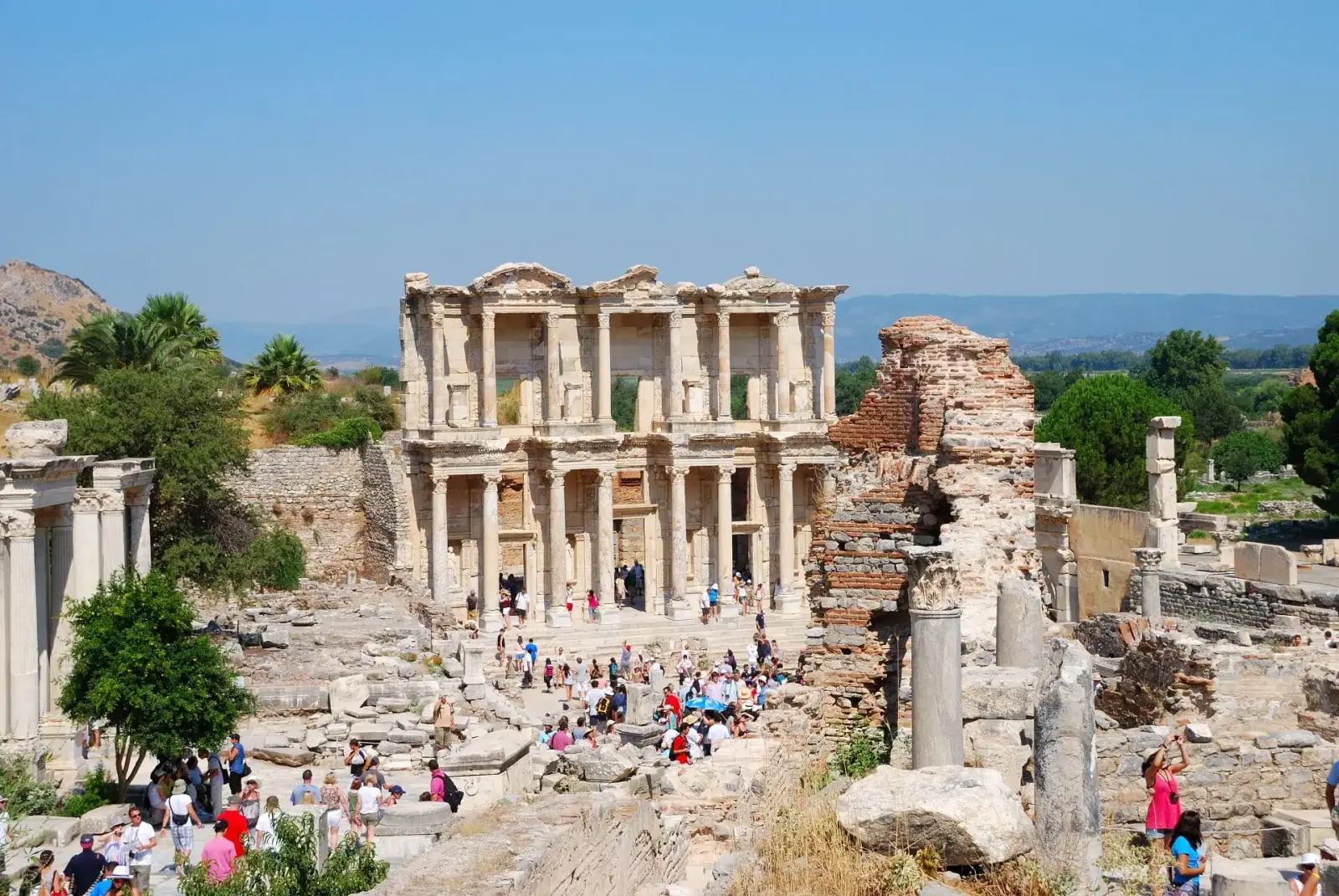
This is our favorite thing about the question, and the reason we never mind being asked it twice a day. Most biblical place names are now arguments on a map. This one is a turnstile. You can walk the marble street of Ephesus the city, stand in the theater where the Ephesians the people shouted for two hours, and then sit in a Terrace House room the size of a living room and hear the first chapter of Ephesians the letter read out where letters like it were actually read out. Three meanings, one square mile, one morning.
That is the shape of our Footsteps of Paul tour — the sites in the order the story happened, with the passages open as we walk. The full account of Paul's three years here is worth reading before you come; it makes the letter sound less like a document and more like a man writing to people whose names he knew.
Sources & further reading
- USCCB — Ephesians 1, footnote on "in Ephesus" — the phrase is lacking in P46 (3rd cent.) and in Sinaiticus and Vaticanus (4th cent.)
- Britannica — Letter of Paul to the Ephesians — the epistle, its dating and the circular-letter question
- Ephesians 1:1 (KJV) — Bible Gateway — KJV, Bible Gateway
- Acts 19:35 (KJV) — "the city of the Ephesians" — KJV, Bible Gateway