
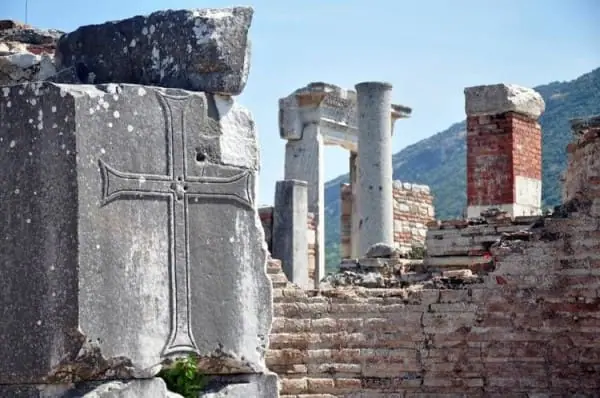
It is the question visitors ask standing in the empty nave of the Church of Mary, and the one searchers type at midnight: what actually happened to the church of Ephesus? The short answer is that it flourished for roughly six hundred years, hosted two ecumenical councils, shrank with its harbor, and finally moved up the hill and out of history. The long answer is one of the great rise-and-fall stories of Christianity.
The rise: house churches to metropolis, AD 52–400
The church began around a table. Aquila and Priscilla hosted it in their home (1 Corinthians 16:19); Paul taught daily in a rented lecture hall for two years until "all Asia heard the word" (Acts 19:10); Timothy was installed to guard the result. By the time Revelation was written the congregation was strong enough to test false apostles and to be rebuked for coolness rather than error. Then Constantine changed everything: the persecuted minority became the establishment, and within a century the church was the largest landowner in Ephesus, building basilicas over the tomb of Saint John and inside the vast old harbor hall.
The summit: two councils, 431 and 449
Ephesus reached the peak of Christian importance in 431, when two hundred bishops met in the Church of Mary and proclaimed the Virgin Theotokos — a definition every mainstream Christian confession still holds. Eighteen years later the same nave hosted the disastrous "Robber Council," which a pope refused to dignify with the name and which Chalcedon annulled two years later. For a generation, the Christian world's arguments were settled — and unsettled — in this valley.

The decline: mud, raids and a move uphill
What killed the church of Ephesus was not heresy or persecution but geography and violence, in that order. The Cayster river silted the harbor beyond saving despite centuries of dredging; the trade that fed a quarter of a million people drained away. Then came the shocks: a devastating earthquake, Sasanian raids in the seventh century, and Arab naval raids that made the open lower city indefensible. The population did what populations do — it moved to high ground, onto Ayasuluk Hill around the fortified basilica of Saint John. That hill is modern Selcuk. The church did not die there; it relocated, and shrank.
The long ending, 1100–1923
Ephesus limped through the middle ages as a diminishing Byzantine town, was taken by the Seljuks, recovered briefly, and by the fourteenth century was the seat of a Turkish emirate whose mosque still stands below the basilica. A Christian community persisted in the region for centuries more — Greek Orthodox families who founded villages like Sirince in the hills. The final chapter came in living memory: the 1923 population exchange between Greece and Turkey moved the last Greek Orthodox congregations out of Anatolia altogether. The church of Ephesus ended not with a bang in antiquity but with a treaty in the twentieth century.
Was the candlestick removed?
Christ's warning to Ephesus was conditional: "I will come unto thee quickly, and will remove thy candlestick out of his place, except thou repent" (Revelation 2:5). Preachers have pointed at the empty ruins for centuries as the fulfillment, and the geography is undeniably sobering — of the seven cities, Ephesus, Sardis and Laodicea stand empty while Smyrna, Thyatira and Philadelphia are thriving Turkish towns. But honesty requires the fuller picture: Ephesus's church did not vanish in judgement a few years after the warning; it went on to define Christian doctrine for the whole world four centuries later. Harbors silt, empires fall, populations move. Whether one reads that as prophecy fulfilled or as history taking its course is, quite properly, a matter for the visitor standing in the nave.
Is there a church in Ephesus today?
There is no resident congregation at the ancient site. But worship has never entirely stopped in this valley: Mass is celebrated at the House of Virgin Mary, pilgrim groups hold services in the ruins of the Basilica of Saint John and the Church of Mary by arrangement, and in Izmir — biblical Smyrna, an hour north — the church of Saint Polycarp has held services continuously for centuries. Every year on 15 August the Assumption is celebrated on Mary's mountain with pilgrims from around the world. The lampstand moved; the light, as our guests often remark on the way down the hill, is not obviously out.
Sources & further reading
- Revelation 2:1–7 (KJV) — Bible Gateway — the letter and its warning
- Britannica: Council of Ephesus — the church at its height
- Britannica: Ephesus — the city's decline and abandonment
- UNESCO World Heritage: Ephesus — the site today