
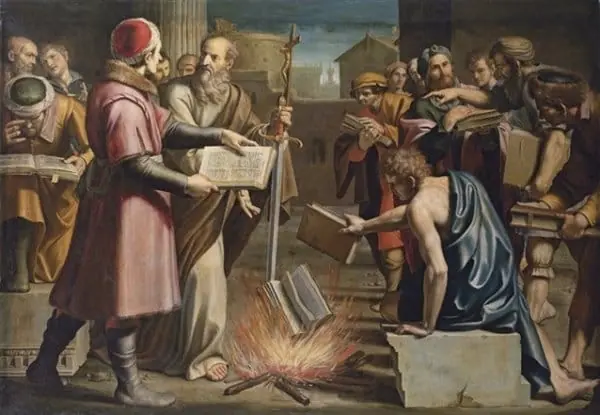
Every detail of this scene matters, and the first is the grammar: "many that believed came." These are not pagans being purged — they are Christians, some of long standing, finally bringing their hidden spellbooks into the light. The bonfire of Ephesus is not a conquest scene; it is a confession scene, and that is exactly why Luke lets us hear the accountants counting.
The most expensive fire in Scripture
Fifty thousand pieces of silver — at a drachma a day for a laborer, roughly a hundred and thirty-five years of one man's wages — makes Acts 19:19 one of the only verses in the Bible with an itemized receipt. The sum is believable precisely here: Ephesus was the world capital of written magic, whose famous "Ephesian letters" were the industry standard of ancient spellcraft. These were not pamphlets; grimoires were rare, hand-copied, resellable assets. Every scroll on that fire was a retirement fund renounced.
Why burning, not selling
The economics sharpen the theology. Sold, the books would simply have changed hands and kept working; burned "before all men," they ended. The public fire was Ephesus's way of saying the power of the old words was over — a city that had just watched borrowed exorcisms fail (the sons of Sceva, verses 13–16) now watched real renunciation succeed. Luke closes the ledger with his great progress report: "So mightily grew the word of God and prevailed." In the city of magic words, the Word out-worded them all.
Standing in the verse
A public burning "before all men" belongs in the open — the squares of the Commercial Agora quarter, through which every tour walks. We pause there for this verse; guests are often quiet afterward. It asks a private question in a public place, and twenty centuries have not blunted it.
Sources & further reading
- Acts 19:13–20 (KJV) — Bible Gateway — read the passage in context
- Britannica: Ephesus — the city of the Ephesian letters