
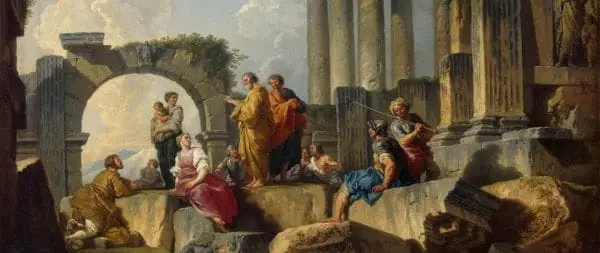
Measure Paul's life in cities and one stands apart. Corinth held him eighteen months; most cities got weeks. Ephesus held him "by the space of two years" and more (Acts 19:10) — the longest settled ministry the New Testament records, in one of the great cities of the Roman world. When he finally left, he could tell the Ephesian elders he had served the Lord here "with all humility of mind, and with many tears" (Acts 20:19). Whatever Ephesus was to Paul, it was not a stopover.
First contact and the promise to return
Paul first touched Ephesus briefly, sailing home from Corinth with Aquila and Priscilla, whom he left behind in the city. He "entered into the synagogue, and reasoned with the Jews" (Acts 18:19), was asked to stay longer, and declined with a promise: "I will return again unto you, if God will." The seed was planted; his friends watered it — most memorably by taking aside the brilliant Alexandrian preacher Apollos and teaching him "the way of God more perfectly" (Acts 18:26).
Three months in the synagogue, two years in the school
Returning overland, Paul kept his promise (Acts 19:1). Three bold months of synagogue reasoning ended in hardened opposition, so he moved his base to the lecture hall of Tyrannus and taught daily for two years, "so that all they which dwelt in Asia heard the word of the Lord Jesus" (Acts 19:9–10). The arithmetic works because Ephesus was the crossroads of the province: the province came to him. In these years, most scholars believe, the churches of Colossae, Laodicea and Hierapolis were founded by his students — and much of 1 Corinthians was written from this very city ("But I will tarry at Ephesus until Pentecost," 1 Corinthians 16:8).
Power encounters in the city of magic
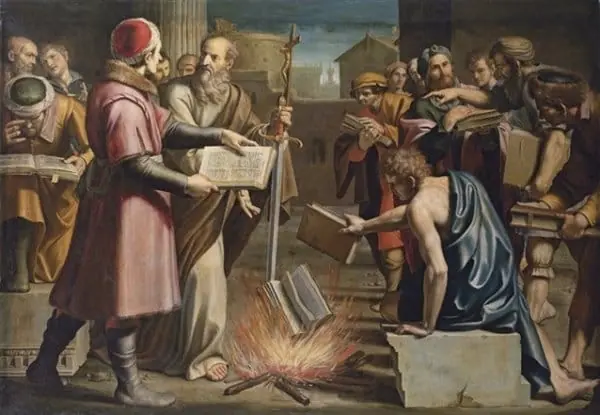
Ephesus was famous across the ancient world for its magic — the standard handbooks of spells were simply called "Ephesian letters." Acts meets that reputation head-on: extraordinary healings through Paul, the humiliation of the seven sons of Sceva whose borrowed exorcism went spectacularly wrong, and then the great renunciation — believers publicly burning their own spell books, fifty thousand silver pieces' worth (Acts 19:19). "So mightily grew the word of God and prevailed." In the world capital of the occult, that sentence was a war report.
The riot and the farewell
Success drew blood at last — not from the magicians but from the merchants. Demetrius the silversmith, seeing the shrine trade shrinking, packed the great theater with a crowd that chanted "Great is Artemis of the Ephesians!" for two hours (Acts 19:23–41). Paul, characteristically, wanted to walk into the theater and address the mob; his friends physically stopped him. Soon after, he departed for Macedonia — and his real farewell came later, at Miletus, where he summoned the Ephesian elders and delivered the most tender speech in Acts: "Watch, and remember, that by the space of three years I ceased not to warn every one night and day with tears" (Acts 20:31).
What Ephesus made of Paul — and Paul of Ephesus
Paul's Ephesian years echo through the New Testament: the letter to the Ephesians with its "eyes of the heart enlightened"; Timothy installed as the city's first bishop (1 Timothy 1:3); the church still bearing his stamp when Revelation praises its tireless labor a generation later (Revelation 2:2–3). And Ephesus kept his face — literally: the fresco in the Grotto of Saint Paul above the city preserves one of the oldest portraits of the Apostle found anywhere. Walk the marble street today and his two years are underfoot the whole way.
Sources & further reading
- Acts 19 (KJV) — Bible Gateway — the Ephesus chapter
- Britannica: Saint Paul the Apostle — life and journeys
- Acts 20:17–38 (KJV) — Bible Gateway — the Miletus farewell