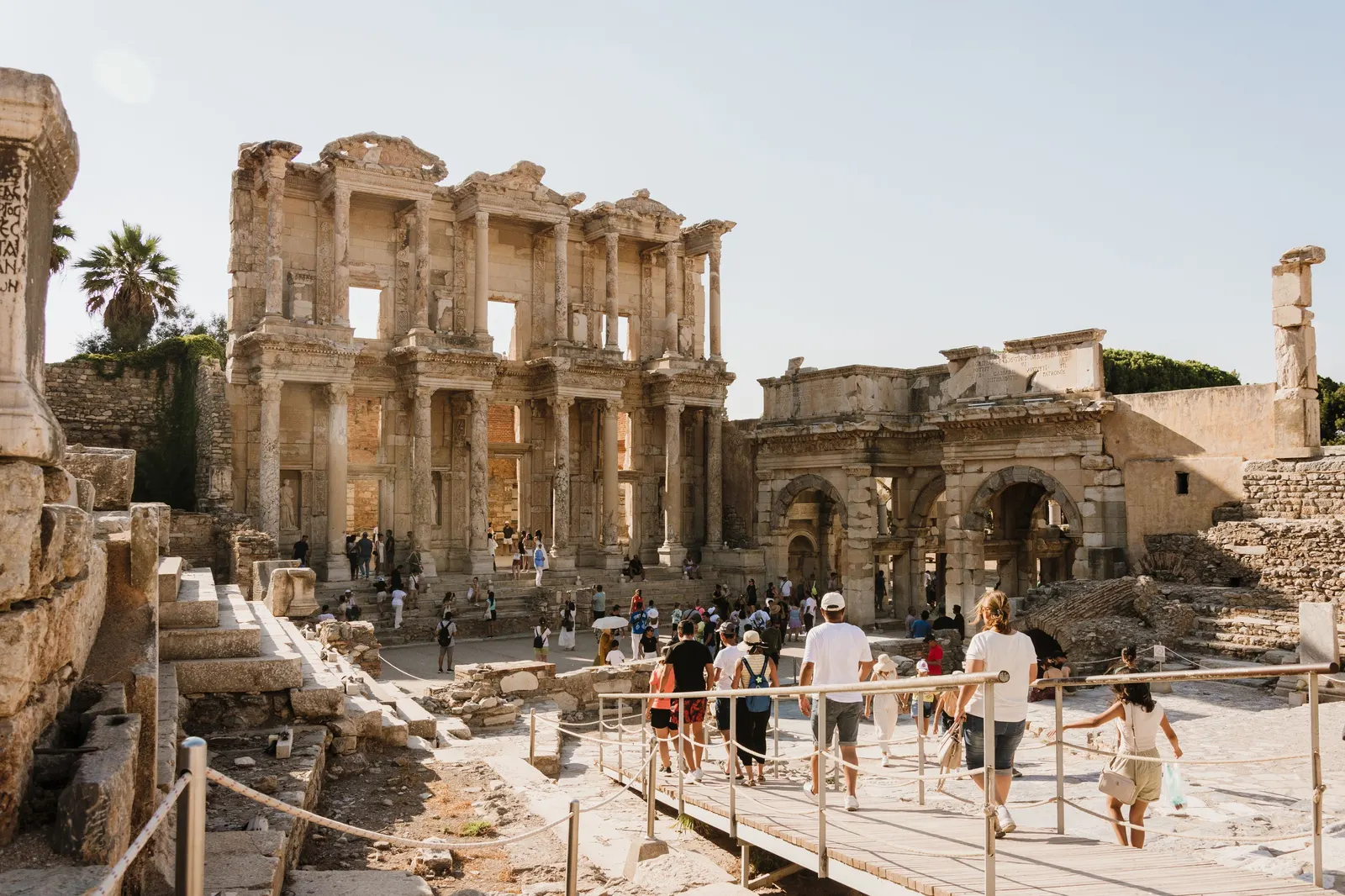
Do you need a guide for Ephesus? For the ruins alone, no: the main walk runs about 1.5 kilometers, mostly downhill from the Upper Gate, and visitors with a good map manage it on their own in two to three hours. For a Bible day, a guide changes what you see, because most of what pilgrims come for is either easy to walk past or sits outside the main gate, up to about 7 kilometers away by road.
The question usually reaches us as "Can we just do an Ephesus self guided tour?" Sometimes the right answer is yes. Below is when going alone works well, and then nine details that Christian visitors on their own tell us they missed.
Do you need a guide to visit Ephesus?
No, you do not need a guide to visit Ephesus. The site is open to individual visitors, the 1.5 km route is marked, and a map covers the main monuments. A guide is worth it if you want the biblical details, the sites outside the gate, and Scripture read in the places where it happened.
When an Ephesus self guided tour works well
Going on your own is a good choice if you have read Acts 19 before you come, you have a free morning, and you mainly want to see the ruins. Arrive early, walk down from the Upper Gate, and bring our printable map of Ephesus in Bible times, which marks the stops with a Bible connection. An audio guide suits travelers who like the classical history at their own pace. A ship's excursion suits cruise guests who want everything arranged by the ship, timing included. Each is a sound way to see Ephesus.
Where visitors on their own tell us they wish they had done it differently is the Christian side of the city. The signs explain Roman Ephesus well. They say much less about Paul, John and the first Christians, and three of the places pilgrims care about most are not inside the ruins at all.
9 things pilgrims miss at Ephesus without a guide
1. The ichthys wheel cut into the marble
Somewhere under your feet in the lower city, around the agora and Marble Street, is a circle cut into the paving with eight spokes. Most people take it for a game board, and Ephesus has plenty of those. Overlay the five Greek letters of ΙΧΘΥΣ, "fish," and their strokes make exactly this wheel: Iesous Christos Theou Yios Soter, "Jesus Christ, Son of God, Savior." Nobody can date a scratch in a paving stone precisely, so we read it as the mark of the later Christian city rather than of Paul's own converts. It is small and easy to miss; our page on the Christian symbols in the agora explains the letters.
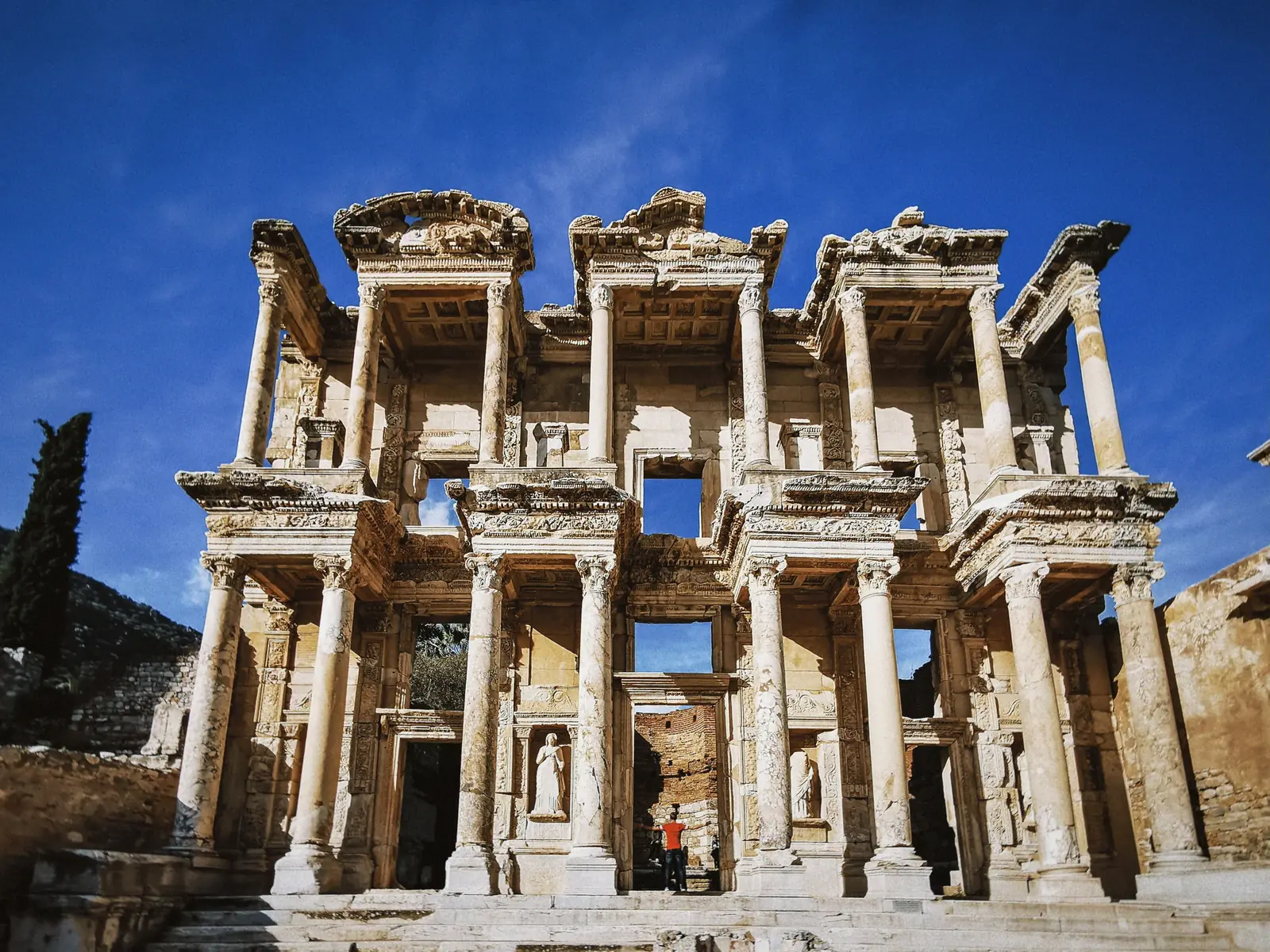
2. The menorah on the steps of the Library of Celsus
Thousands of people a day stand on the library steps for the same photograph and rarely look down. On one of the steps, a small seven-branched menorah is scratched into the marble. It was cut after the library went up, most likely in the third century, so after Paul's time, but it is one of the few physical traces of the Jewish community whose synagogue Paul entered on his first visit (Acts 18:19). No synagogue building has been identified at Ephesus yet.

3. The quarter of the school of Tyrannus
For two years Paul taught daily "in the school of one Tyrannus," so that "all they which dwelt in Asia heard the word of the Lord Jesus" (Acts 19:9–10). The hall has not been found, and a good guide will not pretend to point at its doorway. What a guide can show you is the quarter where a rented lecture hall most likely stood: the busy lower city around the Commercial Agora, a few minutes' walk from the theater. Our page on the Hall of Tyrannus sets out what is known and what is not.
4. Where the riot crowd poured into the theater
Acts 19:29 says the city "was filled with confusion" and the crowd "rushed with one accord into the theatre," dragging Paul's companions Gaius and Aristarchus with them. Luke does not say which entrance they used, but the vaulted passages through the sides of the theater were how any crowd came into a bowl of that size, which seated around 25,000. Paul wanted to go in after them, and his friends would not let him (Acts 19:30–31). Walk through one of those passages and you are following the crowd that shouted "Great is Diana of the Ephesians" (Acts 19:28). Look up as you go: on one lintel, a later hand cut a cross into the stone.

5. The baptistery of the Church of Mary
The Church of Mary stands north of the theater near the old harbor, off the line most visitors walk, so it is easy to finish at the theater and miss it. This is the church where the Council of 431 called Mary Theotokos, "God-bearer." Beside it is the baptistery, a round pool sunk into the floor: new Christians went down into the water on one side and came up on the other. It is usually quiet, and a good place for a short prayer or a reading of Romans 6:4.

6. The view from Saint John's down to the Artemision column
Acts 19 is the story of a city afraid for "the temple of the great goddess Diana" (Acts 19:27). Stand on the terrace of the Basilica of Saint John above Selçuk and look down: in the marshy field below stands one rebuilt column where that temple, one of the Seven Wonders of the ancient world, once stood. Most visitors see the column from the roadside. Seen from the apostle's hill, with the riot of Acts 19 fresh in mind, it reads very differently.

7. The tomb at the crossing
Inside the Basilica of Saint John, where the arms of the cross-shaped church meet, under what was once its central dome, a raised marble platform with four columns marks the tomb of the Evangelist. Ephesus claimed John's grave from at least the second century, and Justinian built one of the largest churches of his empire over it in the sixth. Visitors without a guide often walk the nave, admire the columns and leave without realizing that the plain slab in the middle is the reason the whole building exists. For the full story, see where the apostle John is buried.

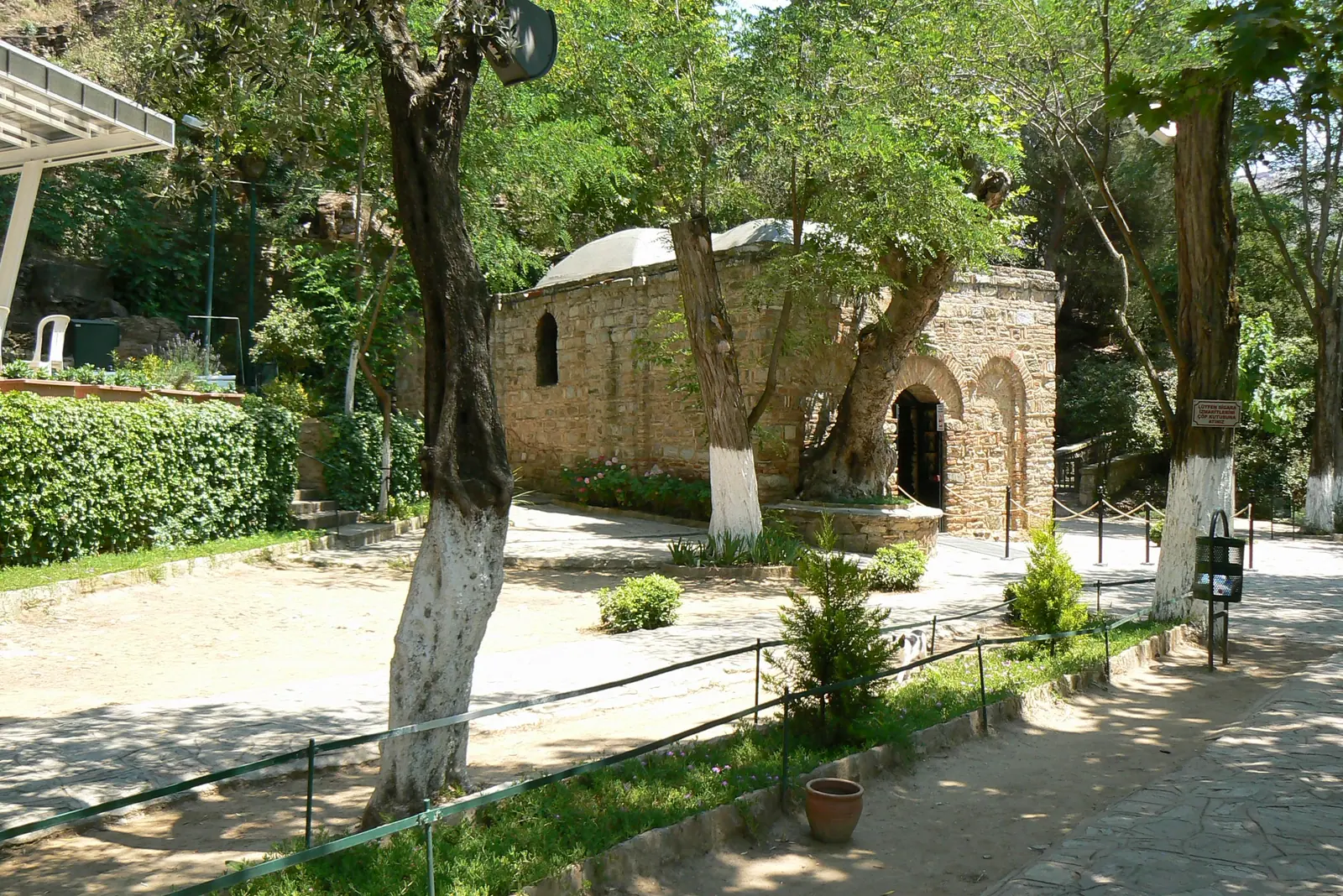
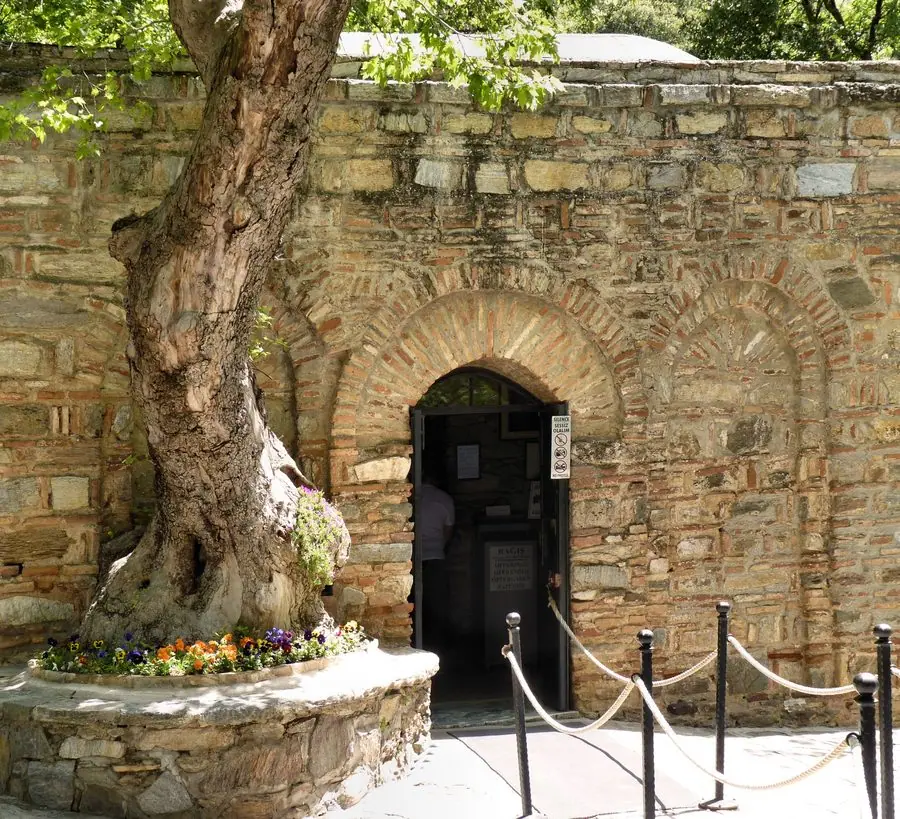
8. The drive up Bülbül Mountain to Mary's House
The House of the Virgin Mary is about 7 kilometers by road from the Lower Gate of Ephesus, up a winding road through the pines of Bülbül Mountain. There is no walking route, so most visitors can reach it only by car or taxi, and many people who visit the ruins on their own do not get there. It is where the Church remembers John taking Mary "unto his own home" (John 19:26–27): a tradition rather than documented history, but one three popes have come to pray at. The house has its own admission at the mountain gate, separate from the Ephesus ticket.
9. A reading at each stop
The ninth thing is not a place. It is the habit of stopping, opening the Bible and reading the passage where it happened. Visitors on their own rarely manage it, because planning the readings, finding the right spot and keeping a group together all at once is hard work. A Christian tour guide in Ephesus does that planning for you. A typical set looks like this:
| Stop | Reading |
|---|---|
| Library of Celsus steps | Acts 18:19, Paul in the synagogue |
| Commercial Agora | Acts 19:8–10, the school of Tyrannus |
| Great Theater | Acts 19:23–41, the riot of the silversmiths |
| Church of Mary | Ephesians 4:1–6, "one Lord, one faith, one baptism" |
| Basilica of Saint John | Revelation 2:1–7, the letter to Ephesus |
| House of the Virgin Mary | John 19:25–27, "Behold thy mother" |
Ephesus guided tour or on your own: side by side
| On your own | With a Christian guide | |
|---|---|---|
| The ruins (about 1.5 km) | Easy with a map, 2–3 hours | The same walk, read as Acts 19 |
| Small Christian marks | Easy to walk past | Pointed out and explained |
| Church of Mary | Off the main line | Included when time allows |
| Mary's House and Saint John's | Car or taxi needed | Car and driver included |
| Tickets | Bought at the gate; queues in busy hours | Pre-booked priority entrance; ticket cost paid separately |
So, do you need a guide for Ephesus?
If you want the ruins, a map and a free morning will serve you well. If you came for the Bible, our answer is yes: not because you cannot find the theater, but because the nine details above are what turn a Roman city into the Ephesus of Acts, Ephesians and Revelation. Our private Biblical Ephesus tour is built around them, with Scripture at each stop, the drive up to Mary's House and the hill of Saint John, and pre-booked priority entrance, so you do not wait in the ticket line. The entrance fees themselves are paid separately at the gate price, listed on our entrance fees page. If you are still deciding how much time to set aside, see how many days you need for a biblical visit.
Written by the Biblical Ephesus Tours guide team. Sources are listed below. Last reviewed: October 2026.
Sources & further reading
- Acts 19 (KJV) — Bible Gateway — the school of Tyrannus, the temple of Diana and the riot in the theater
- "A menorah graffito at an ancient library in Ephesus," PaleoJudaica (2022) — the menorah on the library steps and its likely third-century date
- Britannica: ichthus — the fish acrostic behind the wheel
- J. Daniel Hays, The Ichthus Christogram and Other Early Christian Symbols (Kregel, 2025) — the eight-spoked wheel as a Christian symbol
- Wikipedia: Church of Mary, Ephesus — the council church and its baptistery
- Wikipedia: Basilica of St. John — Justinian's church over the tomb
- Wikipedia: House of the Virgin Mary — location on Bülbül Mountain and papal visits
- UNESCO World Heritage: Ephesus — the inscribed site, including the Basilica of St John and the Temple of Artemis