
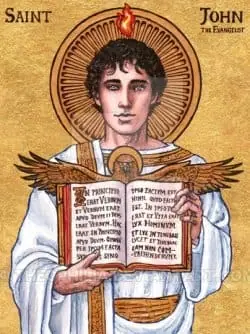
At the foot of the cross, Jesus looked at his mother and the disciple he loved and spoke two short sentences: "Woman, behold thy son... Behold thy mother. And from that hour that disciple took her unto his own home" (John 19:26–27). Everything Ephesus claims about John and Mary grows from that verse — because where the disciple made his home, the mother made hers.
How do we know John lived in Ephesus?
From a chain of named witnesses. Irenaeus, writing about AD 180, had heard Polycarp as a boy, and Polycarp had known John. Irenaeus says John published his Gospel while living at Ephesus and stayed until the reign of Trajan (98–117). Around 190, Polycrates, bishop of Ephesus, wrote that John "sleeps at Ephesus."
That John lived, taught and died here is among the best-attested traditions of the early Church, and the witnesses keep coming. Irenaeus sets a story he had from Polycarp in the city itself: John walked out of a bathhouse at Ephesus without bathing when he learned the heretic Cerinthus was inside. Clement of Alexandria, around 200, tells how John returned from Patmos to Ephesus after the tyrant's death and went out to the neighboring towns appointing bishops. Revelation, written on nearby Patmos, addresses Ephesus first of the seven churches, as a mother-church would be addressed. There is one honest complication. Papias spoke of a second disciple called "John the Elder," and Dionysius of Alexandria, around 250, heard that Ephesus had two tombs bearing the name John, so some scholars think the Ephesian John was the Elder rather than the apostle. The argument has always been about which John, never about which city. The great basilica on Ayasuluk Hill was not built on a guess; it was built on a grave the whole ancient Church could point to.
Where can you read about John's life in Ephesus?
- Irenaeus, Against Heresies 3.1.1 and 3.3.4 (about AD 180): the Gospel published at Ephesus, John in the city until Trajan, and the bathhouse story.
- Irenaeus, Letter to Florinus, quoted by Eusebius in Church History 5.20: his boyhood memory of Polycarp talking about John.
- Polycrates of Ephesus, Letter to Victor of Rome (about 190), quoted in Church History 3.31 and 5.24: John "sleeps at Ephesus."
- Clement of Alexandria, Who Is the Rich Man That Shall Be Saved? 42, retold in Church History 3.23: John back from Patmos and the young man who became a robber.
- Eusebius, Church History 3.39 and 7.25: Papias on "John the Elder" and the report of two tombs of John at Ephesus.
- The Acts of John (second century): legend rather than history, and the oldest cycle of stories set in John's Ephesus.
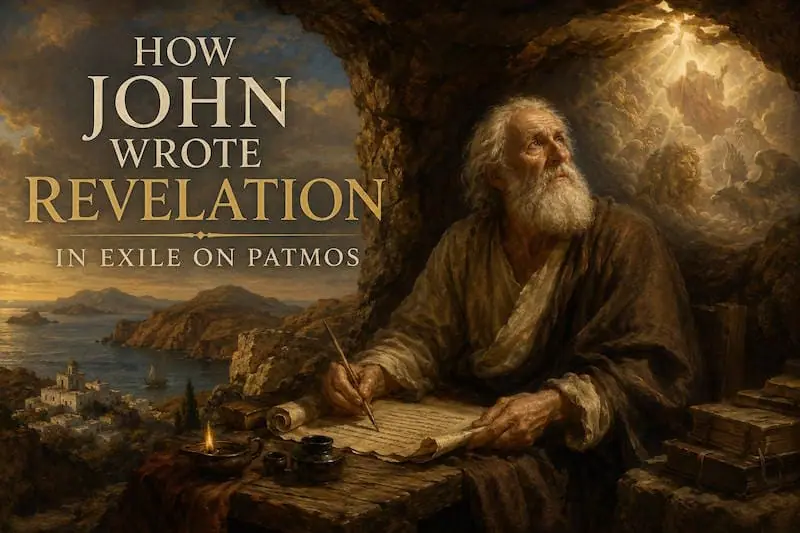
The case for Mary
Mary's Ephesus tradition rides with John's: if he cared for her "from that hour," his city inherits the question of her last home. Ephesus offers converging hints. The Council of 431 met here in a basilica already dedicated to Mary — and churches of that age were normally dedicated where a saint had lived or died. The house on Bulbul Mountain, found in 1891 following Anne Catherine Emmerich's published visions, matched local memory: the mountain villagers' shrine of Panaya Kapulu, visited in pilgrimage every August since anyone could remember. Jerusalem, of course, keeps a rival tradition at the Tomb of the Virgin; the Church has never ruled between them, and honest guides say so.
What the popes did
Rome's verdict has been practical rather than dogmatic: it came, and it prayed. Paul VI in 1967, John Paul II in 1979, Benedict XVI in 2006 — three popes on one Turkish mountainside within forty years. Benedict celebrated Mass on the house's terrace before a crowd of pilgrims and spoke of Mary as mother given "to every disciple." Whatever the geography of her last earthly days, the Church treats this mountain as holy ground.

Visiting the tradition
The two sites make a natural pilgrimage pair, and our Biblical Ephesus Tour joins them in one day: morning silence at the house, afternoon grandeur at the basilica, with the Gospel of John read wherever you wish. Between them lies the whole mystery of that sentence from the cross — a mother and a son by adoption, remembered by one valley for two thousand years.
Sources & further reading
- John 19:25–27 (KJV) — Bible Gateway — "behold thy mother"
- Britannica: Saint John the Apostle — traditions of John's later life
- Wikipedia: House of the Virgin Mary — the shrine and its recognition
- Irenaeus, Against Heresies 3.3 — New Advent — John at Ephesus until Trajan; the bathhouse story
- Eusebius, Church History, Book 3 — New Advent — Clement, Polycrates, Papias and the two tombs