
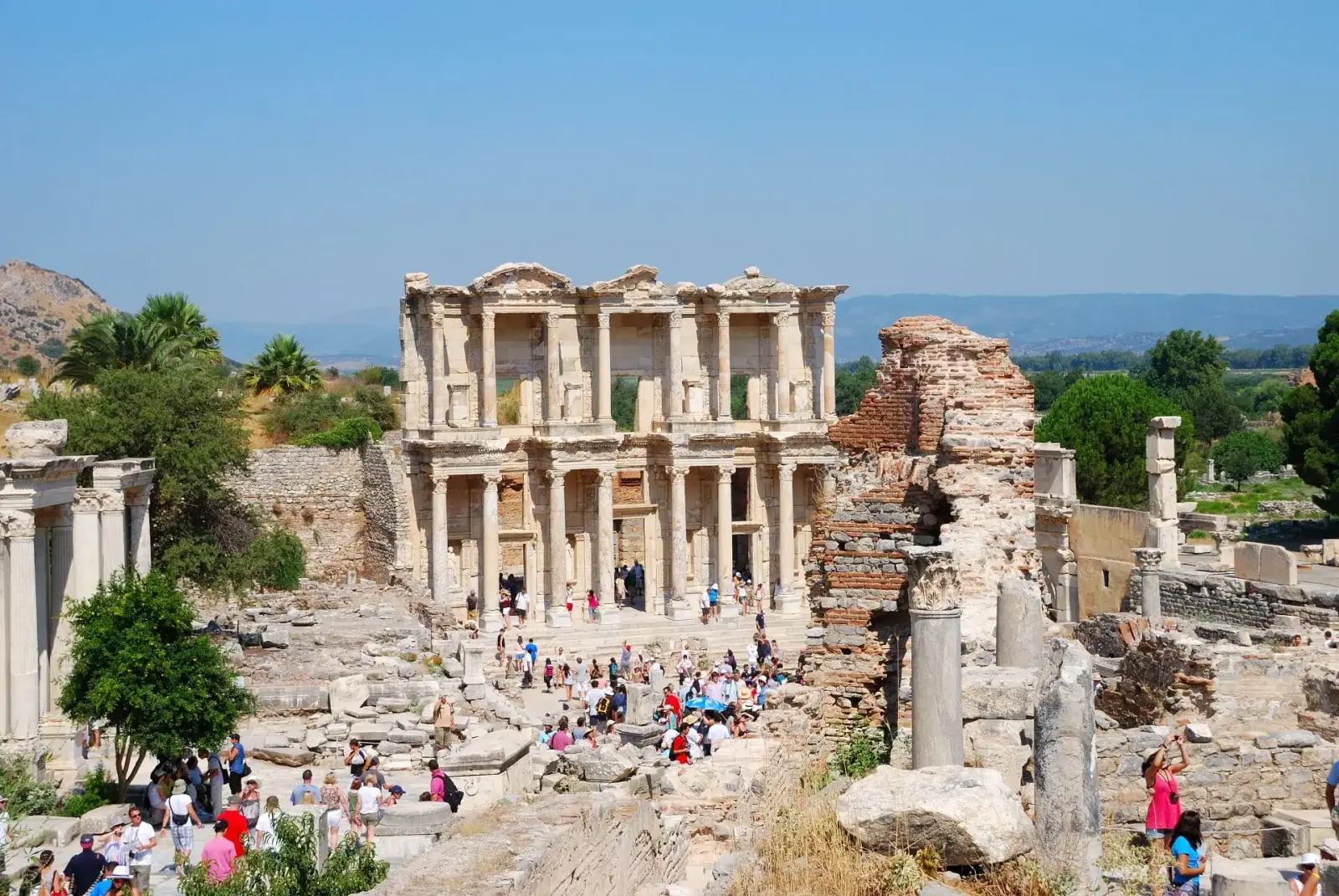
When Paul walked into Ephesus around the year 52, he entered one of the greatest cities a Roman citizen could visit: the seat of the province of Asia, guardian of the Temple of Artemis, a harbor metropolis whose theater alone could seat an estimated twenty-five thousand people. When the Book of Acts says "all they which dwelt in Asia heard the word of the Lord" from this one city, it is describing exactly what Ephesus was built to do — broadcast to a continent.
The city you walk today
A century and a half of excavation has uncovered a marble spine of monuments running downhill from the upper gate to the harbor plain: the Odeon where the city council met, the Temple of Hadrian, the Fountain of Trajan, the Baths of Scholastica, the Library of Celsus with its miraculous two-story facade, the Commercial Agora of the silversmiths, and the Grand Theater of the riot of Acts 19. Between them run streets grooved by chariot wheels, floored with mosaics, and scratched with the games, prayers and advertisements of people who lived here twenty centuries ago.
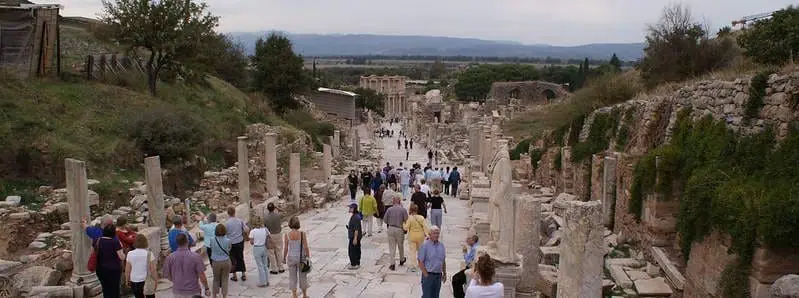
Ephesus in the New Testament
No other city gets so many pages of Scripture. Paul reasons in its synagogue (Acts 18:19), returns to teach daily in the hall of Tyrannus for two years (Acts 19:9–10), and sees converts burn their magic books at enormous cost (Acts 19:19). The silversmith Demetrius raises a riot in the theater that chants for two hours (Acts 19:28–34). Later Paul writes to the church here the letter we call Ephesians; Timothy stays as its first bishop (1 Timothy 1:3); and the risen Christ addresses Ephesus first among the seven churches of Revelation (Revelation 2:1–7). Tradition adds two more names: John the Evangelist, buried on the hill above, and the Virgin Mary, remembered in the house on Bulbul Mountain.
Rise, riot and slow farewell
Ephesus was already ancient when Rome inherited it — founded by Greek settlers around the 10th century BC, moved and rebuilt several times as its harbor silted. Under Augustus it became the provincial capital and boomed for two golden centuries. The riot of Acts 19 caught the city at its very peak. Decline came slowly and from the sea: the Cayster river kept pushing the coastline west, mile by mile, until ships could no longer reach the greatest harbor of Asia. An earthquake-battered, harbor-less Ephesus faded through the Byzantine centuries, and its people drifted to the fortified hill of Ayasuluk — today's Selcuk — leaving the marble city to the storks and the archaeologists.

Visiting with the Bible in hand
Every tour we run through Ephesus can be read as well as walked. Your guide will show you where the town clerk of Acts 19:35 addressed the assembly, where the silver workshops clustered, where early Christians carved crosses over pagan inscriptions — and will read the verses aloud at each spot, if you wish. Allow two to three hours for the city itself, and add the Terrace Houses if you possibly can.

Sources & further reading
- UNESCO World Heritage: Ephesus — the official inscription and its criteria
- Britannica: Ephesus — concise history of the city
- Acts 19 (KJV) — Bible Gateway — the Ephesus chapter in full
- Warden & Bagnall, "The Forty Thousand Citizens of Ephesus," Classical Philology 83 (1988) — why the old population estimates for Ephesus do not hold up
- Hanson & Ortman, Journal of Roman Archaeology 30 (2017) — the modern population estimate for Roman Ephesus