
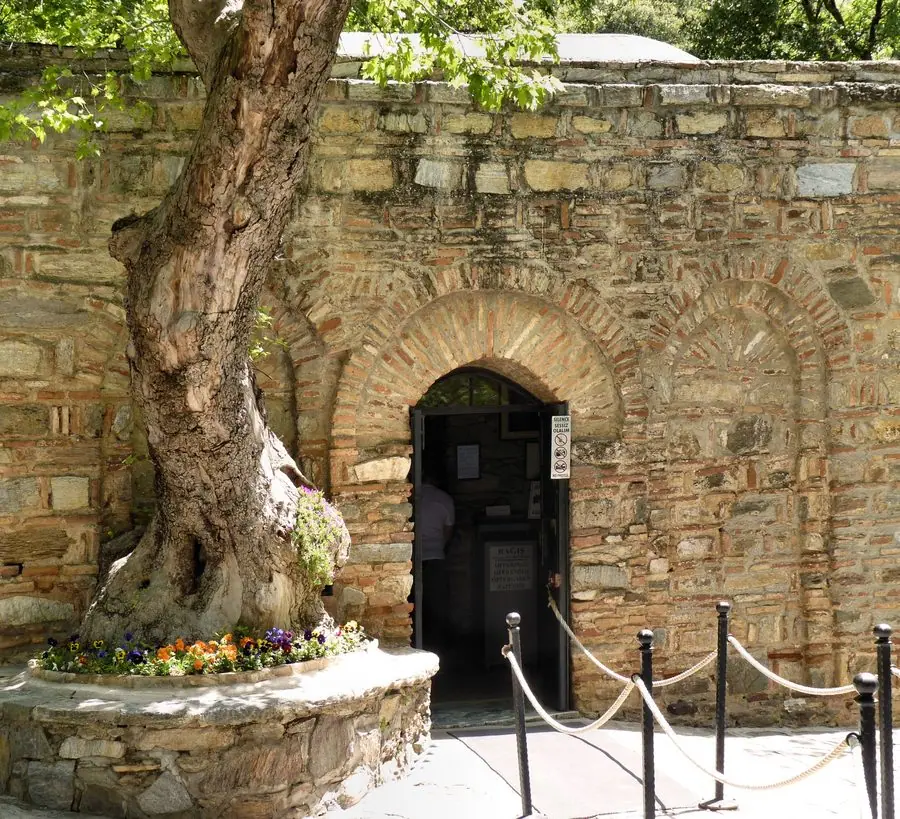
From the cross, Jesus entrusted his mother to the beloved disciple: "and from that hour that disciple took her unto his own home" (John 19:27). The earliest traditions bring John to Ephesus — and where John went, the Church has always reasoned, Mary went with him. High on Bulbul Mountain, nine kilometers from the center of Selcuk and far above the pagan bustle of the ancient city, a small stone house has been venerated for over a century as the place where that verse reached its quiet fulfillment.
A discovery guided by a vision
The house's modern story is one of the strangest in Christian archaeology. Anne Catherine Emmerich, a bedridden German nun who never left her homeland, described in her recorded visions the house John built for Mary near Ephesus — its setting, its shape, its spring. Decades after her death, expeditions from Izmir followed the published descriptions into the mountains and, in 1891, found the ruined foundations exactly where she had placed them. The local Christians of the region, it turned out, had never stopped calling the spot Panaya Kapulu — the Doorway of the All-Holy — and made pilgrimage there each August.
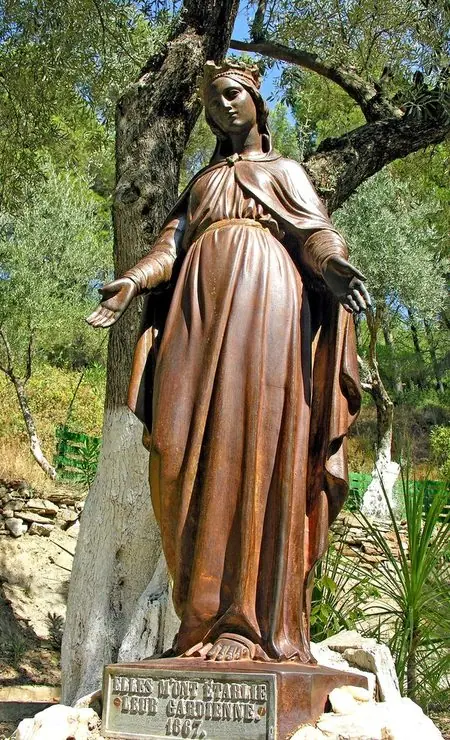
What the Church says
Rome has never formally ruled on whether Mary died in Ephesus or Jerusalem — but its actions have spoken warmly. The house was granted papal blessings from the 1890s onward; Pope Paul VI prayed here in 1967, Pope John Paul II in 1979, and Pope Benedict XVI celebrated Mass on this terrace in 2006. Today the restored house serves as a chapel, tended by religious custodians, with daily Mass in season.
The spring and the wishing wall
Below the chapel runs the spring that has always been part of the site's tradition; pilgrims queue quietly to drink and to fill small bottles. Beside it stretches the famous wishing wall, where visitors tie their written prayers by the hundred thousand — a wall of paper petitions in every language on earth. It is one of the most moving sights in the whole valley.

A shrine of two faiths
Mary — Meryem Ana, "Mother Mary," as Turks affectionately call both her and the house — is deeply honored in Islam, named more often in the Quran than in the New Testament. On any given day Christian and Muslim visitors pray side by side here, which gives the little house a peace that is itself a kind of sermon. Modest dress is appreciated; photography is restricted inside the chapel itself.
Sources & further reading
- Wikipedia: House of the Virgin Mary — history, discovery and papal recognition
- Benedict XVI — homily at Ephesus, 2006 — the papal Mass at the shrine
- John 19 (KJV) — Bible Gateway — "behold thy mother"