How long did Paul stay in Ephesus? About three years — longer than he stayed anywhere else on his journeys. Luke gives the breakdown in Acts 19: three months arguing in the synagogue, then two years of daily teaching in a rented lecture hall, and then a further stretch he does not measure at all. Paul himself, saying goodbye to the Ephesian elders, rounds the whole thing up into one phrase: "by the space of three years I ceased not to warn every one night and day with tears" (Acts 20:31). And that was his second visit. The first one lasted a matter of days.
How long did Paul stay in Ephesus on his second missionary journey?
Days, not years — and only because he was in a hurry. Sailing home from Corinth at what is usually reckoned the close of the second journey, Paul put in at Ephesus with Aquila and Priscilla, left them there, and went into the synagogue alone to reason with the Jews. They wanted more of him: "when they desired him to tarry longer time with them, he consented not" (Acts 18:19–21). He promised to return — "I will return again unto you, if God will" (Acts 18:21) — and sailed.
Scripture gives no length for that first call — if anyone tells you two weeks, they are guessing. What it does tell you is the shape of what followed: Paul left two of his best people in the city, and they had it warm for him when he came back.
How long did Paul stay in Ephesus on his third missionary journey?
This is the long one, and the stay everyone means. Paul came back overland — "having passed through the upper coasts" — and found disciples already there (Acts 19:1). What followed is the most carefully timed ministry in Acts, because Luke, unusually, gives us numbers.
First, three months in the synagogue: he "spake boldly for the space of three months, disputing and persuading the things concerning the kingdom of God" (Acts 19:8). Then opposition hardened, and he did something very Greek — he rented a lecture room. "Disputing daily in the school of one Tyrannus... and this continued by the space of two years; so that all they which dwelt in Asia heard the word of the Lord Jesus" (Acts 19:9–10).
Then comes the verse almost everybody drops. After those two years Paul sent Timothy and Erastus ahead into Macedonia, "but he himself stayed in Asia for a season" (Acts 19:22). Luke never says how long a season is — and that vagueness is the piece that makes the arithmetic work.

How long did Paul teach in Ephesus?
Two years — a genuinely different question from how long he stayed, which is why both numbers circulate and both are right. The teaching in the hall of Tyrannus ran two years (Acts 19:10); the stay in the city ran about three. Say "two years" and you are counting the classroom; say "three" and you are counting the man.
One ancient manuscript adds a detail we love and cannot quite prove. Codex Bezae, the great Western-text witness, has Paul teaching in the school "from the fifth hour to the tenth" — the hours when, as Martial wrote, Rome had finished its business for the day and gone to lunch. The picture is irresistible: Paul at his leather from sunrise, then five hours in a borrowed room while the city dozed.
It is also the reading that the scholar who made it famous eventually talked himself out of. William Ramsay argued for it, and then in 1904 published a short note working through his own three changes of mind, concluding that timekeeping "so minute as the fifth and tenth hours was not in accordance with the nature and style of Luke" — while still holding that the fact behind it might well be true. The Western text, he decided, "gives us a comment or explanation, rather than the actual words of Luke." That is roughly where we leave it on tour: a very good story, honestly labeled.
Why does Acts 19 add up to less than three years?
Because it does, and the gap is the most interesting thing about the whole question. Add Luke's explicit figures and you get two years and three months. Paul says three years. Here is the sum laid out.
| What Acts records | How long | Where |
|---|---|---|
| Preaching in the synagogue (Acts 19:8) | Three months | The Ephesian synagogue |
| Daily teaching (Acts 19:9–10) | Two years | The school of Tyrannus |
| "He himself stayed in Asia for a season" (Acts 19:22) | Not stated | Ephesus and the province |
| Paul's own total (Acts 20:31) | "The space of three years" | Spoken at Miletus |
Three explanations are seriously held, and no evidence settles between them. The commonest is that Paul is rounding: three months plus two years plus that unmeasured "season" comes close enough for a farewell speech, and the season is exactly what fills the gap. The second is that he means it literally, which makes the season about nine months. The third is that he counts the way the ancient world often did, inclusively — parts of three calendar years could be called "three years," allowing a real elapsed time of a little over two.
We tell groups the honest version, and it is where the reference works land too: somewhere between two and a half and three years — "a stay at Ephesus of two years and a half, perhaps more," as the Catholic Encyclopedia has it — and Paul's own word for it was "three years." Anyone giving you a figure to the month is filling in a blank Luke left open on purpose.
Three months in the synagogue. Two years in a rented hall. And then a season that nobody measured — which is precisely the bit that makes the numbers agree.
Why did Paul stay in Ephesus so long?
He answers this one himself, in a letter written from the city during that very stay. "But I will tarry at Ephesus until Pentecost," he tells the Corinthians. "For a great door and effectual is opened unto me, and there are many adversaries" (1 Corinthians 16:8–9).
Read that twice: it is not the reason most people expect. The open door and the many adversaries come in the same breath, as two halves of one reason. And there was strategy in it. Ephesus was the great port and road-hub of Roman Asia; teach daily where the whole province passes through, and the province attends your class in shifts. That is how Luke can say that in two years "all they which dwelt in Asia heard the word" without Paul apparently leaving town. The churches of the Lycus valley — Colossae, Laodicea, Hierapolis — are generally traced to these years.
What year was Paul in Ephesus?
Careful here, because Scripture gives no dates at all. Not one of the passages above contains a year, a consul or a reign. Every AD figure attached to Paul at Ephesus — ours included — is reconstructed backwards from a single piece of stone.
That stone is the Gallio inscription from Delphi: a letter of the emperor Claudius, datable to about AD 52, naming "Lucius Junius Gallio, my friend and proconsul of Achaea" — the same Gallio before whom Paul was hauled in Corinth in Acts 18. Fix Gallio and you fix Corinth, generally placed at AD 50–51; count forward and the Ephesian years land in the early-to-mid 50s. Published ranges cluster around AD 52–55 and 53–56, and serious reference works differ by years — the clearest sign that these are reconstructions, not biblical statements.

Three years is a number until you stand in the room
The last thing worth saying about the length is what it did to him. On his final voyage Paul "determined to sail by Ephesus, because he would not spend the time in Asia" (Acts 20:16) — racing for Jerusalem, and plainly aware that a stop here could not be a short one. But he could not pass it either. So he anchored down the coast at Miletus, sent for the elders, and gave them the number: three years, night and day, with tears.
Three years were long enough for the city to claim him as its own. Long after he sailed, Ephesus gave him a face: a wall portrait dated to around the sixth century, his name lettered beside it in Greek, which is the image at the head of this post. It comes from the Grotto of Saint Paul on the hillside over the city, now closed to visitors for conservation, with no reopening date announced.
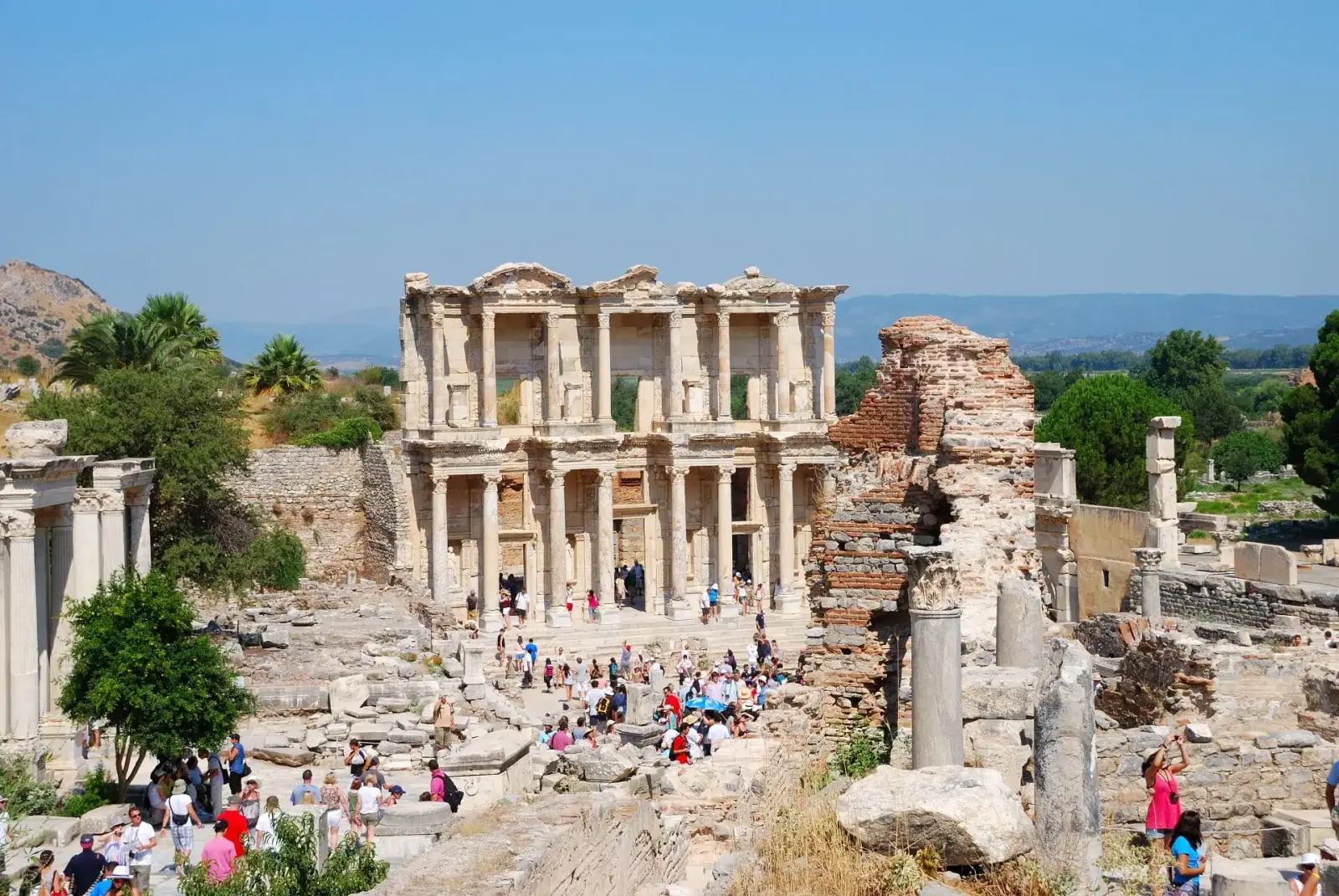
You can walk that arithmetic in a morning: the synagogue quarter, the commercial district where the hall of Tyrannus stood, the theater where it finally boiled over. That is the shape of our Footsteps of Paul tour — and for the whole narrative first, the full account of Paul's years here is the place to start.
Sources & further reading
- Acts 19 (KJV) — Bible Gateway — the three months, the two years and the "season"
- Acts 20:17–38 (KJV) — the Miletus farewell — KJV, Bible Gateway
- Bible Odyssey (Society of Biblical Literature) — Erastus, Gallio, and Paul — C. D. Elledge on the Delphi inscription "dating circa 52 C.E." and Paul at Corinth "from 50-51 C.E." — the anchor for the whole chronology
- Catholic Encyclopedia: St. Paul — New Advent — "a stay at Ephesus of two years and a half, perhaps more (Acts 20:31: trietian)", and the Codex Bezae addition "from the fifth hour to the tenth"
- W. M. Ramsay, “From the Fifth to the Tenth Hour”, The Expository Times 15.9 (1904), p. 397 — Ramsay’s own signed note retracting the Western reading as non-Lukan — the source of the famous 11am–4pm story, and of its withdrawal
- The History of Ephesos — Austrian Archaeological Institute — the excavating institution on Ephesos as capital of the Roman province of Asia