
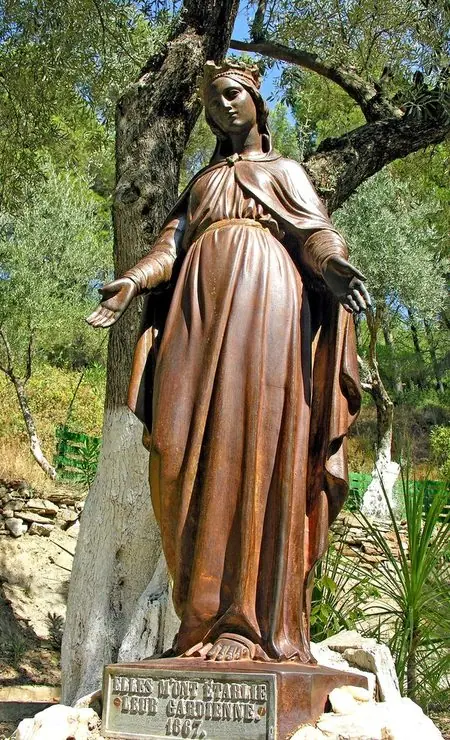
This verse happens far from Ephesus — at Golgotha, in the last hour of the Crucifixion. Yet no passage matters more to this valley. Jesus, seeing his mother and the disciple he loved standing together, joins their lives with two brief sentences; and John — for tradition has always read the beloved disciple as John — "from that hour took her unto his own home." The Gospel never says where that home would be. That silence is where the Ephesus tradition begins.
Following the son to find the mother
The logic of the tradition is simple and honest: the verse binds Mary to John's household, so wherever John's household went, Mary's last years went too. And John's later address is among the best-attested facts of the apostolic age — Ephesus, on the unanimous testimony of the early Church, from Irenaeus to Polycrates, with his tomb on Ayasuluk Hill to seal the record. If the beloved disciple kept his charge, the mother of Jesus knew this valley's light.
What tradition adds — and what honesty requires
The house on Bulbul Mountain, found in 1891 exactly where Anne Catherine Emmerich's visions had described it, gives the tradition its address; the Council of 431, meeting in Ephesus in a church already dedicated to Mary, gives it early weight; three papal visits give it modern blessing. Jerusalem, meanwhile, keeps its own ancient tradition at the Tomb of the Virgin — and the Church has never ruled between them. We tell pilgrims the truth: the verse is certain, the geography is tradition. What is beyond dispute is that this verse created the bond, and this valley has honored it for most of two thousand years.
Standing in the verse
Read these two sentences at the House of Virgin Mary, in the small stone chapel where Christians and Muslims pray side by side — or at the Basilica of Saint John, over the grave of the man who received the charge. Between those two sites, a morning's drive apart, the whole verse is walkable: the son entrusted, the mother received, one household to the end.
Sources & further reading
- John 19:25–27 (KJV) — Bible Gateway — read the passage in context
- Wikipedia: House of the Virgin Mary — the shrine and its history
- Britannica: Saint John the Apostle — the disciple's traditions