
Twice the Book of Acts walks us through the synagogue door in Ephesus. On Paul's first, brief visit he "entered into the synagogue, and reasoned with the Jews" (Acts 18:19); on his return he "went into the synagogue, and spake boldly for the space of three months" (Acts 19:8) before opposition moved him to the hall of Tyrannus. For Luke, the synagogue is simply there — a fixed address in the city everyone knew.
A community older than the city's marble
The Jewish community of Ephesus was ancient, large and legally protected. The historian Josephus preserves Roman decrees — some quoted word for word — guaranteeing Ephesian Jews the right to keep the Sabbath, follow their food laws and send the temple tax to Jerusalem: some of the earliest written guarantees of religious liberty anywhere. A community with that standing certainly had a substantial synagogue, and likely more than one across so large a city.
The menorah on the library steps
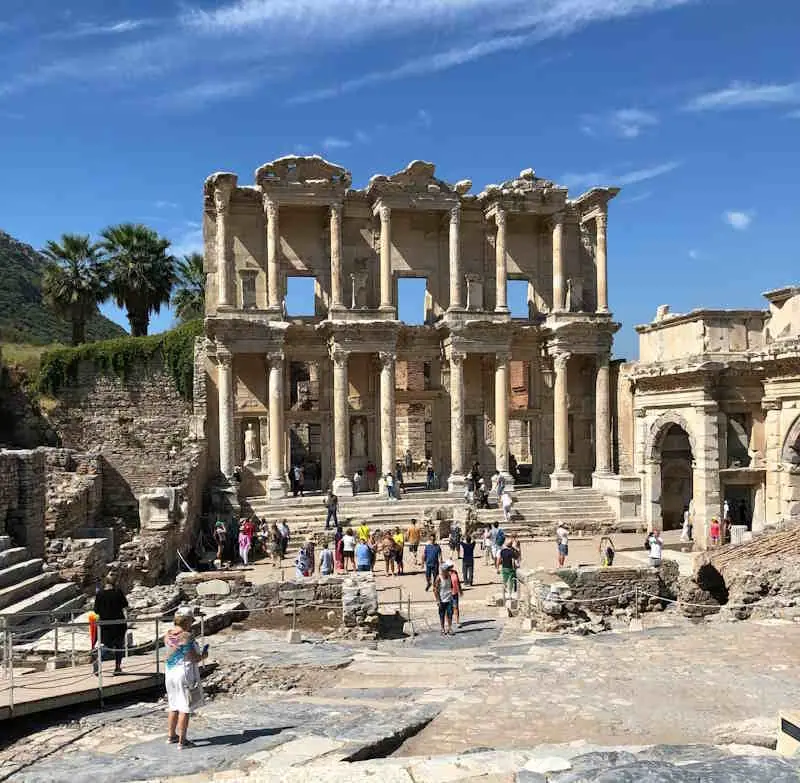
The most touching physical trace sits in plain sight: a menorah scratched into the steps of the Library of Celsus, the city's grandest address. Small lamps, glass vessels and inscriptions naming Jewish residents add their testimony. But the synagogue building itself has so far escaped the spade — not surprising when you remember that roughly ninety percent of Ephesus is still underground. Somewhere beneath the fields or the unexcavated slopes, the room where Paul reasoned is waiting.

Standing in the story anyway
On our tours we pause at the library steps over the menorah and let the texts do the work: here was a community that heard Paul sabbath after sabbath for three months — arguing, questioning, some persuaded, some not (Acts 19:8–9). The building may be lost for now; the conversation it hosted changed the world.
Sources & further reading
- Acts 19:8–10 (KJV) — Bible Gateway — the three months in the synagogue
- Wikipedia: History of the Jews in Turkey — the ancient Anatolian communities
- The Sardis Synagogue — Sardis Expedition — the best-preserved sister synagogue