
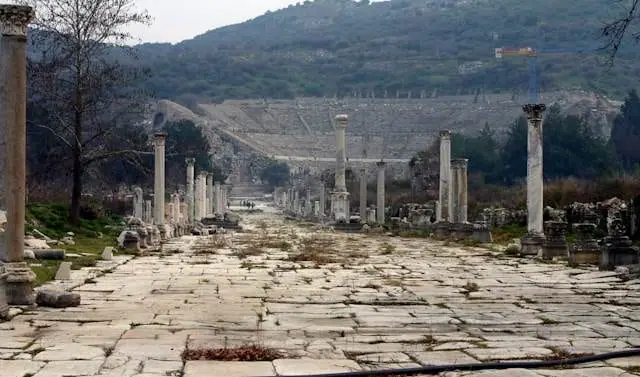
"And the whole city was filled with confusion" (Acts 19:29). Luke's riot narrative is so precise — names, offices, legal formulas, crowd psychology — that historians treat it as a documentary snapshot of how a Greek city under Rome actually worked, and misbehaved. Read in the theater itself, it plays like a script.
Scene one: the guild hall
Demetrius the silversmith convenes his craftsmen: Paul's preaching that "they be no gods, which are made with hands" is emptying the market for silver Artemis shrines, and worse, dishonoring the goddess "whom all Asia and the world worshippeth" (Acts 19:25–27). The meeting ends with the shout that becomes the day's anthem: "Great is Artemis of the Ephesians!"
Scene two: the rush to the theater
The shout spills into the streets and the city pours "with one accord into the theatre," dragging along two of Paul's Macedonian companions, Gaius and Aristarchus (19:29). Paul wants to go in after them — the most Pauline instinct in Acts — and is stopped twice: by the disciples, and by friendly Asiarchs, provincial dignitaries who send word begging him not to risk the stage (19:30–31). That detail alone is gold: within two years, Paul had friends in the highest circles of provincial society.
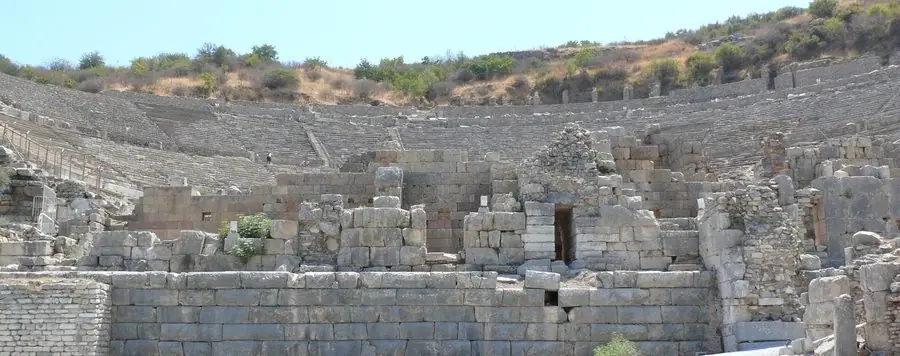
Scene three: two hours of one sentence
Luke's crowd reporting is merciless: "some therefore cried one thing, and some another... and the more part knew not wherefore they were come together" (19:32). A man named Alexander is pushed forward to speak and shouted down the moment the crowd realizes he is a Jew — and then comes the verse that still astonishes: "all with one voice about the space of two hours cried out, Great is Artemis of the Ephesians" (19:34). Stand mid-bowl and time two minutes of imagined chanting; then multiply by sixty. That is the fear a couple of years of one man's teaching had put into a Wonder of the World.
Scene four: the civil servant's masterclass
The hero of the day is a bureaucrat. The grammateus — the town clerk, the city's chief executive officer, a title inscriptions from Ephesus confirm exactly — finally quiets the bowl with a speech of impeccable cool (19:35–41): the goddess's glory is beyond dispute and needs no riot; these men are neither temple-robbers nor blasphemers; courts and proconsuls exist for grievances; and an unlawful assembly could bring Roman punishment on the whole city. "And when he had thus spoken, he dismissed the assembly." Rome's peace, a city's pride and the gospel's progress, all balanced in one address.
Why the riot matters
The riot marks the moment Christianity became economically visible — big enough to move markets in the capital of Asia. It also set the pattern of the next two centuries: the gospel's real friction would come less from theologians than from trades, temples and town squares with money at stake. And it gave the Church a strange comfort ever since: the mob's two-hour chant is history's loudest admission that the message was working.
Sources & further reading
- Acts 19:23–41 (KJV) — Bible Gateway — the full riot narrative
- Britannica: Ephesus — the theater and the city