Ephesus in Paul's day, around AD 52 to 55, already had its theater, its Commercial Agora, its harbor and the Temple of Artemis. But most of the famous ruins you photograph today were built after he left. The Library of Celsus was finished between about AD 117 and 135, some 60 to 80 years later, and the Temple of Hadrian, the Odeon and the Basilica of St John came later still.
So the city Paul knew lies under and between the postcards. Below we sort the ruins you can see today into two groups, with the dates the excavators give for each, and then look at how big the city was when he lived in it. Where scholars disagree about a date, we say so.
When was Paul in Ephesus?
Paul first stopped in Ephesus briefly, on his way from Corinth, and reasoned in the synagogue (Acts 18:19). He came back for the long stay: three months in the synagogue, then two years teaching daily in the school of Tyrannus (Acts 19:8–10), until the silversmiths' riot sent him on to Macedonia (Acts 20:1). Paul himself calls it "the space of three years" (Acts 20:31). Most scholars place the stay roughly between AD 52 and 55, give or take a year; the arithmetic is in our post on how long Paul stayed in Ephesus.
That gives us a fixed point. Anything built after the mid-50s is something Paul did not see, however often it appears on Bible-tour brochures.
Did Paul see the Library of Celsus?
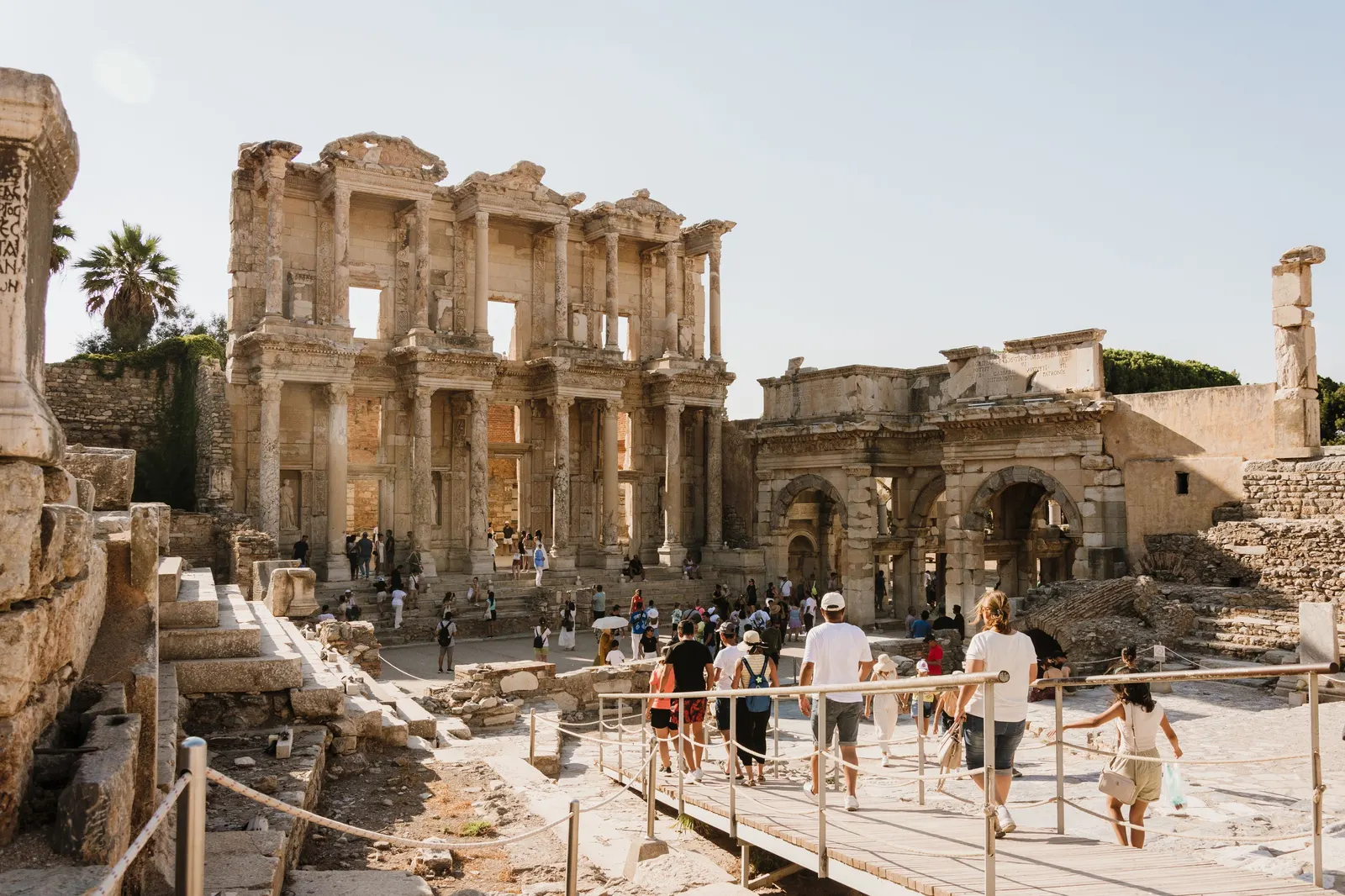
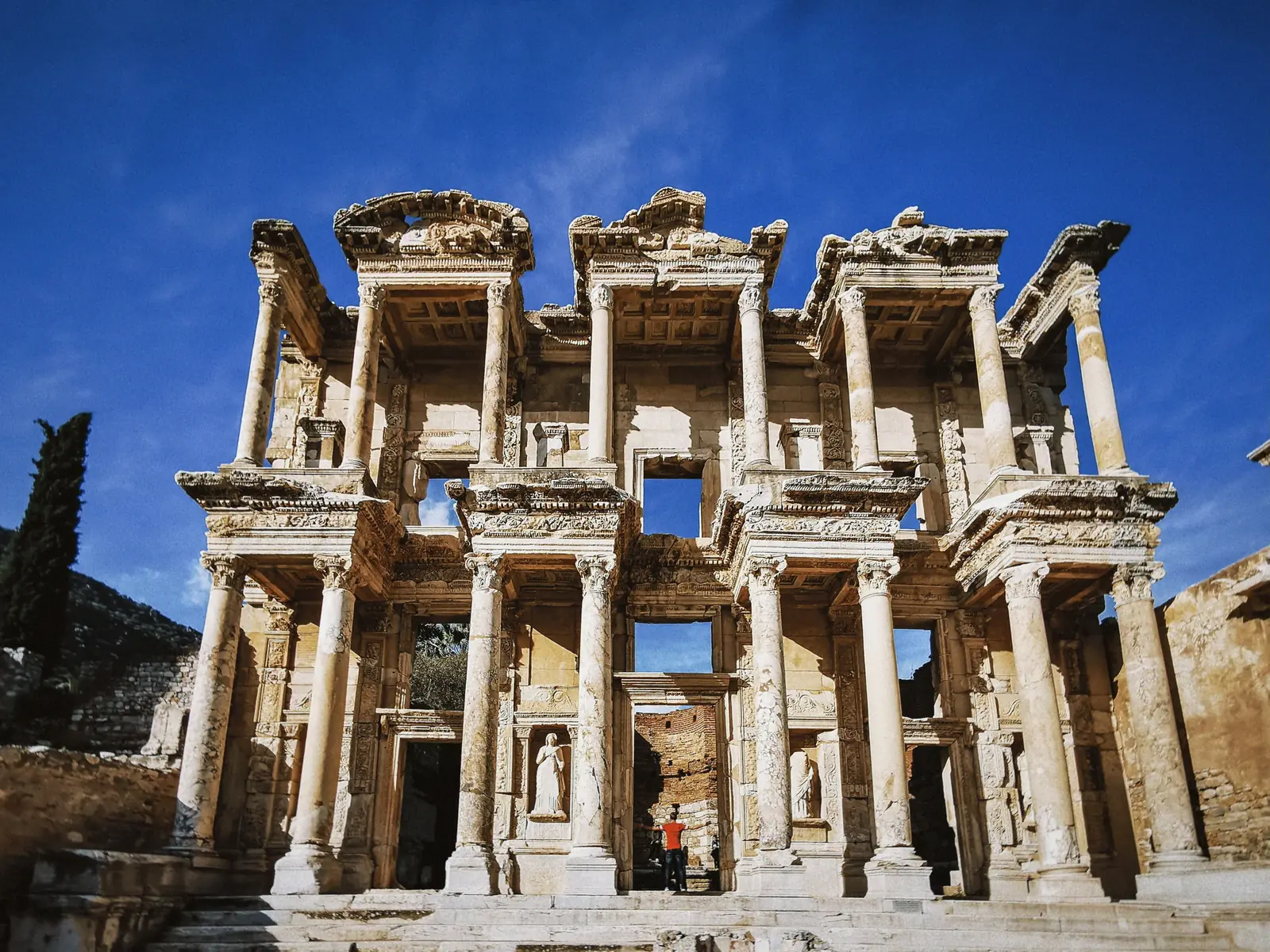
No. The Library of Celsus did not exist in Paul's day. It was commissioned in the 110s as a tomb-monument for Tiberius Julius Celsus Polemaeanus, a former governor of Asia, and finished between about AD 117 and 135, some 60 to 80 years after Paul left Ephesus around AD 55.
Celsus himself was born around AD 45 in Sardis, so while Paul was teaching in Ephesus the future governor was still a boy. The library is not in the Bible, and the timing explains why: even the Book of Revelation, which most scholars date to around AD 95, was written before it went up. The building does have a quiet link to the Bible story, though. A menorah is scratched into its steps, a trace of the Jewish community whose synagogue Paul visited first. Our Library of Celsus page covers the building in full.

Which Ephesus ruins did Paul actually see?
The Temple of Artemis. The great temple, rebuilt after the fire of 356 BC, was standing in full, one of the Seven Wonders of the ancient world. It is the building the silversmith Demetrius feared for when he warned that "the temple of the great goddess Diana should be despised" (Acts 19:27), and the reason Paul's words about gods "made with hands" (Acts 19:26) hit the city's economy. Today a single re-erected column marks the spot; see our Temple of Artemis page.

The Great Theater, in a smaller form. The theater began as a Hellenistic building of the 3rd century BC, and the Roman renewal had started under Claudius and Nero. But a building study published by the Austrian Archaeological Institute in 2022 shows that the huge vaulted corridors that feed today's seating were only begun toward the end of the 1st century AD, and that the theater reached its largest form in the first half of the 2nd century. The crowd that "rushed with one accord" into the theater in Acts 19:29 filled a smaller building than the bowl you sit in today. More on the Grand Theater page, and on why Paul himself did not get in, in did Paul preach in the theater at Ephesus.

The Commercial Agora and its gate. The great market square was laid out in Hellenistic times and rebuilt under Augustus, and the triple gate at its southern corner, paid for by two freedmen named Mazaeus and Mithridates, is dated by its inscription to 4/3 BC. This square is the most likely setting for the silversmiths' trade in Acts 19:24–25.
The State Agora. The upper square, home to the city's council and civic offices, was renovated at the beginning of the 1st century AD. It is the world of the town clerk who calmed the crowd in Acts 19:35, even though the marble council house that stands there now is later (see below).
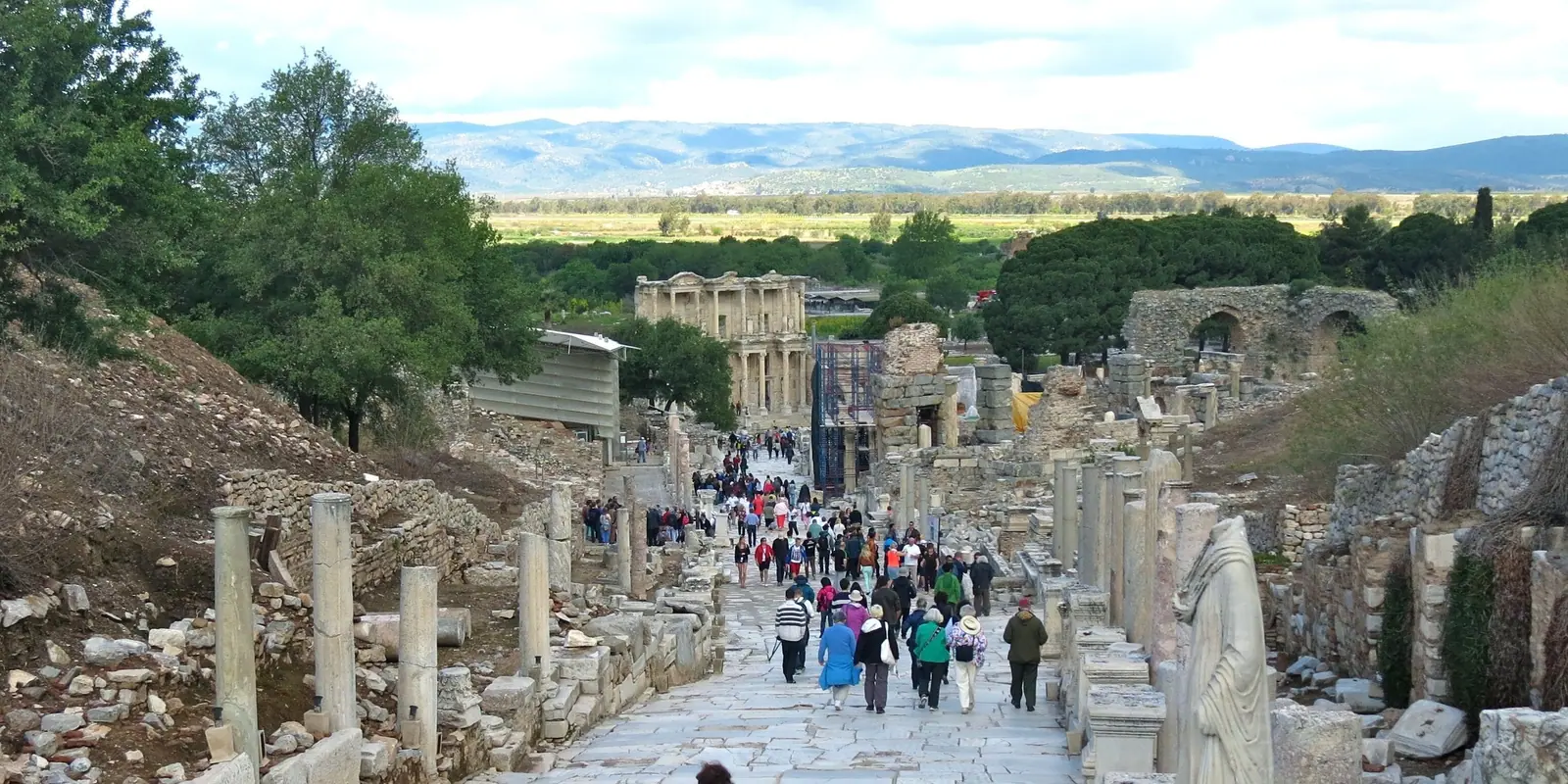
The streets and the harbor. Curetes Street and the road down to the harbor ran along the same lines in Paul's day, and ships still reached the city: Paul landed and sailed from here. The harbor has since silted up and now lies 5–6 km from the sea. The marble colonnades and many of the monuments that line these streets are later.
The first Terrace Houses. This one surprises people. The excavators date the block known as Terrace House 2 to the second quarter of the 1st century AD, so these homes were new, fashionable addresses when Paul arrived. Much of the painted plaster and mosaic you see inside comes from later redecorations, before earthquakes wrecked the block in the 3rd century.

The walls and the water. The city walls of Lysimachus, from the early 3rd century BC, were already old. One of their towers, on Bülbüldağ, is the one tradition calls "St. Paul's Prison"; the name is tradition only, as we explain in was Paul imprisoned in Ephesus? And the aqueduct bridge of Sextilius Pollio outside Selçuk, whose inscription names the emperor Tiberius, dates from AD 4–14.
Built after Paul: the famous ruins he did not see
Here is the other half of the walk, in date order. Each of these went up after Paul left in the mid-50s:
- The Temple of Domitian (properly the Temple of the Sebastoi), dedicated in AD 89/90, a generation after Paul and around the years when Revelation is usually dated.
- The Fountain of Trajan, AD 102–114. Its dedication gives Trajan the title Dacicus but not the titles he took in 114, which is how epigraphers date it.
- The Library of Celsus, commissioned in the 110s and finished about AD 117–135.
- The so-called Temple of Hadrian on Curetes Street, from Hadrian's reign (AD 117–138). Recent studies date it as early as 117–119; older books say the 130s. Either way, about 60 years after Paul.
- The Odeon, the small roofed council hall, built around AD 150 by Publius Vedius Antoninus and his wife. The council met somewhere in Paul's day, but not in this building.
- The Baths of Scholastica, a bath house built in the late 1st or the 2nd century, named after the Christian woman who restored it around AD 400.
- The colonnades of the Arcadian Way, the harbor street rebuilt around AD 400 and named after the emperor Arcadius.
- The Church of Mary, built in the early 5th century inside an older Roman hall. The Council of Ephesus met here in 431.
- The Basilica of St John on Ayasuluk Hill, Justinian's church over John's traditional tomb, begun by 548 and finished by 565.


Seen by Paul? The quick table
| Ruin | Date | Seen by Paul? |
|---|---|---|
| Temple of Artemis | Rebuilt after 356 BC | Yes, standing in full |
| City walls of Lysimachus | Early 3rd century BC | Yes |
| Great Theater | 3rd century BC; enlarged late 1st to 2nd century AD | Yes, in a smaller form |
| Commercial Agora | Hellenistic; rebuilt under Augustus | Yes |
| Gate of Mazaeus and Mithridates | 4/3 BC | Yes |
| State Agora | Renovated early 1st century AD | Yes |
| Pollio aqueduct bridge | AD 4–14 | Yes |
| Terrace House 2 | Second quarter of the 1st century AD | Yes, as new houses |
| Temple of Domitian | AD 89/90 | No |
| Fountain of Trajan | AD 102–114 | No |
| Library of Celsus | c. AD 117–135 | No |
| Temple of Hadrian | AD 117–138 | No |
| Odeon (council house) | c. AD 150 | No |
| Arcadian Way colonnades | c. AD 400 | No (the street line, yes) |
| Church of Mary | Early 5th century | No |
| Basilica of St John | By 548–565 | No |
What was Ephesus like in Paul's day?
Busy, rich and in the middle of a building boom. Ephesus was the seat of the Roman governor of Asia, and the geographer Strabo, writing in Paul's own century, called it the largest emporium in Asia this side of the Taurus mountains. Pilgrims came to Artemis from across the Mediterranean, the silversmiths sold them shrines, and the city had a Jewish community large enough to keep a synagogue. Acts 19 shows all of it at once: the synagogue, the lecture hall, the magic books burned at a cost of fifty thousand pieces of silver (Acts 19:19) and the civic assembly in the theater.
What it did not yet look like was the marble showcase of the 2nd century. Paul walked a city that was renewing its theater, still using its harbor and only beginning the great Roman makeover that produced most of what tourists photograph today.
How big was Ephesus in Paul's day?
Nobody counted, so every figure is a modern estimate, and no study isolates Paul's own decade. The walls of Lysimachus enclosed about 415 hectares, but much of that was steep hillside and public space. Measure only the lived-in part, roughly 224 hectares, and you get about 34,000 to 56,000 people; a 2017 model built on house counts gives about 72,000; and one scholar who allows much denser housing reaches 138,000 to 172,500.
You will still see 200,000 or 250,000 in older books. That figure goes back to an 1886 estimate, to an inscription once read as honoring 40,000 citizens when its Greek actually says 1,040, and to multiplying the theater's seats by ten, a rule of thumb rather than evidence. Whichever modern figure you prefer, Ephesus ranked among the five largest cities of the Roman world. For the wider story of the city, see our Ephesus ancient city page.
Walking Paul's Ephesus today
None of this makes the later buildings less worth seeing. It changes how you read them. Standing at the Library of Celsus, you are looking at what the city became in the century after the gospel arrived. Standing in the agora, by the Mazaeus gate or in the theater, you are in places Paul's first readers knew.

Our Footsteps of Paul tour is built on exactly this distinction. Your guide carries the text of Acts 19, reads it at each stop and says plainly which stones Paul would have known and which came after him. The walk from the Upper Gate down to the harbor street is about 1.5 km, all downhill. Your guide collects the tickets in advance and takes you through the priority entrance, so there is no ticket queue; the entrance fees themselves are paid separately at the Ministry's gate price, listed on our entrance fees page. To see where each place sits, print our map of Ephesus in Bible times before you go.
Written by the Biblical Ephesus Tours guide team. Sources are listed below. Last reviewed: October 2026.
Sources & further reading
- Austrian Archaeological Institute (ÖAW): "Reconstructing the history of the Theatre in Ephesos" (2022) — what the theater looked like in Paul's day and when it was enlarged
- Acts 19 (KJV) — Bible Gateway — Paul's years in Ephesus, the Temple of Artemis and the riot
- Wikipedia: Library of Celsus — commissioned in the 110s, completed about 117–135
- "The so-called Temple of Hadrian at Ephesus", Judaism and Rome database — the dating debate, 117–137 CE
- Wikipedia: Temple of the Sebastoi — dedicated in AD 89/90 under Domitian
- Wikipedia: Basilica of St. John — Justinian's church, begun by 548 and completed by 565
- Warden & Bagnall, "The Forty Thousand Citizens of Ephesus," Classical Philology 83 (1988) — why the old population figures do not hold up
- Hanson & Ortman, Journal of Roman Archaeology 30 (2017) — the modern population estimate and the five largest Roman cities