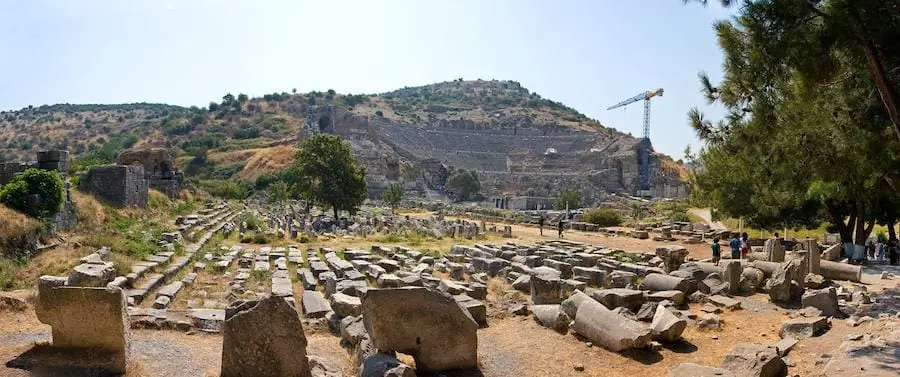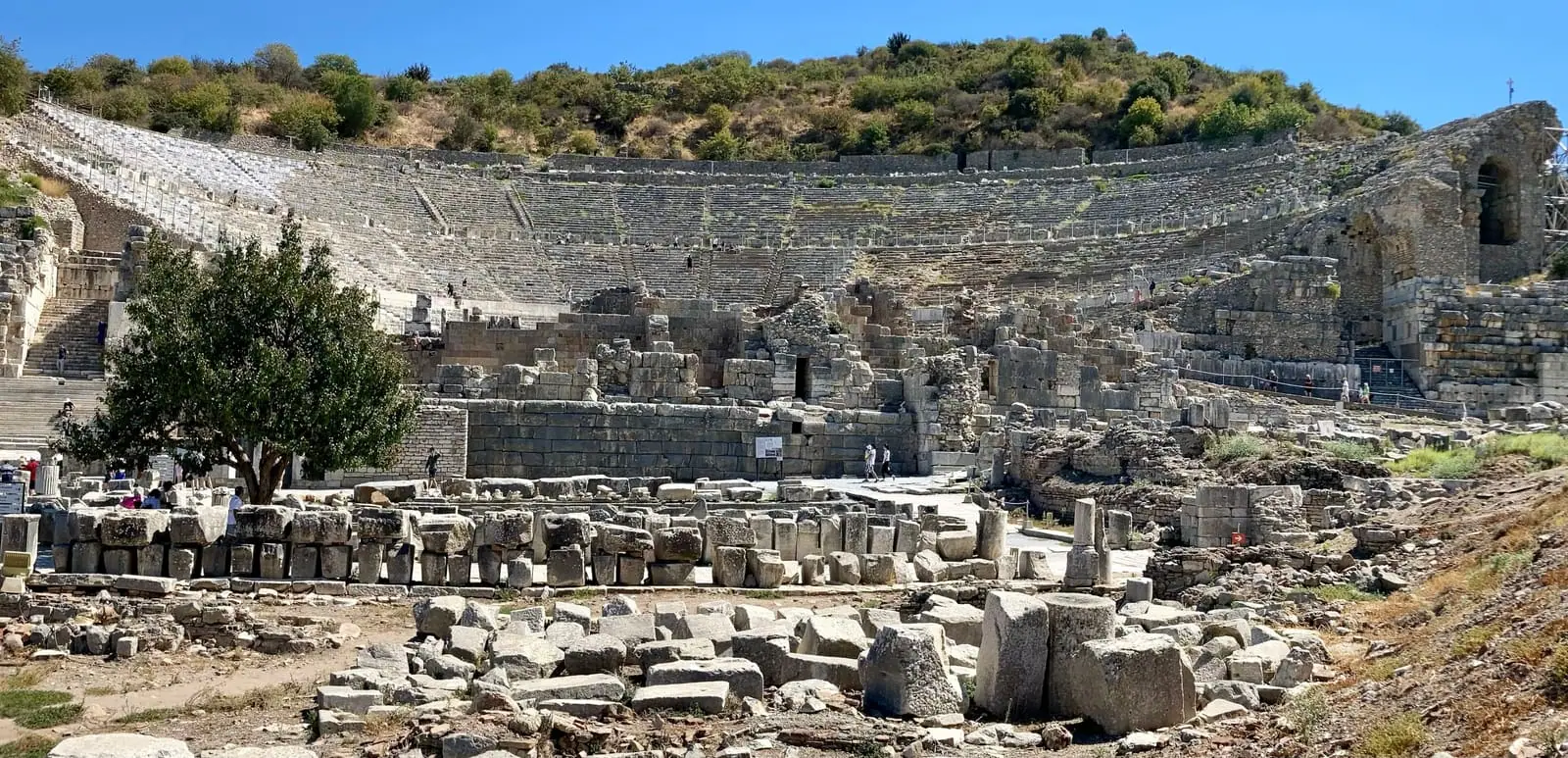
Did Paul preach in the theater at Ephesus? No. He never even got inside. When the silversmiths' riot packed the theater, a building made for more than 20,000 people, Paul wanted to go in and face the crowd. "The disciples suffered him not," and some of the Asiarchs, leading men of the province who counted him a friend, sent word begging him to stay away (Acts 19:30–31).
His preaching in Ephesus happened in three other places: three months in the synagogue (Acts 19:8), two years of daily teaching in the lecture hall of Tyrannus (Acts 19:9–10), and in people's homes, "publickly, and from house to house" (Acts 20:20). None of those rooms has been identified, but each has a spot on today's site where its story is easy to picture.
Did Paul preach in the Great Theater at Ephesus?
No. Acts 19 says Paul never entered the Great Theater at Ephesus. During the silversmiths' riot the crowd seized his companions Gaius and Aristarchus and rushed into the theater. Paul wanted to follow, but the disciples would not let him, and friendly provincial officials begged him to stay away.
Luke tells it in three verses, and they are worth reading slowly:
- Acts 19:29. "Having caught Gaius and Aristarchus, men of Macedonia, Paul's companions in travel, they rushed with one accord into the theatre."
- Acts 19:30. "And when Paul would have entered in unto the people, the disciples suffered him not."
- Acts 19:31. "And certain of the chief of Asia, which were his friends, sent unto him, desiring him that he would not adventure himself into the theatre."
The "chief of Asia" are the Asiarchs, Asiarchai in Greek, a title Strong's lexicon explains as a president of the public festivities. They were wealthy men of the kind who paid for the province's games and ceremonies. Two years of teaching in a public hall had won Paul friends at that level, friends who sent a messenger into the chaos to keep him out.

Who did speak in the theater that day?
Two men, and neither was Paul. The first was Alexander, pushed forward by the Jewish community of Ephesus. He "beckoned with the hand, and would have made his defence unto the people," but once the crowd realized he was a Jew, they drowned him out with two hours of "Great is Diana of the Ephesians" (Acts 19:33–34). The second was the town clerk, who finally calmed the crowd, reminded it that the courts were open, and "dismissed the assembly" (Acts 19:35–41). Our account of the riot of the silversmiths walks through that day scene by scene.
One word in that last verse deserves a second look. The Greek Luke uses for the crowd in the theater is ekklēsia (Acts 19:32, 39 and 41). It was the ordinary word for a citizens' assembly, and it is the same word the New Testament uses for the church. The only ekklēsia that met in the theater in Acts was a confused mob, most of whom, Luke notes, "knew not wherefore they were come together." The church was meeting somewhere else.

Why so many visitors ask: did Paul preach in the theater at Ephesus?
Because the theater is where his Ephesus story reaches its loudest moment, and it is the biggest building in the city tied to his name. Groups read Acts 19 aloud in its seats every day, and somewhere between the reading and the group photo, the riot turns into a sermon. Even some serious history websites describe the theater as the place where Paul defended himself.
Two more things feed the idea. Paul did give a famous public speech, but it was in Athens, on Mars' hill (Acts 17:22), and many people merge the two cities in memory. And the Ephesus building is often called an amphitheater, which suggests a Roman arena with a preacher in the middle. It is a theater: a half-bowl of seats facing a stage building, only partly adapted for gladiator shows in later Roman times.
The building itself was a work in progress in Paul's day. The city began renewing the old Hellenistic theater under Claudius (AD 41–54), the stage building went up under Nero (AD 54–68), and the work was completed under Trajan (AD 98–117). The crowd of Acts 19 filled a theater in the middle of its Roman rebuilding. The marble bowl you sit in today is largely the finished version.
Where did Paul preach in Ephesus?
In three kinds of place, two of them named by Luke. Here they are in the order Paul used them, each with the spot on today's site where it is easiest to picture.
1. The synagogue: three months
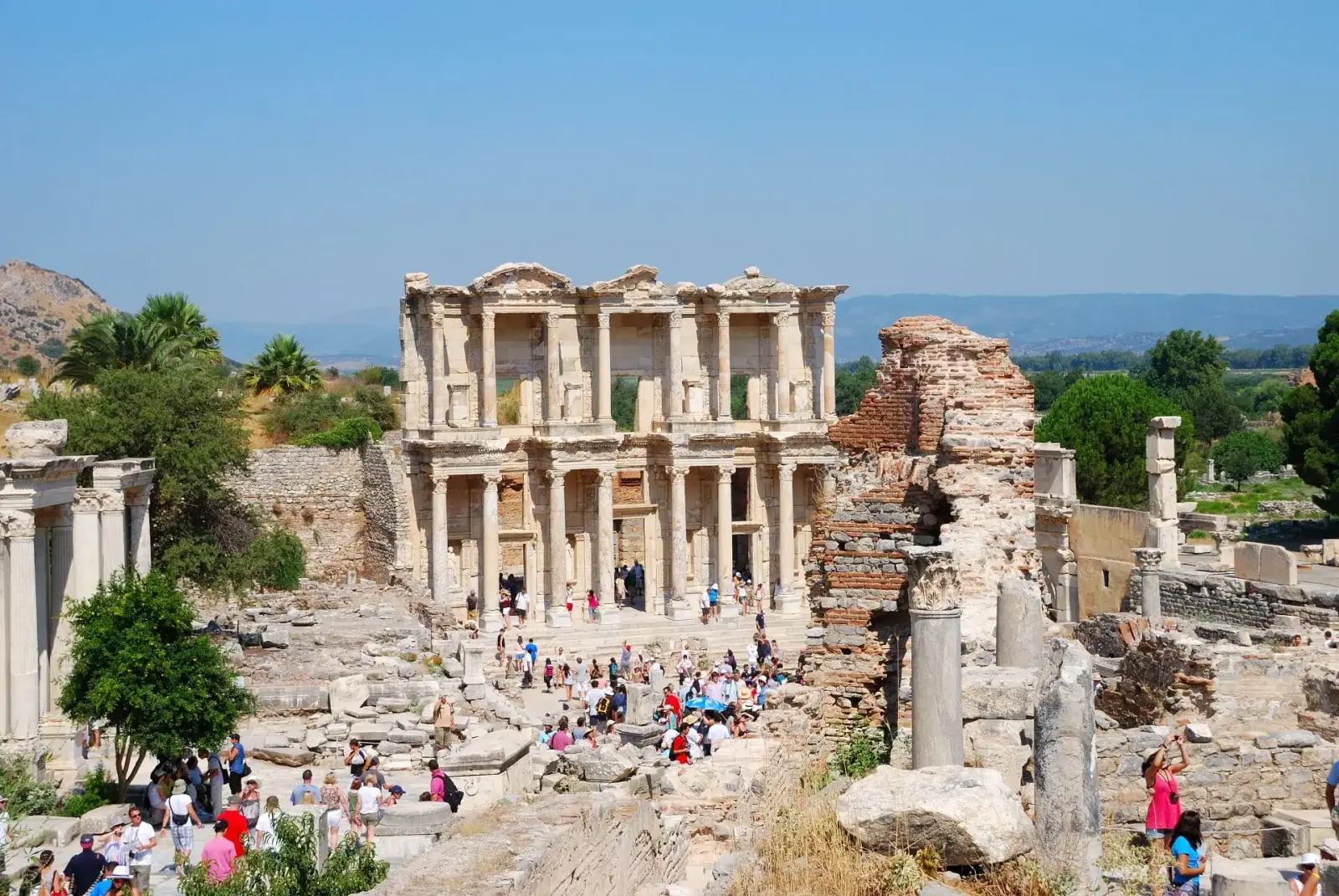
Paul began in the synagogue in city after city, and Ephesus was no exception. On a short first visit he "entered into the synagogue, and reasoned with the Jews" (Acts 18:19). When he came back, he "spake boldly for the space of three months, disputing and persuading the things concerning the kingdom of God" (Acts 19:8). The building has never been found. The community behind it is well attested: the historian Josephus preserves Roman decrees protecting the Jews of Ephesus, and a menorah is scratched into the steps of the Library of Celsus. The library went up decades after Paul, so the menorah is later too, but it shows that the community he preached to was still here generations on. Our page on the synagogue of Ephesus gathers the evidence.

2. The school of Tyrannus: two years
When some in the synagogue "spake evil of that way before the multitude," Paul left, took the believers with him and moved to "the school of one Tyrannus," disputing there daily for two years, "so that all they which dwelt in Asia heard the word of the Lord Jesus, both Jews and Greeks" (Acts 19:9–10). The Greek word is scholē, a lecture hall. So the short answer to "where did Paul preach in Ephesus?" is this: for most of his stay, in a rented classroom. No inscription names it and no building has been identified, so be wary of anyone pointing at a particular doorway. The hall of Tyrannus most plausibly stood in the busy lower city, near the Commercial Agora, where trade and public life met.

3. House to house: the whole time
The third venue is the one Paul himself stressed. Saying goodbye to the Ephesian elders at Miletus (Acts 20:17), he reminded them that he had "taught you publickly, and from house to house" (Acts 20:20). One of those houses has a name. Writing from Ephesus, Paul sends greetings from "Aquila and Priscilla… with the church that is in their house" (1 Corinthians 16:19). The Terrace Houses on the slope opposite the Temple of Hadrian show what Ephesian homes of the period looked like inside. They belonged to the richest families in the city and were grander than a tentmaking couple's home, but their courtyards and dining rooms are the kind of space where a household gathered to hear a letter read aloud.

The only ekklēsia that met in the theater was a mob. The church was meeting in a lecture hall and in people's homes.
What happened to Gaius and Aristarchus?
This is the part of the story we most want people to take home. Paul was the man the silversmiths were angry with, yet he spent the riot outside, held back by his friends, while two of his traveling companions faced the crowd in his place. Luke never says how they got out.
He does show that Aristarchus stayed. The Thessalonian travels with Paul again in Acts 20:4, sails with him toward Rome in Acts 27:2, and is greeted in Colossians 4:10 as "my fellowprisoner." A Gaius also joins Paul's party in Acts 20:4, but Luke calls that one "Gaius of Derbe," and whether he is the Macedonian Gaius of the theater is still debated. Aristarchus, at least, went into the theater in Paul's place and was still at his side years later.
Where to stand today
You can walk these places in one morning, in the order Luke tells them: Curetes Street and the library steps for the synagogue community, the Commercial Agora for the lecture-hall quarter, and finally the theater, where we read Acts 19:30 on the steps and let the building make the point. That is the route of our Footsteps of Paul tour. We collect the tickets in advance and take you in through the priority entrance, so the morning goes on Scripture instead of queues; the entrance fees themselves are still paid separately, at the Ministry's price.
For the building itself, with its history and what to look for, see our page on the Grand Theater of Ephesus.
Sources & further reading
- Acts 19:23–41 (KJV): the riot, the theater and the town clerk — KJV, Bible Gateway
- Acts 20:17–38 (KJV): the Miletus farewell, "from house to house" — KJV, Bible Gateway
- Acts 19:31 interlinear, Bible Hub — Asiarchōn ("chief of Asia") and theatron in the Greek
- Acts 19:32 interlinear, Bible Hub — ekklēsia, the word for the crowd in the theater
- Great Theatre in Ephesus, Turkish Archaeological News — building phases under Claudius, Nero and Trajan, and "no historical evidence of St. Paul's presence in the theatre"
- UNESCO World Heritage: Ephesus — the theater within the inscribed site