
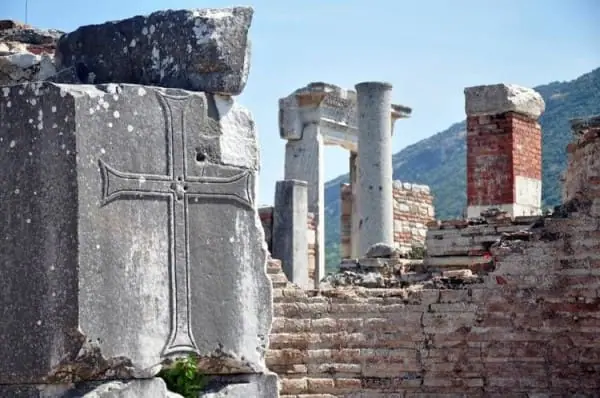
Most church councils are remembered in books; one is remembered in a building you can walk. In the summer of 431, some two hundred bishops crowded into this basilica by the harbor of Ephesus for the Third Ecumenical Council — and their letters home survive, complaining vividly of the heat, the bad air and colleagues falling sick. Out of that sweltering assembly came one of the most consequential words in Christian history: Theotokos.
The question of 431
The dispute sounds technical and was anything but: may Mary be called Theotokos, "God-bearer"? Nestorius of Constantinople hesitated; Cyril of Alexandria insisted, arguing the title protected the deeper truth that the child of Bethlehem was truly God. The council sided with Cyril — and the city exploded with joy. An eyewitness account describes the people of Ephesus escorting the bishops home with torches and incense, the whole harbor quarter ablaze with celebration. That the decision fell in Ephesus, where the Virgin's memory was already cherished, felt to the crowd like heaven's own geography.

One hall, many churches
The building itself is a conversion story in stone. It began as a colossal Roman hall — over 250 meters long — likely serving the harbor quarter's commerce and learning. In the fourth century Christians roofed its western end as a basilica: the first great church anywhere dedicated to the Virgin. Over the centuries the congregation rebuilt inside the shrinking shell, ending with two churches standing end-to-end in the old nave — hence the affectionate local name, the Double Church. To walk its length is to cross five centuries of the city's Christian life in two hundred paces.
The baptistery
Beside the north aisle survives one of the finest baptisteries of the ancient world: a circular chamber with a deep central pool, steps leading down and up on opposite sides. Generations of Ephesians were baptized here by full immersion, walking down one flight into the water and rising from the other side into the congregation. It is quiet, moving, and usually blissfully empty.

Sources & further reading
- Britannica: Council of Ephesus — the council of 431 explained
- Wikipedia: Church of Mary, Ephesus — the building's phases