
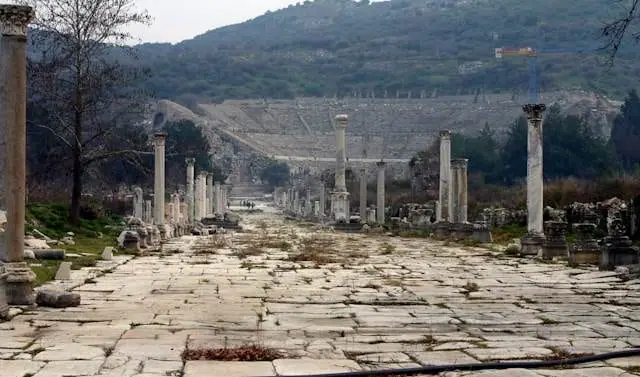
Every ancient city had a theater; only one theater has a chapter of the New Testament set inside it. When the silversmiths of Ephesus realized Paul's preaching threatened their trade in silver shrines of Artemis, "the whole city was filled with confusion" and the mob "rushed with one accord into the theatre" (Acts 19:29). For about two hours, Luke records, the great bowl roared a single sentence: "Great is Artemis of the Ephesians!"
The building
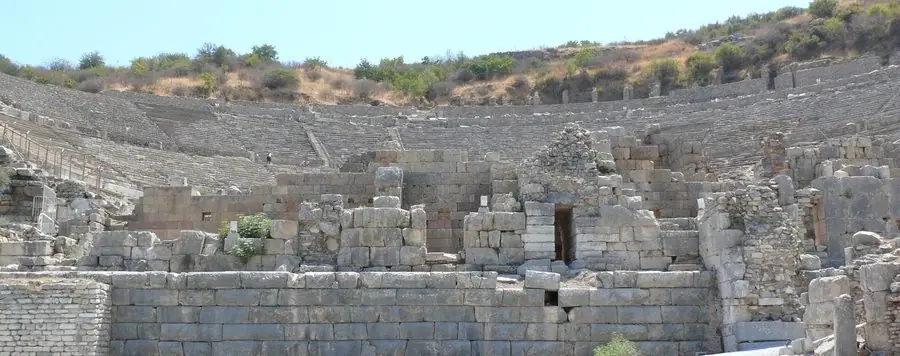
Cut into the flank of Mount Pion where the harbor avenue meets the marble street, the theater began as a Hellenistic building of the third century BC and was progressively enlarged under the Roman emperors into the giant that stands today: three tiers of twenty-two rows each, seating an estimated twenty-five thousand people — one of the largest outdoor auditoriums of the ancient world. Its stage building rose some eighteen meters, a marble cliff of columns, niches and statues; its gates sorted the classes of Ephesian society to their proper rows.
More than drama
The theater was the city's parliament as much as its playhouse: civic assemblies, religious festivals and political debates filled it as often as tragedy and comedy, which is exactly why the rioting crowd flowed there by instinct — it was where Ephesus went to decide things. In the later empire a protective wall was added around the orchestra so gladiator fights and beast hunts could be staged. It was, in every sense, where the city's passions played out.
Reading Acts 19 in the bowl
The scene rewards a slow reading on site. Paul wants to enter and face the crowd; the disciples and even friendly provincial officials beg him not to (Acts 19:30–31). Most of the crowd "knew not wherefore they were come together" (19:32) — the most honest description of mob dynamics ever written. And it ends not with a miracle but with a civil servant: the town clerk's masterly speech about courts, proconsuls and lawful assemblies (19:35–41), delivered from a stage whose foundations still stand. Our guides read it aloud here on every biblical tour; the acoustics do the rest.
Sources & further reading
- Acts 19:23–41 (KJV) — Bible Gateway — the riot, verse by verse
- UNESCO World Heritage: Ephesus — the theater within the inscribed site
- Britannica: Ephesus — the theater in the city's history