
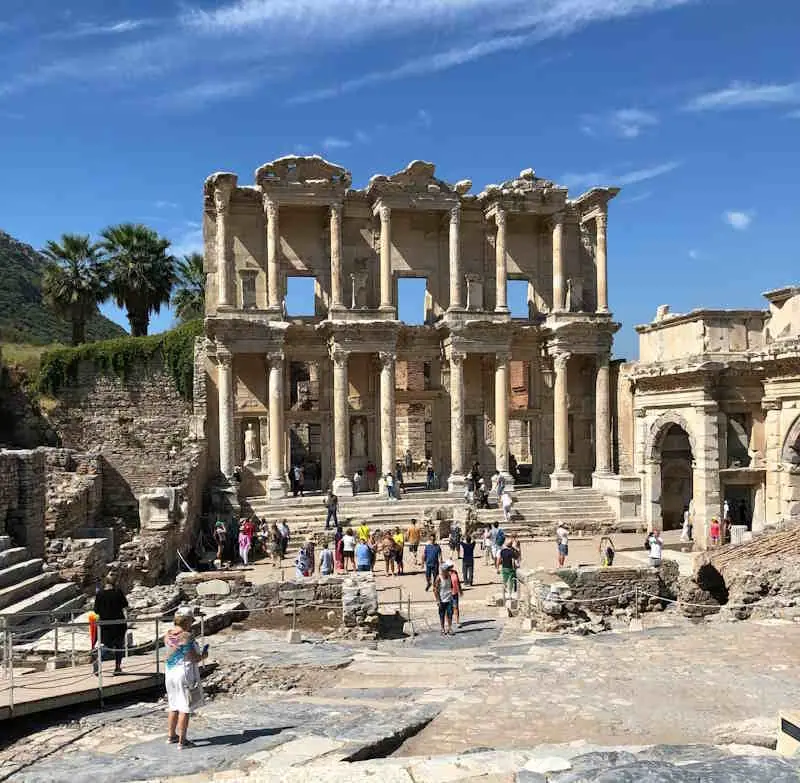
Around the year 110, a son began building a memorial for his father unlike any in the Roman world: not an arch or a statue, but a library. Tiberius Julius Celsus Polemaeanus had been consul in Rome and governor of Asia; his son Julius Aquila buried him in a lead-lined marble sarcophagus beneath the reading hall and raised above it a treasury of learning that held up to twelve thousand scrolls.
Architecture with a wink
The famous two-story facade is a masterpiece of controlled illusion: its central columns stand slightly taller and wider apart than the outer ones, a trick of perspective that makes the building look grander than its true size. Four statues filled its niches — Wisdom, Virtue, Insight and Knowledge, the qualities claimed for Celsus. Inside, a horseshoe of galleried shelves rose behind the marble, with an ingenious air gap between inner and outer walls to protect the scrolls from damp — climate control, second-century style.
The steps tell another story
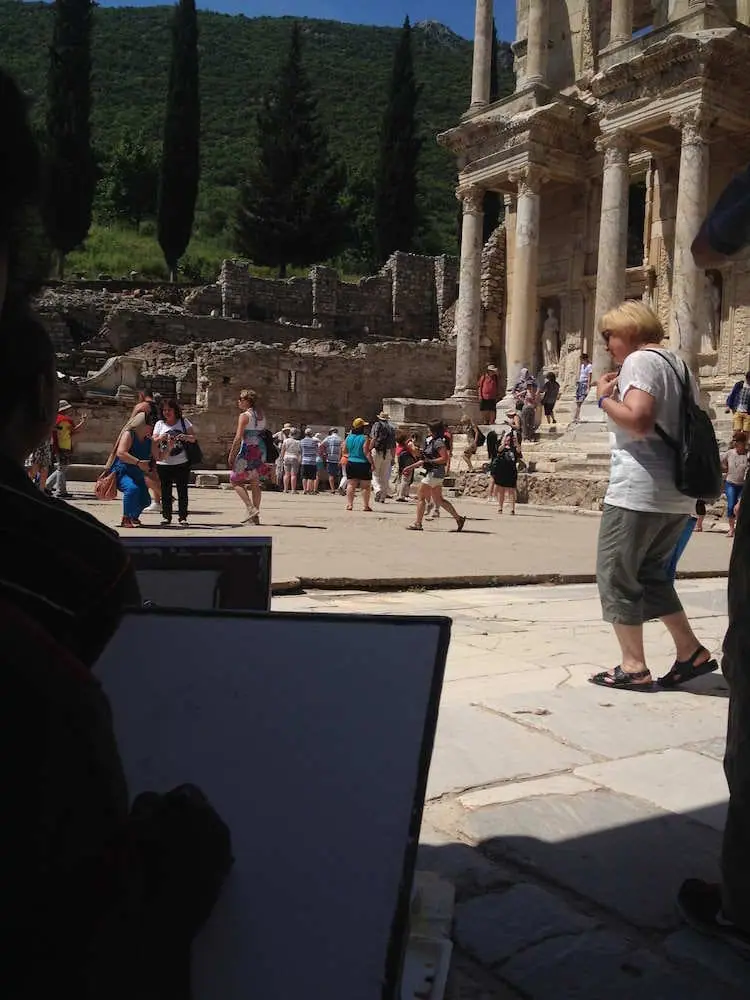
Look down before you look up. On the library's steps a menorah is scratched into the marble — a quiet signature of the Jewish community of Ephesus, the same community in whose synagogue Paul first reasoned (Acts 18:19). It is one of the very few physical traces of that community found so far, and one of the most touching: faith writing itself into the city's grandest address.
Fall and resurrection
The library's working life lasted barely a century and a half; an earthquake and fire in the third century gutted the interior, and the facade later served as the backdrop to a street fountain. What you see today is the world's most famous archaeological jigsaw: between 1970 and 1978, engineers re-erected the collapsed facade stone by original stone. Celsus, remarkably, never left — his sarcophagus still lies in the vault below, making the brightest photo-stop in Turkey secretly a tomb.
Sources & further reading
- Britannica: Ephesus — the library in context
- UNESCO World Heritage: Ephesus — the site listing
- Acts 18:19 (KJV) — Bible Gateway — Paul in the synagogue of Ephesus