
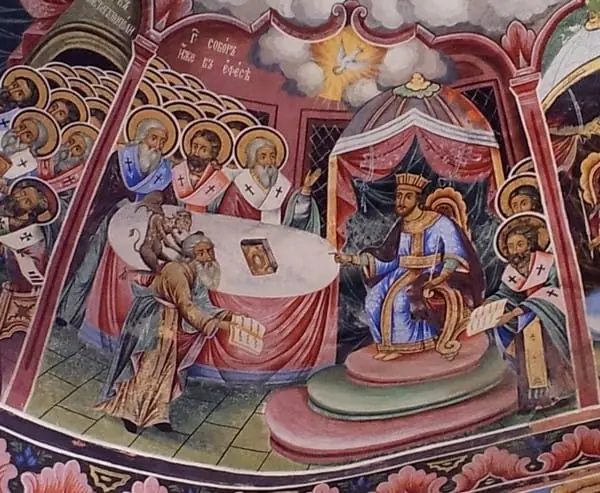
Every Sunday, millions confess that Jesus Christ is "true God and true man." The grammar of that sentence was hammered out in a series of great councils — and the third of them met here, in the harbor church of Ephesus, in the sweltering June of 431. Its question sounded like a title for Mary; its answer was really a definition of her Son.
The quarrel
Nestorius, the new archbishop of Constantinople, disliked the popular title Theotokos — "God-bearer" — for Mary; a creature, he reasoned, cannot bear God, and he preferred Christotokos, "Christ-bearer." Cyril, the formidable patriarch of Alexandria, heard in that hesitation a divided Christ — one person split into a divine Son and a human Jesus. If the child Mary bore was not truly God, Cyril pressed, then the cross saves no one. Emperor Theodosius II summoned the bishops to Ephesus — a city whose devotion to the Virgin was already famous.
A council of two tempers
The proceedings were, by any honest account, chaotic. Cyril opened the council before the Syrian bishops arrived; some two hundred bishops condemned Nestorius in a single long day's session. When John of Antioch reached the city days later, his party convened a rival council and deposed Cyril in return; both sides excommunicated each other and appealed to the emperor, who briefly arrested everyone of importance. It took two more years of negotiation to reunite the church. Ecumenical history is rarely tidy — and the bishops' surviving letters complain bitterly of Ephesus's summer heat and sickness while it happened.

The word that stood
Through the tumult, the core decision held and was received by the whole Church: Mary is rightly called Theotokos, because the one she bore is one person, truly God and truly man. The city, by every account, erupted with joy — crowds escorted the bishops through the streets by torchlight with incense burning. Twenty years later the Council of Chalcedon built its famous definition squarely on Ephesus's foundation. One Greek word, confirmed in this city, became a load-bearing wall of Christian faith — honored to this day by Catholic, Orthodox and most Protestant confessions alike.
Why Ephesus was the right address
No city could have felt the question more personally. Ephesus kept the tradition of Mary's residence on its mountain and John's tomb on its hill; its faithful had venerated her for generations. That the Church defined Mary's title in the city that claimed her home gives the site a resonance you can still feel, standing in the grass-grown nave where two hundred bishops once shouted, sweated and — eventually — got it right.
Sources & further reading
- Britannica: Council of Ephesus — the council explained
- Wikipedia: Council of Ephesus — proceedings and aftermath
- Luke 1:43 (KJV) — Bible Gateway — "the mother of my Lord" — the scriptural root