
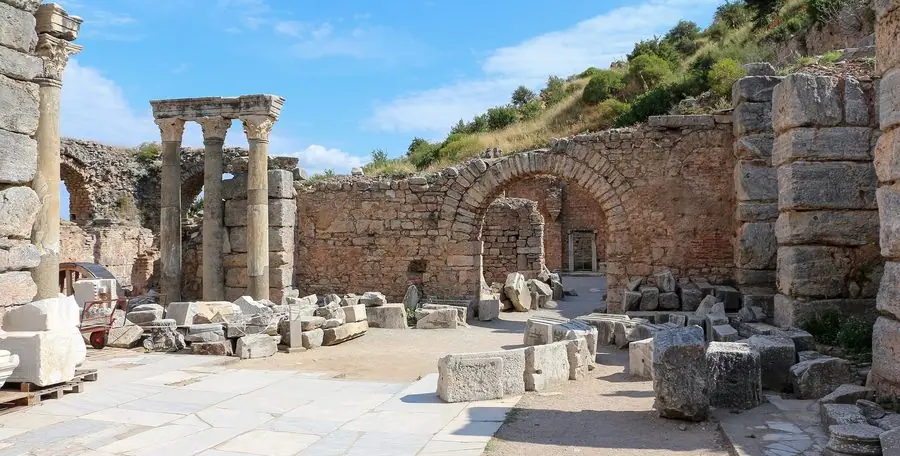
Just uphill from the Temple of Hadrian, a three-story ruin of brick and marble marks the social heart of late Roman Ephesus: the central baths. An inscription found here tells their later story in one gracious sentence — that a pious woman named Scholastica restored the crumbling complex at her own expense around the year 400. The grateful city set up her statue in the entrance hall, seated like a hostess; headless now, she sits there still.
A Christian at the baths
Scholastica is a small but precious window into a great change. By her lifetime Ephesus was a largely Christian city — and here is a Christian benefactress doing exactly what pagan magnates had always done: endowing the public baths. The old Roman institution of civic generosity simply changed hands and faith. Some of her building material, archaeologists note, was salvaged from older monuments — including stones from derelict pagan structures, the age's standard recycling of a retired religion.

How the baths worked
Bathers moved through the classical sequence — changing hall, cold room, warm room, hot room — over floors raised on brick pillars through which furnace air circulated. Baths were the Roman world's living room: business, gossip, politics and friendship all happened here, wet and warm. When Paul lived in Ephesus, this corner already steamed; the city's conversation about the strange new "Way" (Acts 19:23) surely passed through these rooms with the towels.

And yes — the latrines
Attached to the baths sit the most photographed toilets of the ancient world: a marble bench of forty seats around three walls, a water channel at the feet, and no partitions whatsoever. Romans treated the visit as social time. Guests always laugh here — and then go quiet when the guide explains the running-water engineering beneath, seventeen centuries ahead of most of Europe.
Sources & further reading
- UNESCO World Heritage: Ephesus — the baths within the site
- Britannica: Ephesus — city context