The Katagogia was a festival of Roman Ephesus in which masked revelers carried clubs through the city center. According to the Acts of Timothy, a text written roughly 300 to 400 years later, Timothy, Paul's disciple and the city's first bishop, tried to stop it and was beaten to death around AD 97, under the emperor Nerva.
That is the story in two sentences, and it is the version most of our guests have heard, if they have heard it at all. What follows is the part they rarely hear: where the story comes from, how far we can trust it, what an Ephesian stone says about the festival itself, which streets a procession like this would have used, and where Timothy's body went afterward.
What was the Katagogia festival in Ephesus?
The Katagogia was a recurring religious festival in Roman Ephesus. A second-century inscription calls it "the day of the Katagogia," when a market was held. A later Christian text describes masked men with clubs roaming the city center, and says Timothy was killed opposing it.
The Greek name means something like "the bringing down" or "the bringing home." Which god it honored is still debated. Scholars such as Josef Keil and Rick Strelan connect it with Dionysus, the god of wine, ecstasy and the theater mask. Some modern retellings of Timothy's death make it a feast of Artemis, the Diana of Acts 19:28, instead. The ninth-century patriarch Photius, who read the Acts of Timothy, called it a "devilish and abominable festival," which tells us how Christians remembered it, not what the Ephesians thought they were doing.
Is the Katagogia festival real? The stone in the agora
Yes. The Katagogia is not only a Christian memory. A statue base found in the agora of Ephesus, dated by scholars to about AD 130–150, honors a city magistrate named Dionysios, son of Nikephoros. Among his gifts to the city, he supplied oil "on the day of the Katagogia, when the market is held" in every gymnasium and every bath in Ephesus. The same stone names his daughter Iulia as a priestess of Artemis.
So the festival was civic, crowded and well funded: a market day, full bathhouses, and a holiday paid for by a leading family that also served the city's goddess. That fits the picture of the Katagogia as a whole-city event, which is exactly the setting the Timothy story needs.

Dionysus had a long history in this city. When Mark Antony entered Ephesus in 41 BC, Plutarch writes, the crowds hailed him as the god himself:
"Women arrayed like Bacchanals, and men and boys like Satyrs and Pans, led the way before him." Plutarch, Life of Antony 24
Costume, crowds and processions were part of that worship. In the second century, one of the grand homes in the Terrace Houses seems to have served as the clubhouse of a Dionysian association, led by its owner, a priest of Dionysus.

How did Timothy die, according to the Acts of Timothy?
The Acts of Timothy tell it this way. Timothy, whom Paul had left in charge at Ephesus (1 Timothy 1:3), served the church there into old age. During the reign of Nerva the Katagogia came round again. Its celebrants wore masks, carried clubs, and roamed the central streets attacking free men and respectable women, until there was blood in the squares. The revelers seem to have treated the violence as part of the worship.
Timothy went out and rebuked them in public. They turned their clubs and stones on him. Christians carried him away, and one scholarly summary of the text says he died three days later. He was buried outside the city at a place called Pion. That is the ancient name of the hill now called Panayırdağ, the slope into which the Grand Theater is built.

How reliable is the story of Timothy's death?
Honestly, it is tradition, not documented history. The New Testament never mentions Timothy's death; the last we hear of him in Scripture is Paul asking him to come to Rome before winter (2 Timothy 4). Everything else comes from the Acts of Timothy, and that text has problems:
- It is late. Hermann Usener, who published the Greek text in 1877, dated it to about 320–340. Most scholars now place it in the fifth century, because it treats Lycaonia as a separate province, which it only became around 370.
- Its officials do not check out. It names two governors of Asia, Maximus and Peregrinus. The Roman historian Ronald Syme judged both to be fictitious.
- Its author is unknown. A Latin version credits Polycrates, a second-century bishop of Ephesus, but the Greek original carries no such name.
What the text gets right is the setting. The Katagogia existed, Ephesus did host masked Dionysian crowds, and Nerva did reign from 96 to 98, which is where the traditional date of about AD 97 comes from. We tell the martyrdom as the Church's memory of its first bishop, which is what it is, and the Orthodox and Catholic churches both keep his feast: 22 January in the East, 26 January in the West. For his life and his two letters, see our Saint Timothy article.
Which route would the Katagogia procession have taken?
The Acts of Timothy do not trace a route. They only place the violence in the central parts of the city. But Ephesus has one procession whose route we do know. In AD 104 a wealthy Roman citizen, Gaius Vibius Salutaris, endowed a parade of gold and silver statues. It left the Temple of Artemis, entered the city by the Magnesian Gate, crossed the city to the theater, and returned to the temple by the Koressian Gate.

Between the Magnesian Gate and the theater there is one main road: past the State Agora, down Curetes Street, and along Marble Street to the theater. It is, almost step for step, the walk most visitors make today from the Upper Gate. If the Katagogia revelers paraded, they very likely used the same streets, because those were the streets the city built for crowds. That is our inference, not something the text says. It would make Curetes Street, lined with statue bases of the city's benefactors, the most likely stage for Timothy's last public act.

What happened to Timothy's relics?
They did not stay in Ephesus. The emperor Constantius II had the relics of Timothy, Andrew and Luke brought to Constantinople and laid in the Church of the Holy Apostles, in the 350s; Jerome dates the arrival of Luke and Andrew to 357. Timothy was among the first saints whose bodies were moved this way. In the 13th century relics believed to be his reached Termoli, on Italy's Adriatic coast, around 1239, and were rediscovered in the cathedral there in 1945.
So there is no tomb of Timothy to visit in Ephesus today, and no marker on Panayırdağ. The city keeps him in other ways: in the street, in the theater above his burial hill, and in the long story of how Ephesus became Christian, a story his death sits near the start of.
Festivals that took place in Ephesus
The Katagogia was one festival among many. A few that the evidence lets us name:
| Festival | What we know |
|---|---|
| Artemisia | The great feast of Artemis, in the spring month named after her, Artemision. A decree of AD 162–164 made the whole month sacred, with business suspended. |
| Salutaris procession | From AD 104, gold and silver statues of Artemis, the emperor and the city carried in procession from the temple through the city to the theater and back. |
| Katagogia | A market day honored by a second-century inscription; in Christian memory, the masked festival during which Timothy died. |
| Dionysian feasts | Plutarch's crowds of Bacchants and Satyrs in 41 BC; Dionysian associations met in the Terrace Houses in the second century. |
For how the city looked when Paul and the young Timothy first walked it, see Ephesus in Paul's day.
Walking Timothy's street today
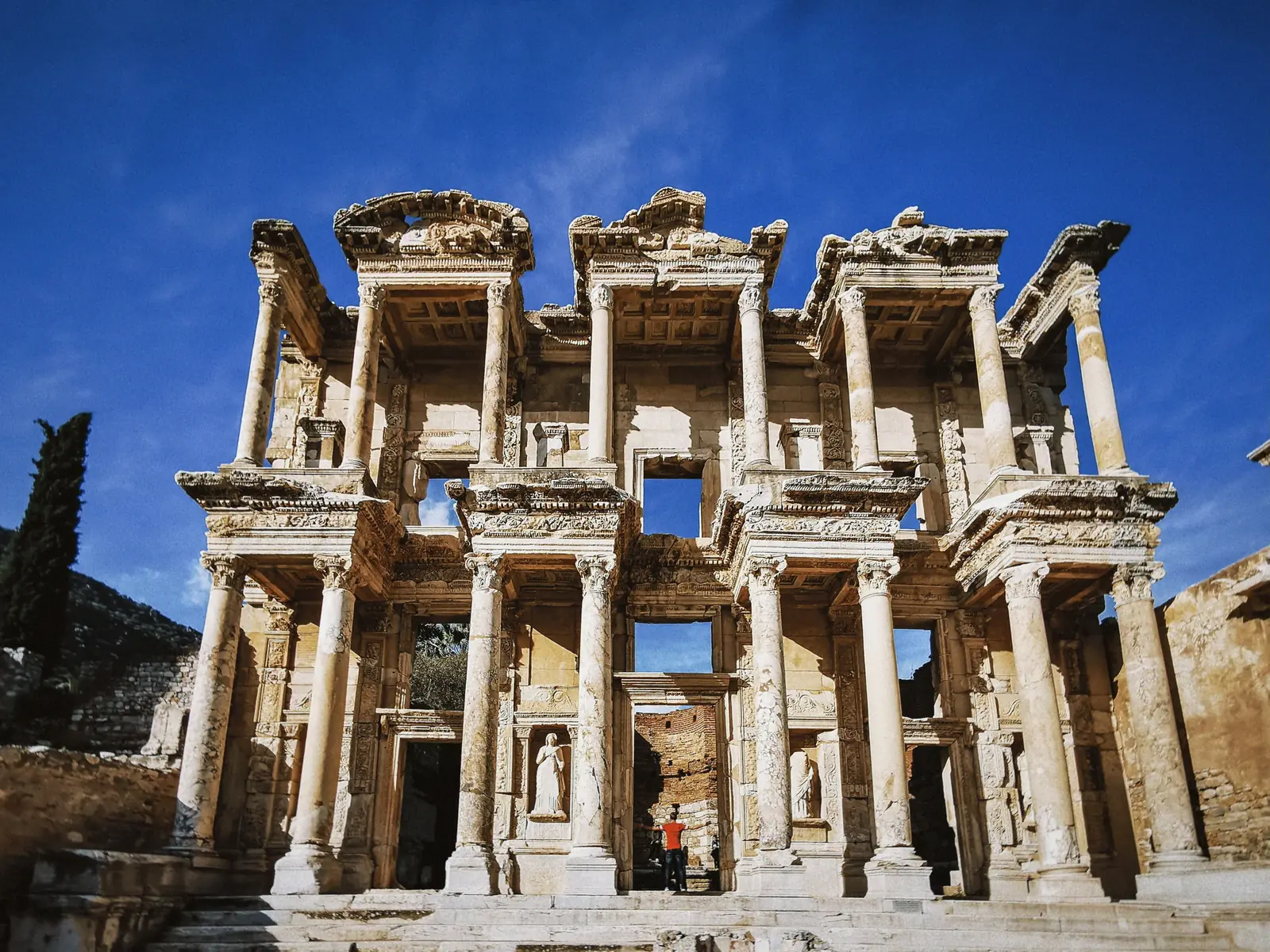
Stand at the top of Curetes Street early in the morning, before the groups arrive, and look down toward the Library of Celsus. Most of what you see was built after Timothy's time, but the line of the street is the line his city used for its crowds. Our Footsteps of Paul tour walks exactly this way, from the civic square down to the theater, with Acts 19 and the letters to Timothy in hand. Your guide collects the tickets in advance and takes you through the priority entrance, so there is no queue; the entrance fees themselves are paid separately at the gate price, listed on our entrance fees page.
Written by the Biblical Ephesus Tours guide team. Sources are listed below. Last reviewed: October 2026.
Sources & further reading
- Wikipedia: Acts of Timothy — the text, its dating, Photius, the masks and clubs, Syme on the proconsuls
- Tony Burke, "More Christian Apocrypha Updates 14: Acts of Timothy," Apocryphicity — clubs and stones, burial at Pion, manuscripts and translation
- Martin Meiser, "The City of Ephesus in Early Christian Literature," Early Christianity 7 (2016) 368–377 — the Acts of Timothy on the festival, his death three days later and burial
- Hüseyin Uzunoğlu, Epigrafik Belgeler Işığında Güney ve Güney Batı Anadolu'da Su ve Su Yapıları, Akdeniz University doctoral thesis (2018), no. T.54 = IEphesos III 661 — Greek text and dating of the "day of the Katagogia" inscription
- Plutarch, Life of Antony 24 — LacusCurtius — Antony hailed as Dionysus at Ephesus
- "A Stroll along the Sea: The Processional Way in Ephesus," Harvard CHS Research Bulletin — the Salutaris procession and its route
- Popillius Carus Pedo and the festivities of Artemis in Ephesus — Judaism and Rome database — the month of Artemision made sacred, AD 162–164
- Philostorgius on the relics of Andrew, Timothy and Luke — Cult of Saints, University of Oxford — the transfer to the Holy Apostles under Constantius II
- Wikipedia: Saint Timothy — feast days and the Termoli relics