Is Kusadasi in the Bible? No. The name Kusadasi appears nowhere in Scripture, and the town only took it under Turkish rule in the 14th century. But the coast is biblical: around AD 57 Paul's ship sailed past this bay, and in the King James Version of Acts 20:15 it "tarried at Trogyllium," the tip of the Dilek Peninsula just south of town. Ephesus itself is 18–20 km up the road.
So a cruise passenger stepping onto the pier is not standing in a Bible town. You are standing on the shore of a Bible voyage, a short drive from the city where Paul lived for about three years. That is worth knowing before you choose how to spend the day.
Is Kusadasi mentioned in the Bible?
No. Kusadasi is not mentioned in the Bible, because no town of that name existed in New Testament times. The nearest place the Bible does name is Trogyllium in Acts 20:15 (KJV), the tip of the Dilek Peninsula south of Kusadasi, where Paul's ship waited on its way to Miletus.
Is Kusadasi in the Bible at all? Paul's voyage in Acts 20
Paul was on his way to Jerusalem at the end of his third journey, with Luke on board writing in the first person. Acts 20:13–15 reads like a ship's log, one port a day down the coast:
"And we sailed thence, and came the next day over against Chios; and the next day we arrived at Samos, and tarried at Trogyllium; and the next day we came to Miletus." Acts 20:15, KJV
To get from Chios to Samos, a ship crosses the open mouth of the gulf on which Kusadasi stands. Then it threads the narrow strait between Samos and the mountain the Greeks called Mycale. Paul had good reason not to turn in. Acts 20:16 says he "had determined to sail by Ephesus," because a stop there would cost days and he wanted to reach Jerusalem by Pentecost. So he went on to Miletus and sent for the Ephesian elders to come to him instead.

Think about where that leaves the bay. Paul's ship passed within sight of the hills above today's cruise pier, carrying a man who had spent three years in the city just inland, and it did not stop. The farewell he gave the elders at Miletus a few days later is the most personal speech in Acts.
Where is Trogyllium today?
Trogyllium is the western cape of the Dilek Peninsula, the long mountain ridge you see to the south of Kusadasi. In antiquity the whole ridge was Mount Mycale, and the geographer Strabo, writing in Paul's lifetime, names its end "the promontory called Trogilian," where the mainland and Samos form a strait "about seven stadia" wide. Today that channel is the Mycale Strait, about 1.6 km across at its narrowest, the closest any Aegean island comes to Turkey. Most of the peninsula is now the Dilek Peninsula–Büyük Menderes Delta National Park.
One honest note for Bible readers. The words "and tarried at Trogyllium" are in the King James Version and the New King James, which follow the Byzantine text, but most modern translations, such as the NIV and ESV, leave them out because many of the oldest manuscripts lack them. The New Testament scholar Mark Wilson thinks the longer reading still describes something real: a ship becalmed off the cape, waiting for wind, which could have delayed Paul's arrival at Miletus by perhaps half a day. Either way, Paul's course ran through that strait between Samos and Mycale.

What was Kusadasi called in biblical times?
It did not have one fixed name, because there was no single town here. In Paul's day this shore was shared between Ephesus and Samos, dotted with small harbors. Strabo lists them going south from Ephesus: Neapolis, Marathesium and Pygela, a little town with a temple of Artemis. Scholars still argue over exactly where each one stood, so we would not tell you Kusadasi "was" any one of them. None of them is named in the Bible.
The names that follow are clearer:
- Phygela. As the harbor of Ephesus silted up in late antiquity, a port on this bay, usually called Phygela, took over its sea trade and later served as a Byzantine naval base.
- Scala Nova, "the New Port." After 1261 Genoese merchants gained trading rights on this coast and gave the harbor its Italian name. Old travel books call the whole gulf the Bay of Scala Nova.
- Kuşadası, "Bird Island." Under Turkish rule, from the early 14th century, the town took the name of the little island off its harbor, today's Pigeon Island.

Was Kusadasi called Ephesus in the Bible?
No. Ephesus and Kusadasi are two different places. The Ephesus of Acts and Revelation is the ruined city near Selçuk, 18–20 km northeast of the cruise pier, about 20 to 30 minutes by road. Its own harbor, where Paul landed in Acts 18:19, has silted up and now lies 5–6 km from the sea. That silting is the whole reason a port grew up on the Kusadasi bay: when the ships could no longer reach Ephesus, the sea trade moved down the coast, and the cruise ships followed it centuries later. You can read the city's story on our Ephesus ancient city page.
Kusadasi biblical history timeline
| When | What happened on this coast |
|---|---|
| c. AD 52 | Paul sails from Corinth and lands at the harbor of Ephesus with Priscilla and Aquila (Acts 18:19). |
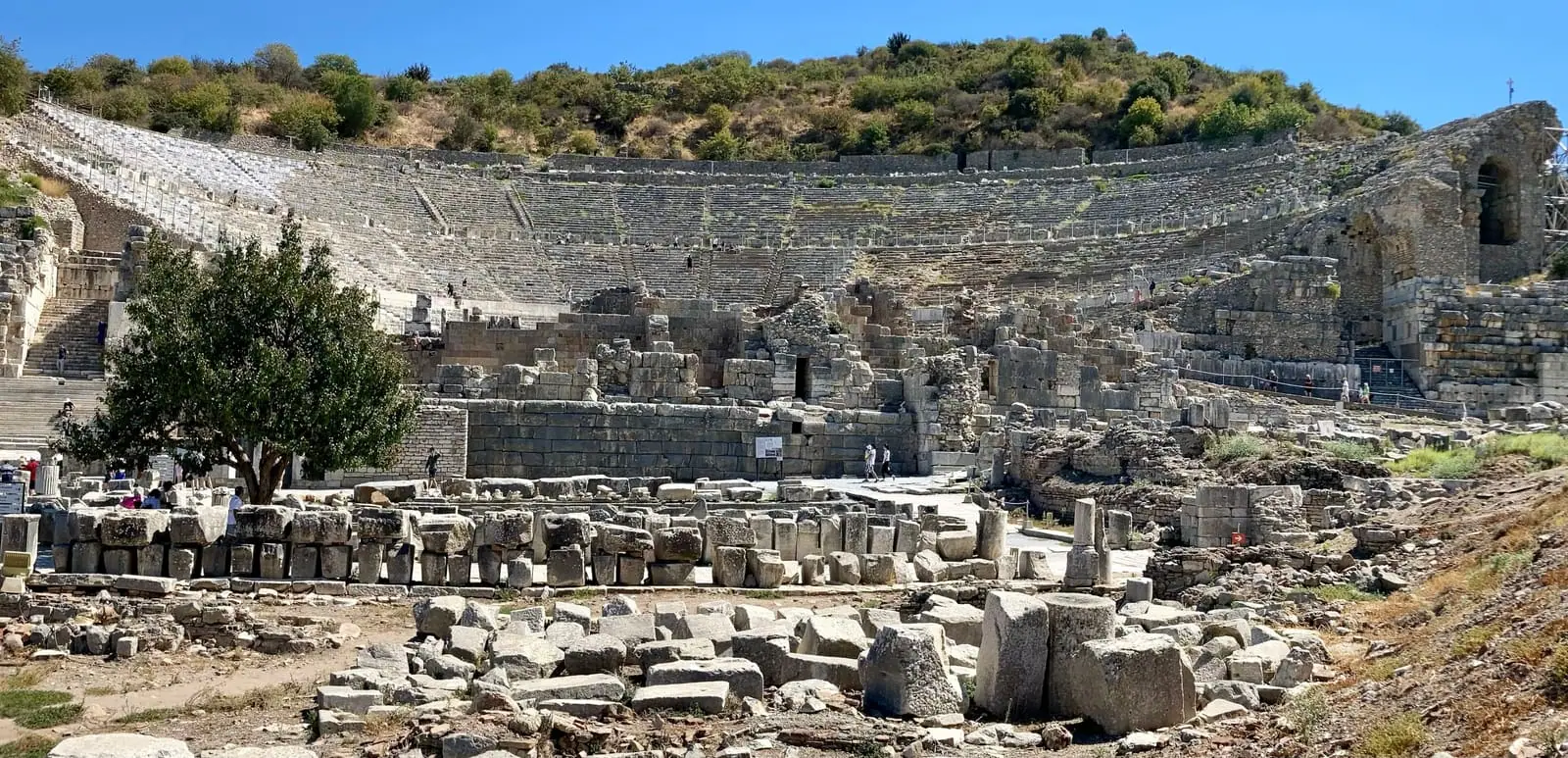
| c. AD 52–55 | Paul's long stay in Ephesus: the synagogue, the school of Tyrannus and the riot in the theater (Acts 19). |
| c. AD 57 | Paul's ship crosses the bay, passes Samos and, in the KJV, waits at Trogyllium, then calls the Ephesian elders to Miletus (Acts 20:15–17). |
| Late antiquity | The Ephesus harbor silts up and a port on this bay, Phygela, takes over. |
| After 1261 | Genoese traders name the harbor Scala Nova, "the New Port." |
| Early 14th century | Under Turkish rule the town becomes Kuşadası, "Bird Island." |
| 1618 | The Öküz Mehmed Pasha caravanserai is built for the port's trade. |
| Today | A major cruise port, and the usual landing place for visitors to Ephesus. |
Dates for Paul's journeys are scholars' reckonings, not dates written in Acts, and they vary by a year or two. For the arithmetic of the Ephesus years, see how long Paul stayed in Ephesus.
Seeing Paul's coast from Kusadasi
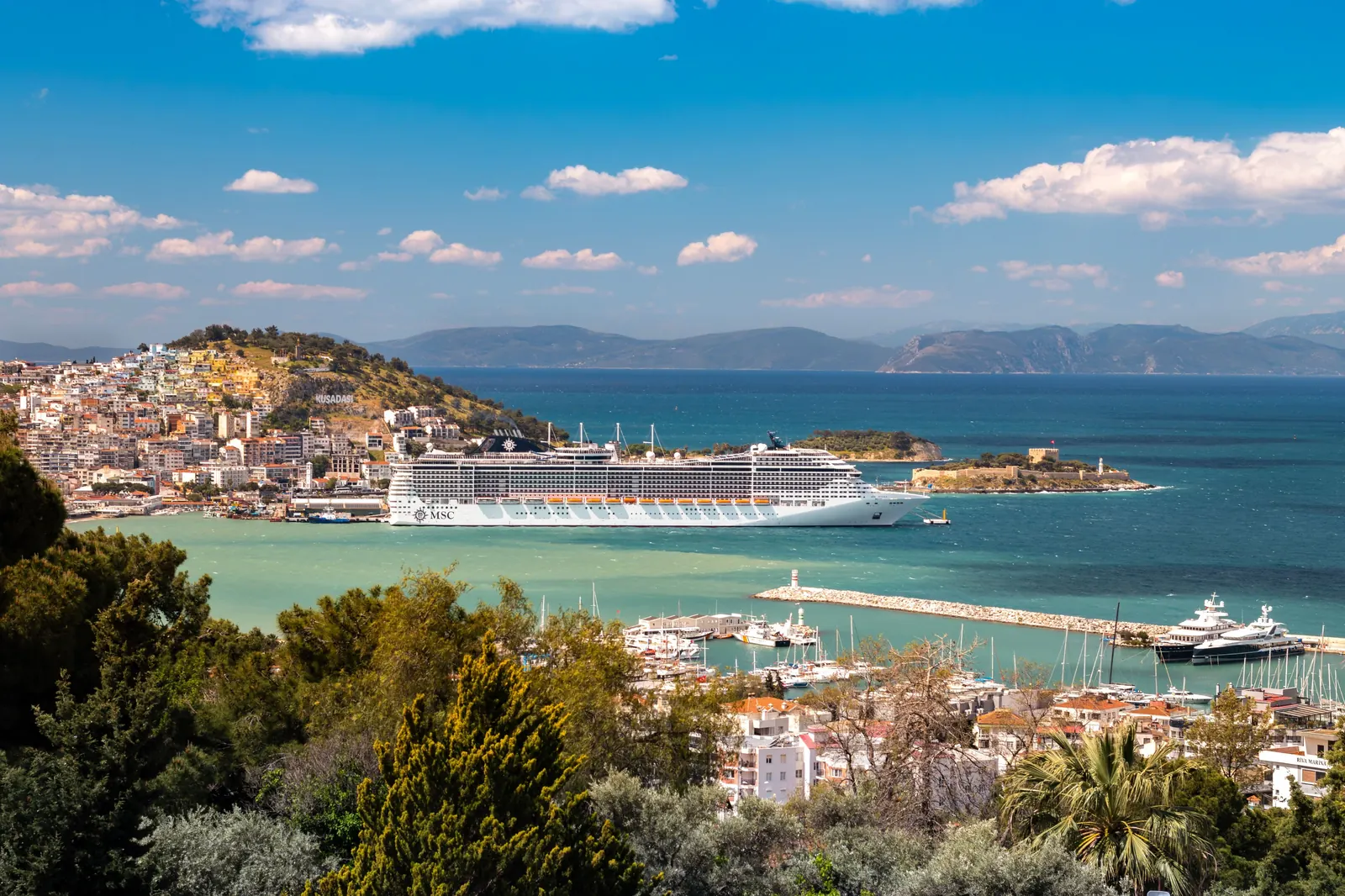
You do not need to leave the port to see the setting of Acts 20. From the hills above town, the Dilek Peninsula runs off to the south and Samos sits on the horizon: the two shores Luke's ship passed between. Mycale is no stranger to history either: the Ionian Greeks held their league festival, the Panionia, on its slopes, and the city of Priene still sits on a terrace beneath its cliffs.

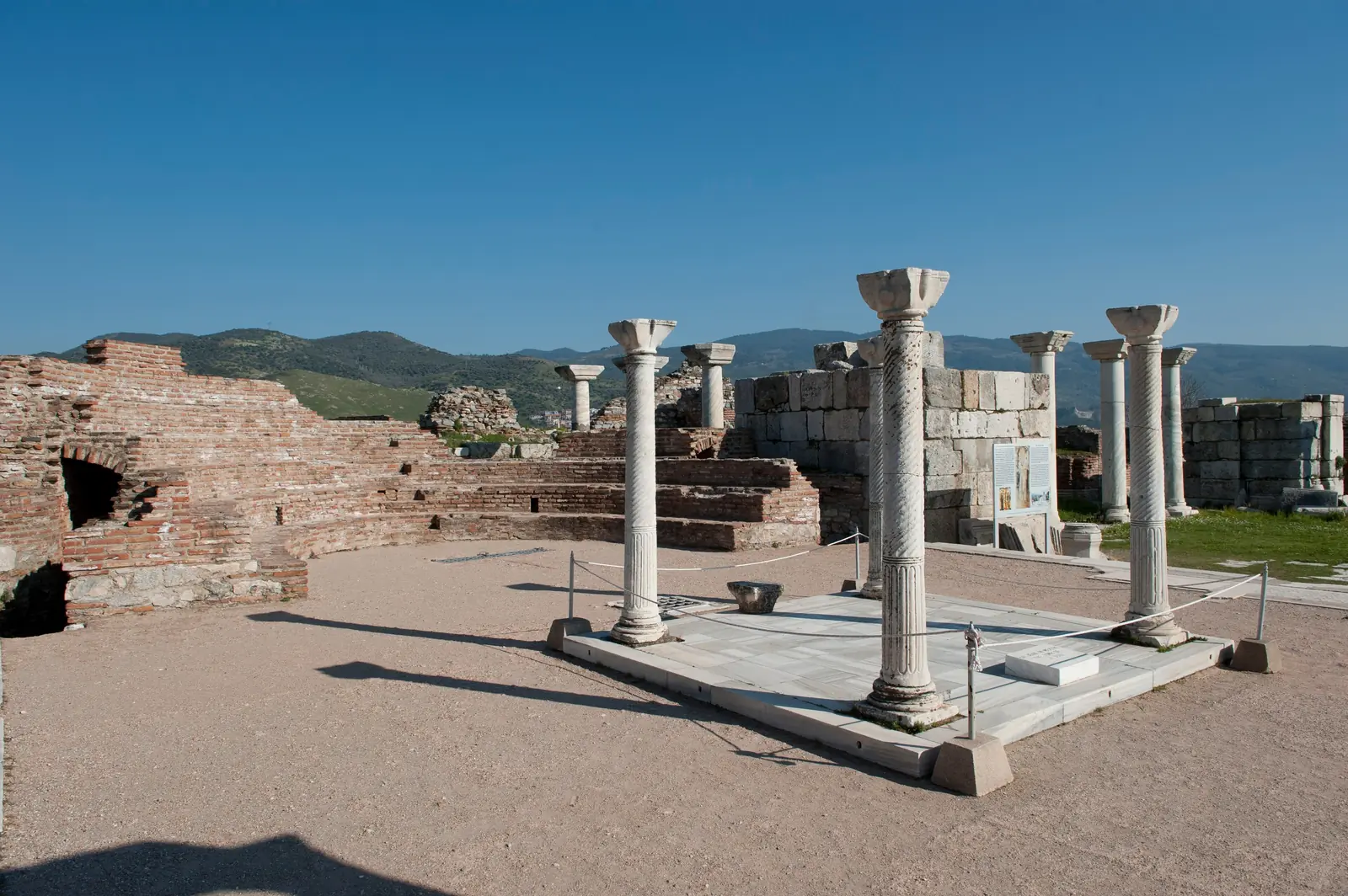
Most of our cruise guests have one day, and we think it belongs to the city Paul could not bear to stop at. Our Biblical Shore Excursion meets you at the gangway and takes you to Ephesus, the theater of Acts 19 and the House of the Virgin Mary, with the day planned backward from your ship's all-aboard time. Your guide collects the tickets in advance and takes you through the priority entrance, so there is no queue. The entrance fees themselves are paid separately at the gate price; current figures are on our entrance fees page. Guests with more time can add Miletus, where the farewell of Acts 20 was spoken, on a tailor-made day.
If your ship gives you only a short call, or you would rather explore the town, the Kusadasi port page covers what is within walking distance of the pier. Either way, open Acts 20 on deck as you sail out and look south to the cape.
Written by the Biblical Ephesus Tours guide team. Sources are listed below. Last reviewed: October 2026.
Sources & further reading
- Acts 20:13–17 (KJV) — Bible Gateway — the voyage past Samos and Trogyllium, and the call to Miletus
- Mark Wilson, "The Ephesian elders come to Miletus: An Annaliste reading of Acts 20:15-18a," Verbum et Ecclesia 34.1 (2013) — Trogyllium, the Byzantine and Western reading, the likely weather delay
- Strabo, Geography 14.1.12 — Perseus Digital Library — Mycale, the Trogilian promontory and the strait to Samos
- Strabo, Geography 14.1.20 — Perseus Digital Library — Neapolis, Marathesium and Pygela on the Ephesian coast
- Wikipedia: Mycale Strait — the strait between Samos and the Dilek Peninsula, 1.6 km at its narrowest
- Wikipedia: Kuşadası — Scala Nova and the origin of the name "Bird Island"