
Written within months of his departure from Ephesus, 2 Corinthians opens with Paul still shaking. Something in Asia — the province whose beating heart was Ephesus — had pressed him "out of measure, above strength," to the point of despairing of life itself. For the man who once listed his beatings and shipwrecks almost cheerfully (2 Corinthians 11), this trembling vagueness is unique. Whatever happened, he could describe the feeling but not, or not yet, the event.
The candidates
Scholars have filled the silence with proposals, all of them Ephesian: the riot of the silversmiths, escalating beyond what Acts records; an imprisonment (Paul writes elsewhere of fighting "beasts at Ephesus" and of Priscilla and Aquila risking "their own necks" for his life); a crushing illness; even a formal death sentence narrowly escaped — "we had the sentence of death in ourselves." Acts, focused on the gospel's public progress, may simply have passed over the apostle's darkest private hour. The honest answer is that no one knows — and that the not-knowing is itself instructive.
What despair was for
Paul, ever the theologian of his own biography, wrings meaning from the wreckage: the crisis happened "that we should not trust in ourselves, but in God which raiseth the dead." The lesson of Ephesus's worst chapter was resurrection practiced in advance — and verse 10 turns it into a grammar of hope: God "delivered... doth deliver... will yet deliver." Past, present, future: the most complete tense-map of trust in the New Testament, drafted by a survivor.
Standing in the verse
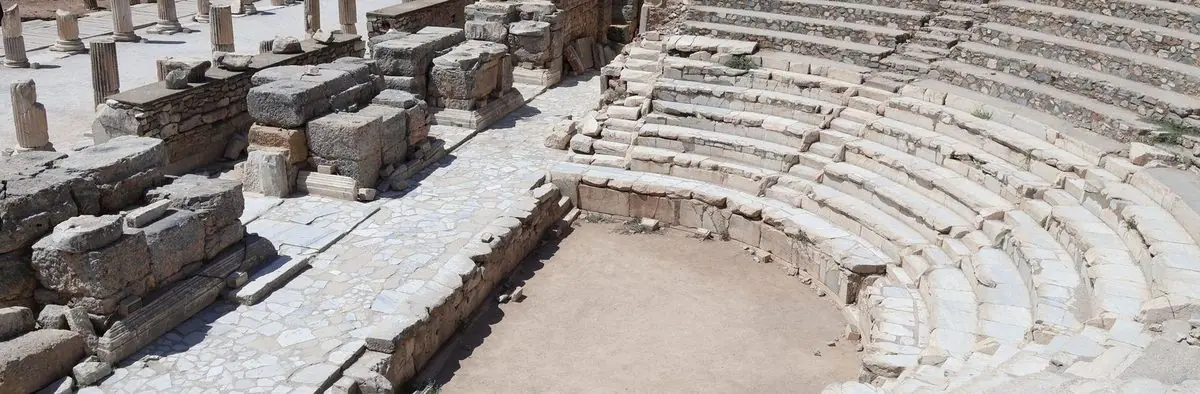
Because the event is unnamed, the whole city is its memorial. Guests who carry their own unnamed troubles — most of us do — often find this the verse that lands hardest on the marble. We read it wherever the day's quiet moment comes; Ephesus, which pressed Paul beyond his strength, is a strangely comforting place to hear that despair was not the end of his story.
Sources & further reading
- 2 Corinthians 1:3–11 (KJV) — Bible Gateway — read the passage in context
- 2 Corinthians 11:23–28 (KJV) — Bible Gateway — read the passage in context
- Britannica: Saint Paul the Apostle — the Ephesian years