Where is the Apostle John buried? At Ephesus, in modern Turkey: his grave lies beneath the crossing of the ruined Basilica of St. John on Ayasuluk Hill in Selçuk, marked today by a marble platform and four columns. The earliest written witness is Polycrates, bishop of Ephesus, who wrote around AD 190 that John "sleeps at Ephesus."
Two things complicate that simple answer, and both are older than the basilica. Ancient Ephesus pointed to two tombs bearing John's name, and the grave beneath the altar was believed to be empty. We will take them in turn, because a pilgrim standing at the rope deserves the whole story.
Where is the Apostle John buried?
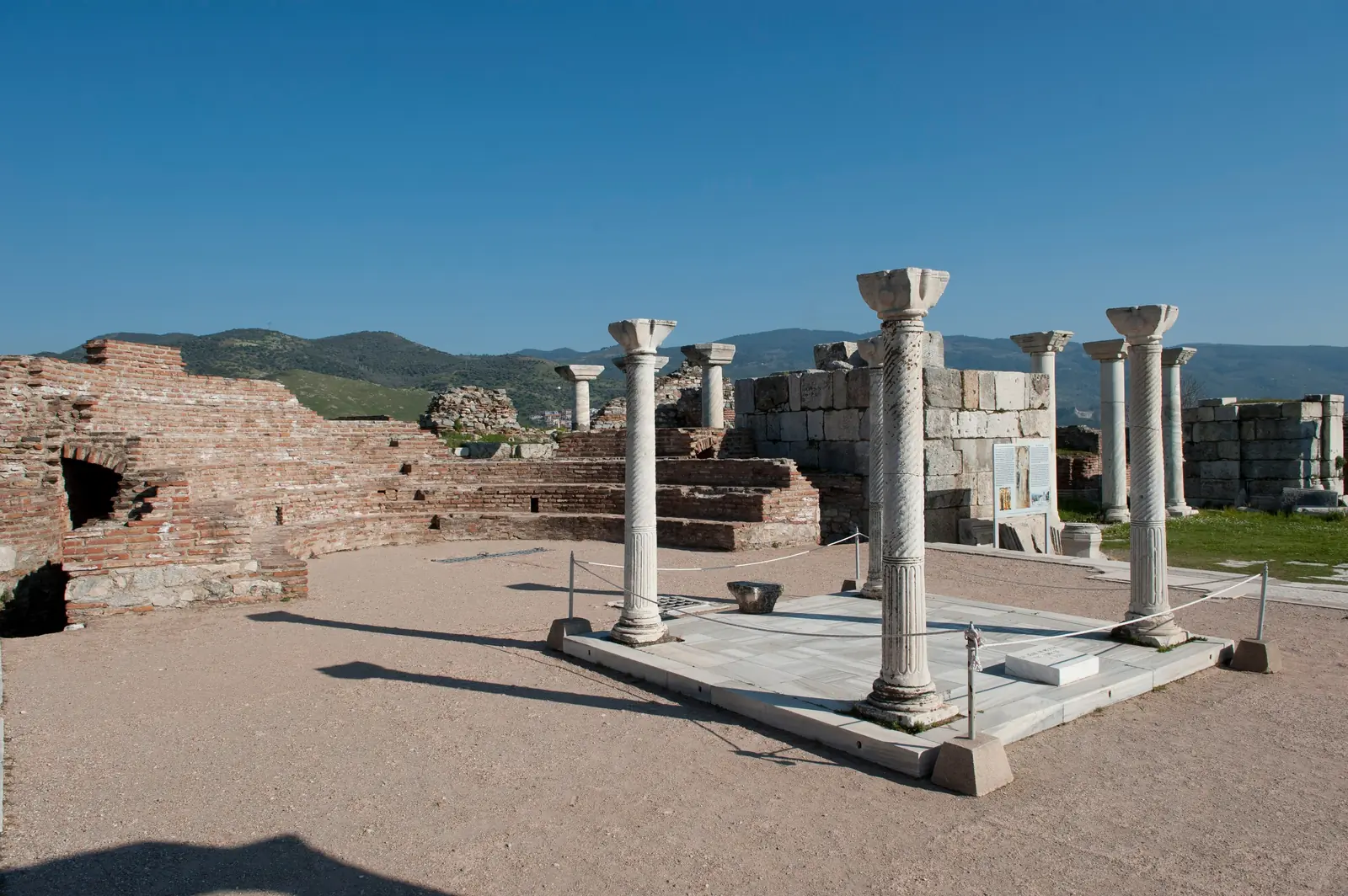
The Apostle John is buried at Ephesus, on Ayasuluk Hill in Selçuk, beside the ruins of the ancient city. His tomb lies under the central crossing of the Basilica of St. John, which Justinian built over the grave in the sixth century. A marble platform with four columns marks it.

Where is the tomb of St. John today?
The tomb is inside the Basilica of St. John, a roofless ruin on the slope of Ayasuluk Hill just above the center of Selçuk, below the walls of the fortress. You enter through the old fortified gate, walk up the nave and reach the tomb at the heart of the cross-shaped plan, where the great central dome once stood.
The grave itself is not visible. What you see is a raised square of white marble, roped off, with a column at each corner and a small stone marker at the front. Beneath it, excavators found a crypt of small chambers cut into the hill, the burial place the basilica was built to cover.

Selçuk is the Turkish town that grew up on the hill after the harbor city of Ephesus emptied, and the hill kept John's name. "Ayasuluk" is what centuries of local pronunciation made of Hagios Theologos, the Holy Theologian, the Greek Church's title for John.
How do we know John is buried in Ephesus?
Not from the Bible. The New Testament never records John's death; John 19:26–27 is the last we hear of him and Mary together, and John 21:23 goes out of its way to correct a rumor that he would not die at all. The evidence comes from the generations right after the apostles, and it is unusually close to the source.
- Polycrates, about AD 190. Writing to Victor, bishop of Rome, the bishop of Ephesus listed the "great lights" buried in Asia: "Philip, one of the twelve apostles, who sleeps in Hierapolis," and "John, who was both a witness and a teacher, who reclined upon the bosom of the Lord." And then: "He also sleeps at Ephesus." Eusebius copied the letter twice (Church History 3.31 and 5.24).
- Irenaeus, about AD 180. He had listened to Polycarp as a boy, and Polycarp had known John. Irenaeus says John lived on at Ephesus until the reign of Trajan (AD 98–117).
- Jerome, AD 392. He says John, "worn out by old age, died in the sixty-eighth year after our Lord's passion and was buried near the same city."
Polycrates matters most. Seven of his relatives had been bishops before him, he says, and he was the eighth, so he is writing about his own church's cemetery about ninety years after John's death. That is about as close as ancient burial traditions get.
"John, who reclined upon the bosom of the Lord ... He also sleeps at Ephesus." Polycrates of Ephesus, about AD 190
Why did ancient Ephesus have two tombs of John?
Here is the puzzle. Papias, a bishop of nearby Hierapolis in the early second century, named two men called John among his sources: John the apostle, and "the presbyter John," or John the Elder. Eusebius, writing around AD 325, thought this confirmed a report that "there were two tombs in Ephesus, each of which, even to the present day, is called John's" (Church History 3.39).
Some seventy years earlier, Dionysius of Alexandria had heard the same thing: "they say that there are two monuments in Ephesus, each bearing the name of John" (Church History 7.25). Jerome, too, mentions "another sepulchre" shown at Ephesus in memory of John the presbyter, adding that some thought both were memorials of the same John.
Why did it matter to them? Dionysius and Eusebius both used the second John to argue that Revelation might have been written by a different John from the Gospel. That authorship debate belongs to the Book of Revelation, and our sister site on the seven churches of Revelation covers it. For the question of the grave, one point is enough: nobody in antiquity doubted that John was buried at Ephesus. They argued about which John, never about which city.
Where was the second tomb? No ancient writer says, and no second grave of John has been identified on the ground. The basilica on Ayasuluk Hill is the only one whose tradition survived, and it is the one Polycrates, Justinian and fifteen centuries of pilgrims all meant.
Is John's body still in his tomb?
No relics of John have ever been shown at Ephesus, and the tradition itself says the grave was empty. A second-century story in the Acts of John has the old apostle order a grave dug, lie down in it and die, and later tellings say nothing was found there afterward. In the early fifth century, Augustine had heard people claim John was "sleeping rather than lying dead in his tomb at Ephesus," with the ground above him rising and falling as he breathed. He did not believe it, and said so gently.
That belief fed the most famous marvel of Byzantine Ephesus: a fine dust, called manna, which was said to rise from the grave each year on John's feast, May 8. Pilgrims carried it home in small clay flasks. It is a story with a surprising archaeological twist, and we will give it a post of its own.
Where did the Apostle John die?
At Ephesus, of old age, if the early tradition is right. Irenaeus places him in the city into Trajan's reign, which began in AD 98, so he would have been a very old man. He is the one member of the Twelve whom most early writers do not count among the martyrs. Before that he had been exiled to Patmos, the island off this coast where Revelation places him (Revelation 1:9), and returned to Ephesus afterward.
For the story of how John came here, and the tradition that Mary came with him, read our article on John and Mary in Ephesus.
How a grave became one of the largest churches of its age
The first memorial over the grave was small. An earlier church was built over it in late antiquity, and in the mid-sixth century Justinian and Theodora replaced it with a cross-shaped basilica about 130 meters long, roofed with domes and modeled on the Church of the Holy Apostles in Constantinople. Their monograms are still carved on the capitals. The tomb stood at the crossing, directly under the central dome, where every line of the building meets.

Earthquakes and war brought the domes down in the late Middle Ages. What you walk through now is the ground plan, the rebuilt arcades and the columns re-erected by archaeologists, whose work on the site began in the 1920s. The hill still gathers three faiths and three ages in one view: the church over the apostle's grave, the Isa Bey Mosque of 1375 at its foot, and the last column of the Temple of Artemis in the field below.

Visiting the tomb of St. John
The basilica has its own ticket, separate from the Ephesus site; current prices are on our entrance fees page. It is rarely crowded, and it is the quietest of the biblical sites around Ephesus. It is an open-air ruin, not a working church, so there is no service to wait for. Guests pray, read Scripture or sing a hymn at the rope, and nobody minds.
Our Biblical Ephesus Tour is built to end here: the morning at the House of the Virgin Mary, then Paul's city with Acts 19 open, and the last stop at John's tomb, with the valley below. Your guide collects the tickets in advance and takes you through the priority entrance, so there is no queue. The entrance fees themselves are paid separately at the Ministry's gate price.
Written by the Biblical Ephesus Tours guide team. Sources are listed below. Last reviewed: September 2026.
Sources & further reading
- Eusebius, Church History, Book 3 (ch. 31 and 39) — New Advent — Polycrates on John "sleeps at Ephesus"; Papias and the two tombs
- Eusebius, Church History, Book 5 (ch. 24) — New Advent — the full letter of Polycrates to Victor of Rome
- Eusebius, Church History, Book 7 (ch. 25) — New Advent — Dionysius of Alexandria: "two monuments in Ephesus, each bearing the name of John"
- Jerome, De viris illustribus 9 — New Advent — John "buried near the same city"; the second sepulchre
- Augustine, Tractate 124 on the Gospel of John — New Advent — the belief that John was sleeping in his tomb at Ephesus
- Irenaeus, Against Heresies 3.3 — New Advent — John at Ephesus until the time of Trajan
- Wikipedia: Basilica of St. John — the building, its dating and the tomb at the crossing