
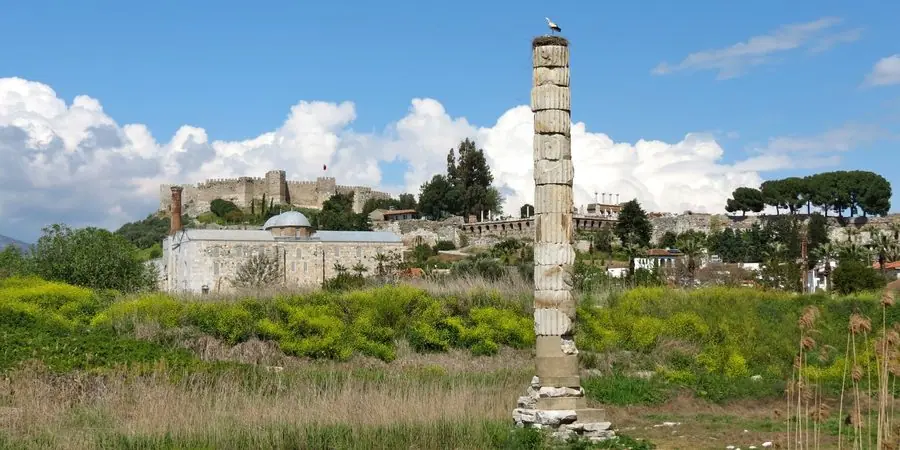
No congregation on earth could hear this passage the way Ephesus heard it. Their city's entire identity — its title "temple-keeper," its bank, its festivals, its skyline — rested on the marble immensity of the Artemision, four times the Parthenon's size. Into that city comes a letter declaring that God's dwelling is under construction elsewhere: in them. Not beside the great temple; instead of it.
A builder's vocabulary
The passage talks like a construction site, and Ephesians knew construction. A "chief corner stone" was the first stone laid, the one every line of the building was squared from — get it wrong and the whole structure drifts. "Fitly framed together" translates a term for stones dressed to join perfectly. And the tense is present continuous: the building "groweth." Unlike the Artemision, finished and frozen, this temple was designed never to stop being built — every convert another dressed stone.
Strangers made family
Verse 19 lands the social revolution first: "no more strangers and foreigners, but fellowcitizens." The old temple had its famous asylum line — fugitives who crossed it were safe, but they remained fugitives at a boundary. The new temple abolishes the boundary altogether: Gentile and Jew, once divided by "the middle wall of partition" (2:14), are not refugees at God's border but household members in God's house. In a city of strict citizen rolls and temple lines, the sentence was social dynamite dressed as comfort.
Standing in the verse
There is only one place to read this: beside the single re-erected column of the Temple of Artemis, in the marshy field where the Wonder of the World stood. One column remains of the building; the other temple — the one "fitly framed together" of people — is presently distributed across every continent, still growing. The contrast needs no guide's commentary, though ours will happily provide the verse.
Sources & further reading
- Ephesians 2:11–22 (KJV) — Bible Gateway — read the passage in context
- Britannica: Temple of Artemis — the rival temple
- UNESCO World Heritage: Ephesus — the site today