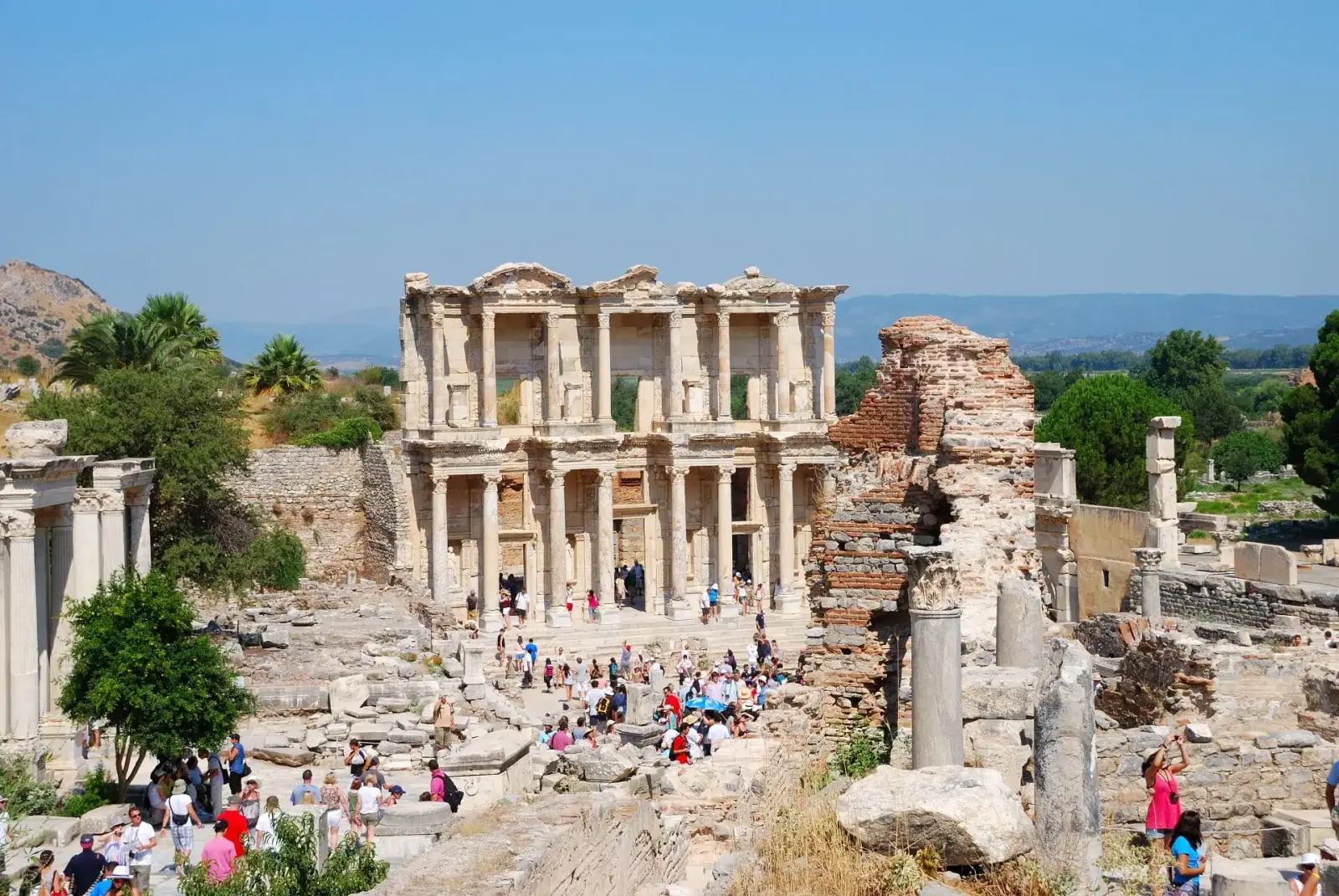
It is the question we get asked more than any other, usually somewhere around the Library of Celsus, usually by someone who has just realized how big this place is. If Ephesus was one of the greatest cities in the Roman world — and it genuinely was, up there with Rome, Alexandria and Antioch — then where did everybody go?
The short answer surprises people, because it is not a war, a plague or a volcano. Ephesus was killed by mud.
The river that ate a city
Ephesus was built where it was for one reason: the harbor. Ships came in from the Aegean, up a navigable channel, and tied up at quays right beside the city. Everything else — the wealth, the marble, the Temple of Artemis, the population of perhaps two hundred thousand people — grew out of that one geographical advantage.
The problem was the Cayster river, which emptied into the same bay. Rivers carry silt. Year after year, the Cayster dumped mud into the harbor, and year after year, the coastline crept a little further west. Not fast enough for anyone to panic, but relentlessly — the way a leaking roof is relentless.
And the Ephesians fought back. Hard. They dredged constantly. In the 2nd century BC, King Attalus II of Pergamon tried to fix the problem by narrowing the harbor mouth, on the theory that a faster current would flush the silt out to sea. It did the opposite: the narrower channel trapped more sediment inside, and the harbor got worse. It is one of history's great civil-engineering own goals, and our guides never quite manage to tell it with a straight face.
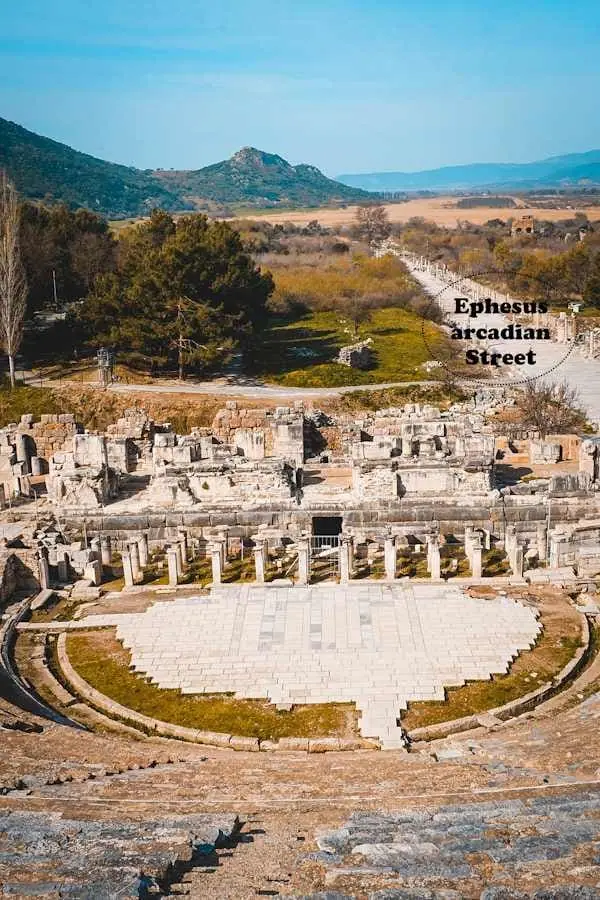
By the Byzantine period the harbor needed near-continuous work to stay open at all. Eventually the money, the will, or both ran out. Today the sea is about seven kilometers away — a ninety-minute walk from the harbor gate.
Then the mosquitoes arrived
Here is the part that gets left out of most guidebooks. A silted harbor does not simply become dry land; it becomes marsh. And marshland on the Mediterranean coast in antiquity meant one thing: malaria.
We do not have a public-health file from 6th-century Ephesus, but we have the pattern, and it repeats all along this coast. The wetlands spread, the fevers came, the people who could leave left, and the ones who stayed were sicker and fewer. It is a slow, grinding, deeply unglamorous way for a great city to end — no invading army, just standing water.
Earthquakes, raiders and bad luck
The silt was the underlying cause. Everything else was the shove.
- Earthquakes. Western Turkey sits on an active fault system, and Ephesus was hit repeatedly. A severe quake in the 3rd century AD did enormous damage, and the city never fully rebuilt to its former scale.
- The Goths. Around AD 262 raiders sacked the city and badly damaged the Temple of Artemis — which had already burned down and been rebuilt once before, on the night, tradition says, that Alexander the Great was born.
- Arab naval raids. From the 7th century onwards, raids along this coast made a sprawling, wall-less lower city genuinely dangerous to live in. High ground with defenses started to look very attractive.
- Shifting trade. Once the harbor closed, the trade routes simply routed around Ephesus. Cities do not survive on scenery.
So they moved. Uphill.
This is the detail we most enjoy telling people, because it changes the story from a tragedy into something more like a relocation.
The Ephesians did not die out. They walked about three kilometers up the valley to Ayasuluk Hill — defensible high ground, above the marshes, crowned by the great basilica built over the tomb of Saint John. A town grew around it. That town is still there. It is called Selcuk, it has about forty thousand residents, and you probably drove through it on your way to the ruins.
Ephesus was not abandoned so much as evacuated, slowly, over several centuries, to a better address.
So when someone asks what happened to the people of Ephesus, the honest answer is: they are still here. They moved house. It just took them a thousand years and they left the furniture behind — which is precisely why you can walk through their living rooms in the Terrace Houses today.
When exactly was Ephesus abandoned?
There is no single date, and anyone who gives you one is simplifying. The decline runs roughly like this:
| Period | What was happening |
|---|---|
| 1st–2nd century AD | Peak. Capital of Roman Asia, perhaps 200,000 people. |
| 3rd century | Earthquake damage and the Gothic raid of c. 262. Recovery is partial. |
| 5th–6th century | Still a major Christian city — two church councils meet here — but the harbor is a constant struggle. |
| 7th–8th century | Coastal raids. Population shifts up to Ayasuluk Hill. |
| 11th–14th century | A modest medieval town, changing hands between Byzantines and Turks. |
| 15th century onward | The classical city is essentially empty. Selcuk carries on. |
If you want one sentence for a pub quiz: Ephesus faded over roughly a thousand years and was effectively abandoned by the 1400s.
"Why was Ephesus abandoned in the Bible?"
People search this one a lot, so let us answer it directly: the Bible does not say Ephesus was abandoned, and it never predicts the city's destruction.
What Revelation contains is a letter to the church at Ephesus — praising its hard work, then delivering the famous line, "thou hast left thy first love," with a warning that its lampstand could be removed if it did not repent (Revelation 2:1–7). That is about a congregation's spiritual condition, not urban planning.
Now — is it striking to stand in an empty city and read a warning about a removed lampstand? Absolutely. We read that passage with guests in the ruins most weeks and nobody is unmoved by it. But the honest history is that the church of Ephesus went on to thrive for centuries after Revelation was written, hosting the councils that shaped Christian doctrine. The city emptied for reasons of silt and geography. What you do with that juxtaposition is, quite properly, up to you. We have written more about that in what happened to the church of Ephesus.
The upside for you
Here is the strange gift in all of this. Cities that stay inhabited get built over — that is why you cannot excavate central London. Ephesus was abandoned early enough and completely enough that nobody built a modern town on top of it, and the same silt that killed the harbor also buried and protected the ruins.
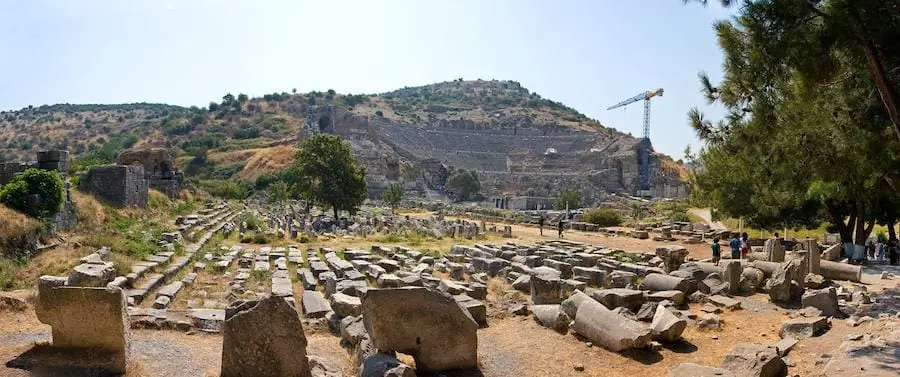
The result is one of the most complete ancient cities anywhere in the Mediterranean: a 25,000-seat theater, a library facade you can photograph without a single modern building in the frame, streets with the original marble underfoot, and mansions with the paint still on the walls. The mud took the city and then, in its own slow way, handed it back.
Only about ten percent of it has been excavated. The other ninety is still down there under the fields — which means the best answer to "what happened to Ephesus" is really: most of it is still waiting.
Sources & further reading
- UNESCO World Heritage: Ephesus — the inscribed site and its significance
- Britannica: Ephesus — the city's history and decline
- Revelation 2:1–7 (KJV) — Bible Gateway — the letter to the church at Ephesus