
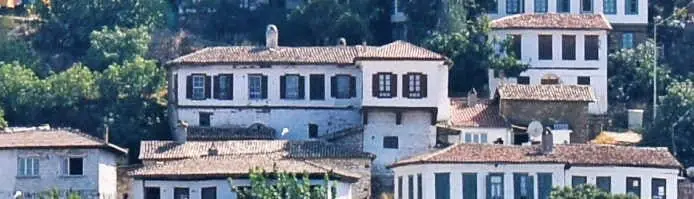
When the harbor of Ephesus finally died, its people did not vanish — they moved. Local tradition says Greek families from the fading valley climbed into these hills and built themselves a village among the orchards, naming it Cirkince, "the ugly one," in the fond hope that no tax collector or rival would bother visiting. The republic later renamed it Sirince — "the pretty one" — which is, frankly, more honest.
A village of two faiths' memories
Sirince's Greek Orthodox centuries ended with the population exchange of 1923, when its families departed for Greece and Muslim families arriving from the Balkans took their houses. The two communities' architecture now lives side by side: vine-shaded courtyards, a small mosque, and two 19th-century Greek churches, St John the Baptist and St Demetrius. Neither is ancient; both are touching, the last Christian chapter of a valley whose first chapter was written by apostles.

Is there a church in Sirince?
Yes, two, both built by the village's Greek Orthodox families in the 19th century. The larger is the Church of St John the Baptist, completed in September 1805, restored by the Ephesus Museum between 1988 and 1993 and now used for exhibitions. The smaller St Demetrius stands near the village entrance. Sirince itself is never named in the Bible.
St John the Baptist, also called the Domed Church or the Upper Church, stands on a high terrace on the west side of the village. A marble inscription over its north door tells its story in Greek: the first church fell down soon after it was finished, and the Christians of the village and beyond rebuilt it at great cost and effort. The date that closes the text, written in Greek numerals, is September 1805. Inside, piers and marble columns divide a three-aisled hall of about 20 by 13 meters, with a wooden gallery for the women at the west end, and some of the reused stone came from ancient Ephesus. A man's bust brought up from Ephesus was once set into the wall above the door; after treasure hunters tried to pry it loose, it was moved to the Ephesus Museum. In 1921–22 the village boys' school met in the church courtyard. Without a congregation after 1923 and a ruin by the 1980s, it was rescued by the Ephesus Museum's restorers and restored again in 2015–16, and its nave now serves as a hall for art and photography exhibitions. It is the church our Ephesus & Sirince Village tour visits in the afternoon, after the ruins.

Nothing records why the villagers chose John the Baptist, but pilgrims coming up from Ephesus will know the name: the Book of Acts meets his followers in Ephesus twice, first Apollos, "knowing only the baptism of John" (Acts 18:25), then the dozen or so disciples Paul found in the city, baptized "unto John's baptism" (Acts 19:1–7). The village reached back to the New Testament in other ways too. In 1699 its priest showed a visiting English chaplain, Edmund Chishull, a Gospel book he said had been written by Prochorus, one of the seven deacons of Acts 6:5. Chishull judged it a lectionary, perhaps of the sixth or seventh century.
The pleasures of the place
Sirince's fame today is happily edible: fruit wines pressed from peach, blackberry and quince, dense village olive oil, lace and needlework sold from doorsteps, and long courtyard breakfasts. The lanes are cobbled and car-free, the pace is pre-industrial, and the view over rooftops and orchards belongs on a postcard. Tastings everywhere are hospitality first — sip, chat, and wander on; nobody will press you.

With Ephesus below
We pair Sirince with Ephesus on our Ephesus & Sirince Village day, and the sequence matters: the marble metropolis first, then the village that inherited its people. Ancient grandeur in the morning, living continuity in the afternoon — the whole account of this valley, told in one day.
Sources & further reading
- Wikipedia: Sirince — village history
- Britannica: Ephesus — the valley the village inherited
- Izmir Metropolitan Municipality: Ayios Ioannes Prodromos Church — the Church of St John the Baptist, in Turkish
- Edmund Chishull, Travels in Turkey and back to England (1747) — Project Gutenberg — the 1699 visit and the Prochorus manuscript