
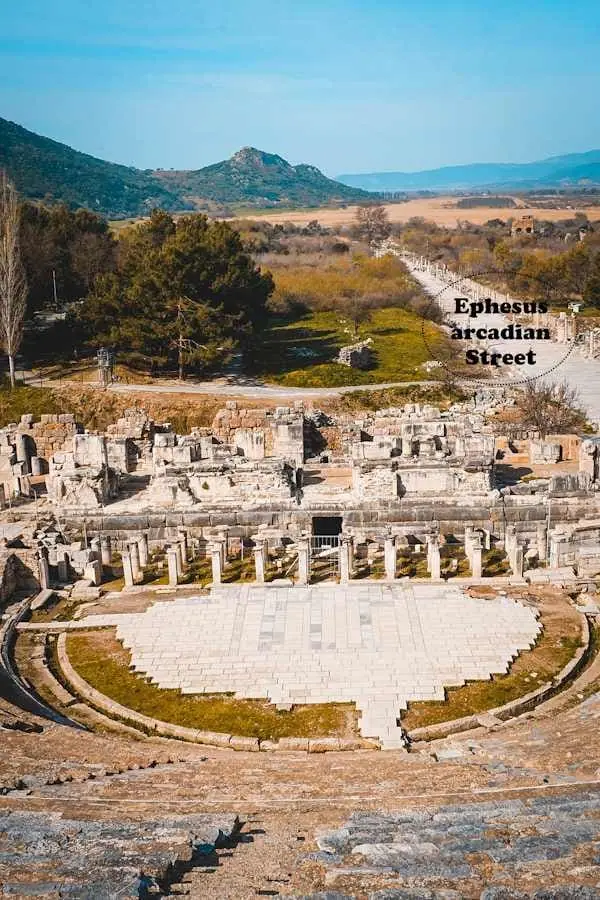
Ephesus stands in the Aegean region of western Türkiye, at the mouth of the Cayster valley in Izmir province. The ruins sit immediately beside the small town of Selcuk — close enough to walk in about forty minutes — roughly 20 kilometers north-east of the resort and cruise port of Kusadasi, and about 75 kilometers south of Izmir, Turkey's third city. The site is open to visitors every day of the year.
What is Ephesus called today?
The ancient city has no modern inhabitants — it is an archaeological site, not a living town. Its heirs are two places right next to it: Selcuk, the market town built on Ayasuluk Hill where the surviving population moved when the harbor silted up, and Kusadasi, the coastal town that inherited its sea traffic. In Turkish the ruins are called Efes — the name you will see on every road sign, and, incidentally, on the country's best-known beer, which is named after the city.
What country is Ephesus in?
Türkiye — Turkey in English. In the Bible's day this coastline was the Roman province of Asia (not the continent, but the province of which Ephesus was the capital), which is why Acts 19:10 can say that "all they which dwelt in Asia heard the word of the Lord." Geographically the site sits in Anatolia, the Asian side of modern Turkey, about 60 kilometers from the Greek island of Samos.
How do you pronounce Ephesus?
Three syllables, stress on the first: EFF-uh-sus (IPA: ˈɛfəsəs). The "ph" is a plain f sound, and the final syllable is a soft "sus," not "soose." The Greek original is Ephesos (Ἔφεσος); Turkish speakers say Efes — "EH-fess." Nobody local will mind whichever you use, but EFF-uh-sus is the standard English form, and "Ephesians" follows it: eh-FEE-zhuns.
What does the name mean?
Nobody is certain, and that is a clue in itself. The name is older than the Greek language in this region: scholars connect it to Apasa, capital of the Bronze Age kingdom of Arzawa, recorded in Hittite archives centuries before Greek settlers arrived. The Greeks inherited the name and attached their own founding legend to it — Prince Androclus of Athens, an oracle, a fish and a wild boar. When a city's name predates the language of the people who made it famous, you are standing somewhere very old indeed.
Where is Ephesus in the Bible?
In the New Testament, Ephesus is the capital of Roman Asia and the setting of Acts 18–20 — Paul's longest recorded ministry, the burning of the magic books and the riot in the theater. A whole epistle carries its name, Timothy served here as its first bishop, and the risen Christ addresses it first among the seven churches of Revelation. Tradition also brings Saint John and the Virgin Mary here. Our Ephesus in the Bible section walks through every passage, verse by verse.
How far is Ephesus from...?
| From | Distance | Typical drive |
|---|---|---|
| Kusadasi (town & cruise port) | 20 km / 12 mi | 20–25 minutes |
| Selcuk town center | 3 km / 2 mi | 5 minutes |
| Izmir city & Izmir cruise port | 75 km / 47 mi | about 1 hour |
| Izmir Airport (ADB) | 55 km / 34 mi | 45–50 minutes |
| Pamukkale | 190 km / 118 mi | about 3 hours |
| Istanbul | 600 km / 373 mi | 1 hour by air + 1 hour road |
| The sea today | 5–6 km / ~3.5 mi | the harbor silted up |
Why is Ephesus not on the coast any more?
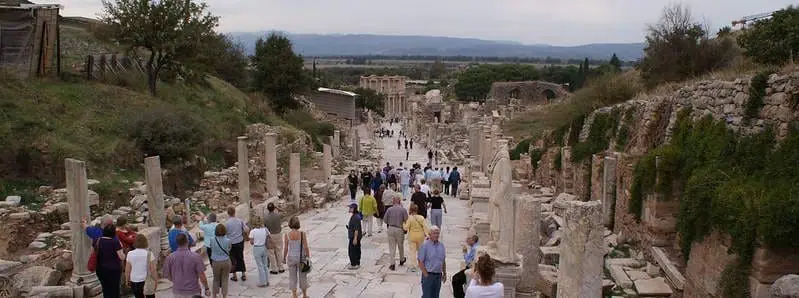
It was — that is the tragedy of the place. Ephesus was one of the great harbors of the Mediterranean, and ships once tied up where the Arcadian Way now ends in a meadow. The Cayster river carried silt down the valley for centuries, pushing the coastline steadily west despite enormous dredging efforts, until the harbor closed for good and the city's reason to exist closed with it. Stand at the harbor gate today and the Aegean is five to six kilometers away.
Getting there and getting in
Most visitors come from Kusadasi (including cruise passengers), Izmir, or by air into Izmir Airport; our how to get to Ephesus page covers every route, and the entrance fees and tickets page covers gates, prices and opening hours. If you would rather not drive, park or queue, our private tours collect you from your hotel, ship or the airport and handle the whole day.
Sources & further reading
- UNESCO World Heritage: Ephesus — the official site listing and boundaries
- Britannica: Ephesus — history and geography