
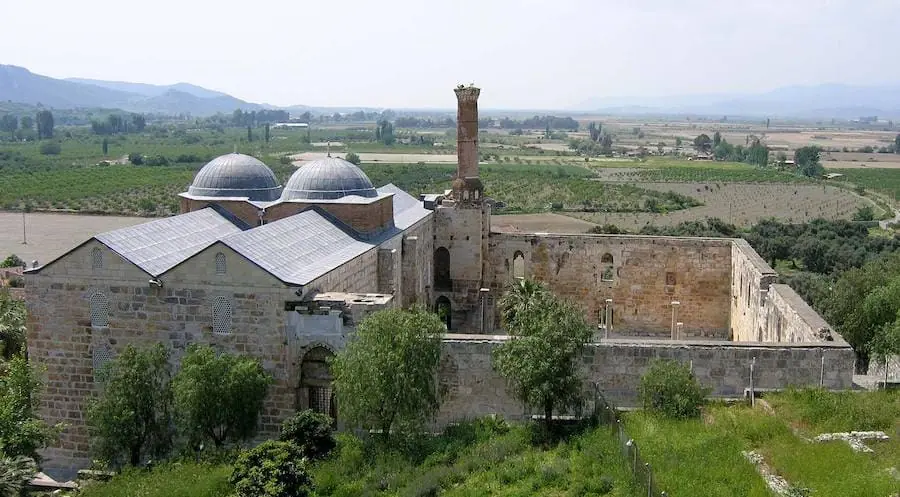
Walk down from the Basilica of Saint John and you arrive, in about four minutes, at a large and beautiful mosque built while Chaucer was alive. Isa Bey Mosque was raised in 1375 for a Turkish emir of the Aydınoğulları principality, at a moment when Ephesus was fading and Ayasuluk was becoming the town we now call Selcuk. It is the last great building of this valley's long story, and it was made out of the first ones.
A building made of other buildings
Look at the courtyard columns and the mismatched capitals: granite and marble shafts quarried in Egypt and Anatolia centuries earlier, carried here for the harbor baths and public buildings of Roman Ephesus, then carried again — a few kilometers and a thousand years — to hold up a mosque. Reusing older stone (spolia) was normal practice everywhere in the medieval Mediterranean, but few buildings wear it as openly as this one. The Byzantine hill above supplied more. Three civilizations, one courtyard, no pretense about any of it.
The architecture
The design is unusual and rather lovely: a broad prayer hall on a Syrian-influenced plan, entered through a monumental west facade of finely carved marble that would not look out of place in Damascus — its architect, Ali son of Mushimish, came from there. Two domes cover the central bays, an arcaded courtyard with a central fountain fronts the hall, and the surviving minaret stands over the entrance. The stalactite carving around the portal is the finest 14th-century stonework in the region.

Why include a mosque on a biblical tour?
Because the valley's story does not stop at the Byzantine era, and because Mary is honored here too — she is named more often in the Quran than in the New Testament, and the House of Virgin Mary on the mountain above is visited by Muslim and Christian pilgrims alike. Standing in this courtyard with the basilica of the Evangelist on the hill behind and the column of Artemis in the field below is the clearest three-minute summary of religious history anyone could ask for. Guests of every background find it moving; it is always optional on our tours.

Visiting
It is a working mosque, so the usual courtesies apply: shoes off at the door, shoulders and knees covered, a headscarf for women (usually available to borrow), and quiet if people are praying. Prayer times briefly close the hall to visitors. Entry is free, it takes fifteen minutes, and it is included on our full-day itinerary — see our what to wear page for the practical details.
Sources & further reading
- Wikipedia: İsa Bey Mosque — construction, architect and architecture
- UNESCO World Heritage: Ephesus — the wider inscribed area including Ayasuluk