
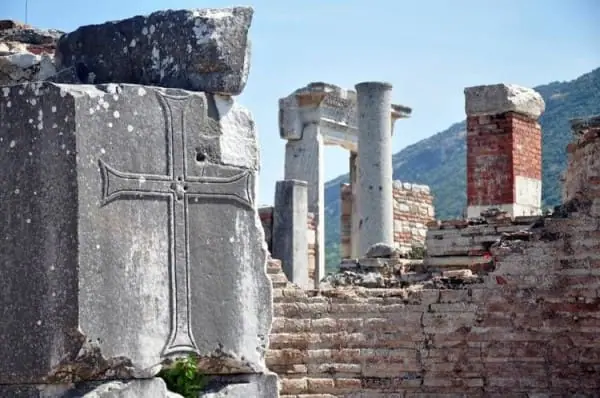
Ephesus hosted the Church's finest conciliar hour in 431 — and its most notorious in 449. The Second Council of Ephesus was summoned as ecumenical, conducted like an ambush, and repudiated within two years. Pope Leo the Great refused it the name of council at all, branding it a latrocinium — a den of robbers — and the label stuck for fifteen centuries.
The road back to Ephesus
The question had moved on since 431. Against Nestorius's divided Christ, some now swung to the opposite pole: the aged Constantinopolitan monk Eutyches taught that after the Incarnation Christ had only one nature, his humanity absorbed into divinity "like a drop of honey in the sea." Condemned at home, Eutyches found a powerful patron in Dioscorus, Cyril's successor at Alexandria, and a sympathetic emperor summoned a new council — back to Ephesus, city of the Theotokos triumph.
What went wrong
Nearly everything. Dioscorus presided with imperial soldiers at his back; the two-nature statement of faith sent by Pope Leo — the famous Tome — was never allowed to be read; Eutyches was rehabilitated in short order; and Flavian, archbishop of Constantinople, was deposed amid scenes of open violence — he died soon after, his death blamed by contemporaries on rough handling at the council. Bishops later testified they had signed blank or under duress. When the papal deacon Hilarus escaped Ephesus with his one-word protest — "Contradicitur!" — the West already knew what it had witnessed.

The correction: Chalcedon
The whirlwind reaped quickly. The emperor died in a riding accident in 450; the new rulers, Pulcheria and Marcian, convened the Council of Chalcedon in 451. It annulled the acts of 449, deposed Dioscorus, read Leo's Tome at last, and gave the Church its enduring definition: one Christ "in two natures, without confusion, without change, without division, without separation." The Robber Council thus achieved the opposite of its aim — it provoked the most precise statement of Christ's two natures ever written. (The aftermath also opened the sad, still-unhealed division with the Oriental Orthodox churches, who honor Dioscorus and reject Chalcedon — a reminder that these old wounds have living heirs.)
Standing in the double-storied nave
Both councils met in the same Church of Mary by the harbor, which makes the site a rare thing: one address holding both a definition and a warning. Our guides tell the two stories together on its long nave — how the same room, the same rite and very nearly the same men produced the Church's best and worst afternoons, eighteen years apart.
Sources & further reading
- Britannica: Robber Synod of Ephesus — the council of 449
- Britannica: Council of Chalcedon — the correction of 451
- Wikipedia: Second Council of Ephesus — proceedings in detail