
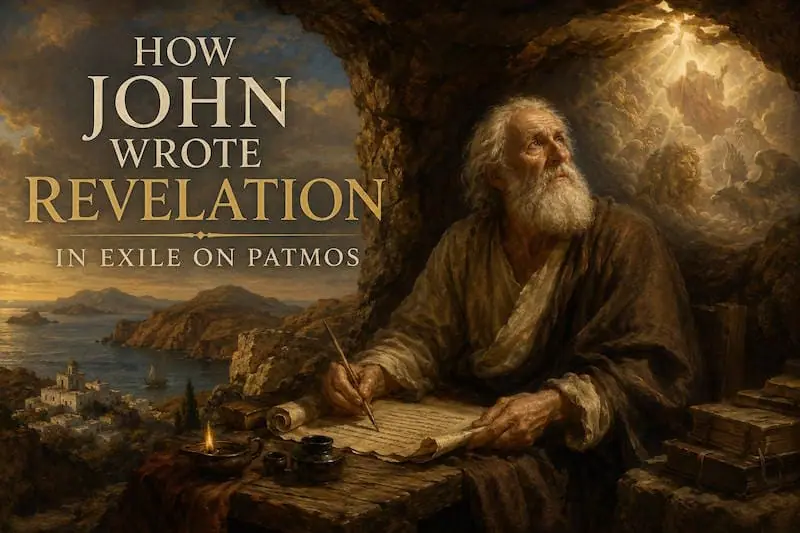
The Book of Revelation opens not with beasts or trumpets but with the postal service: "What thou seest, write in a book, and send it unto the seven churches which are in Asia; unto Ephesus, and unto Smyrna, and unto Pergamos, and unto Thyatira, and unto Sardis, and unto Philadelphia, and unto Laodicea" (Revelation 1:11). Seven real congregations in seven real cities of Roman Asia — every one of them in today's western Turkey, every one of them visitable, and every one still preaching its letter through its stones.
John in Ephesus — the shepherd of Asia
The story begins in Ephesus. By the last decades of the first century, the early Church remembered one towering figure on this coast: John — the beloved disciple, who by unanimous ancient tradition settled in Ephesus, cared there for the churches Paul had planted, and published his Gospel while dwelling in the city. Irenaeus, who as a boy heard Polycarp of Smyrna — himself a hearer of John — preserves the chain of memory; Polycrates, bishop of Ephesus around 190, points proudly to John's tomb on the hill above town. From Ephesus, John knew the churches of the province the way a mother knows her children's houses — which is exactly how the seven letters read.
Patmos — the island of the vision
"I John... was in the isle that is called Patmos, for the word of God, and for the testimony of Jesus Christ" (Revelation 1:9). Rome dealt with troublesome public men by relegation to small islands, and Patmos — a rocky Aegean outcrop within sight of the Anatolian coast, traditionally under the emperor Domitian in the mid-90s — received its most consequential exile. There, tradition holds, in a hillside grotto now called the Cave of the Apocalypse, John heard behind him "a great voice, as of a trumpet." A monastery of Saint John has crowned the island since 1088, and cave and monastery together are today a UNESCO World Heritage Site. Released after Domitian's death, the old apostle returned — where else? — to Ephesus, where he died in the reign of Trajan and where Justinian's great basilica later rose over his grave. Our sister site Seven Churches of the Apocalypse tells the island's own story in depth: Patmos, the island where Revelation was written.

Seven addresses on one mail road
Look at the seven cities on a map and the list explains itself: they form a rough circle along the Roman roads of the province. A courier landing from Patmos at the nearest great harbor — Ephesus — would ride north up the coast to Smyrna and Pergamon, then swing inland and south through Thyatira, Sardis and Philadelphia to Laodicea. John names them in exactly that riding order. Each city was also a natural hub for its district, from which a letter would radiate outward. The seven letters, in other words, were addressed to all Asia — through seven post offices.

1. Ephesus — the church that left its first love
THEN: the metropolis of Asia and mother-church of the province — Paul's base for over two years, Timothy's see, John's own city. Its letter (Revelation 2:1–7) praises tireless labor and doctrinal vigilance, then delivers the most quoted diagnosis in church history: "thou hast left thy first love." NOW: the grandest ruin field in the Mediterranean — theater, library, marble avenues — with the Church of Mary and John's basilica completing the story. The candlestick's removal reads soberly here: of the seven cities, Ephesus is among those with no living town on the site at all. Every page of this website is, in a sense, this church's entry.
2. Smyrna — the church under the crown
THEN: a beautiful port city and Ephesus's great rival, whose poor, persecuted congregation received the shortest letter and, alongside Philadelphia, one of only two with no rebuke at all (Revelation 2:8–11): "be thou faithful unto death, and I will give thee a crown of life." Its most famous son proved the letter literally — Polycarp, John's own disciple, martyred in the city's stadium around 155, refusing to curse the Christ he had served "eighty and six years." NOW: Smyrna is Izmir, Turkey's third city, alive and enormous — the excavated Roman agora sits downtown, and the church of Saint Polycarp still holds services. The church told to be faithful unto death is the one whose city never died.

3. Pergamon — the church beside the throne
THEN: the old royal capital of Asia, stacked on a spectacular acropolis — library of 200,000 scrolls, the great altar of Zeus, and the province's first temple of the imperial cult. Its letter (Revelation 2:12–17) locates the church "even where Satan's seat is" and honors Antipas, "my faithful martyr." NOW: the acropolis of Bergama is one of Turkey's most dramatic sites — a UNESCO World Heritage city — with the cliff-edge theater and the altar's foundations (the sculpted frieze itself stands in Berlin). Below in town looms the colossal brick Red Basilica, a pagan temple later converted into a church dedicated, fittingly, to Saint John.

4. Thyatira — the longest letter to the smallest city
THEN: the least of the seven by size and fame — a workaday garrison-and-guild town famous for its dyers and bronze-smiths. The New Testament's first European convert, Lydia, "a seller of purple, of the city of Thyatira" (Acts 16:14), carried its trade abroad. Yet this modest congregation received the longest of the seven letters (Revelation 2:18–29), with its searching words about the prophetess "Jezebel" and the promise of the morning star. NOW: modern Akhisar covers the ancient city; in its town center a fenced block preserves the ruins of a Byzantine basilica and colonnaded street — small, honest remains that make the letter's lavish length all the more moving. Heaven, evidently, does not measure churches in acreage.

5. Sardis — the church with the reputation
THEN: the fabled capital of King Croesus, where gold was first refined and coinage struck rich — a city living, by John's day, largely on its glorious name. The letter cuts accordingly (Revelation 3:1–6): "thou hast a name that thou livest, and art dead." Twice in its history Sardis's "impregnable" acropolis fell to climbers who came like thieves in the night — the letter's "I will come on thee as a thief" landed on flinching ears. NOW: Sardis is archaeologically magnificent — the vast marble-courted gymnasium, the largest ancient synagogue ever excavated, the Temple of Artemis with a tiny fourth-century church tucked against its corner: the "few names even in Sardis" in brick and stone.

6. Philadelphia — the church of the open door
THEN: the youngest of the seven cities, founded as a missionary outpost of Greek culture on the road to the interior — and shaken repeatedly by the earthquakes of its volcanic valley, so that its people, Strabo says, lived half out-of-doors in fear. To this small, battered congregation with "a little strength" came the tenderest letter (Revelation 3:7–13): an open door no man can shut, and the promise that the overcomer will be made "a pillar in the temple of my God" — something that never falls, in the city where everything fell. NOW: Alasehir thrives among its vineyards; of ancient Philadelphia the most visible remains are, poignantly, massive Byzantine piers of the church of Saint John — pillars still standing after every earthquake since.

7. Laodicea — the lukewarm church
THEN: the banker of the seven — so rich it rebuilt itself without imperial aid after the earthquake of 60, famous for its black wool, its medical school and its Phrygian eye-salve. Its letter (Revelation 3:14–22) turns every civic boast to diagnosis: "thou art neither cold nor hot... thou sayest, I am rich... and knowest not that thou art wretched... and blind." Even the water preaches — piped in from distant springs, it arrived tepid, unlike neighboring Hierapolis's hot healing springs or the cold streams above Colossae. NOW: Laodicea is one of Turkey's most exhilarating active excavations — colonnaded avenues re-erected year by year, and an early fourth-century church uncovered in 2010, with Pamukkale's white terraces shining across the valley. The chapter ends with the line that outgrew its envelope: "Behold, I stand at the door, and knock."

Walking the mail route today
The full circuit is one of the great road-pilgrimages of the Christian world, and it is entirely drivable in three unhurried days — our Seven Churches of Revelation Tour follows the courier's exact order, reading each letter within sight of its own ruins, with Patmos available as an island extension for those who want to begin where John did. Whether you take the whole loop or only its first station at Ephesus, the letters change once you have stood at their addresses: they stop being ancient mail, and start being yours.
Sources & further reading
- Revelation 1–3 (KJV) — Bible Gateway — the vision and all seven letters
- UNESCO World Heritage: Patmos — the cave and monastery of Saint John
- UNESCO World Heritage: Pergamon — the acropolis and its monuments
- Britannica: Patmos — the island of the Revelation