
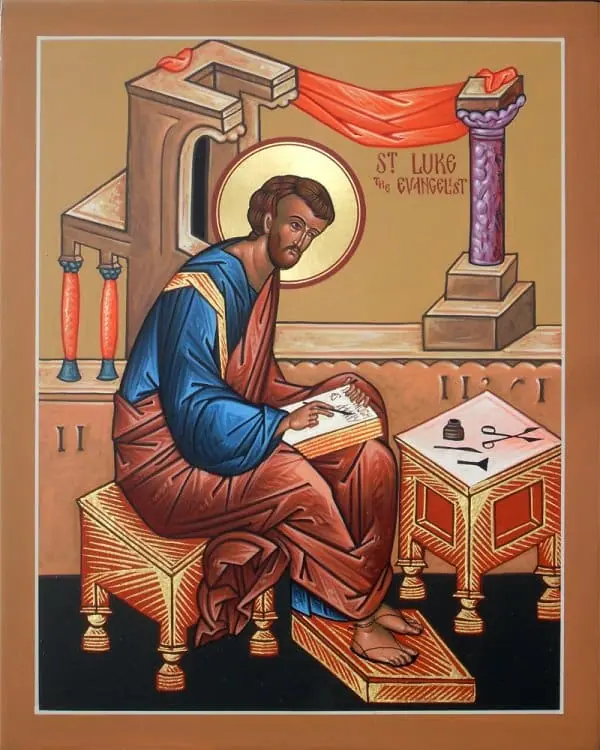
Remove Luke and this website goes quiet. The riot in the theater, the school of Tyrannus, the book fire, the town clerk's speech, the tearful farewell at Miletus — every scene of biblical Ephesus survives because one educated Greek convert chose to write it down. Paul calls him "Luke, the beloved physician" (Colossians 4:14); the Church calls him Evangelist; historians call him, quite seriously, one of the finest ancient writers of narrative history.
The man behind the "we"
Luke never names himself in his two books, but he steps into his own story through a pronoun. In the "we" passages of Acts, the narration quietly shifts from "they" to "we" — the author has joined the ship. One such passage sails this very coastline: "we came the next day over against Chios; and the next day we arrived at Samos... and the next day we came to Miletus" (Acts 20:15). From that deck Luke watched these mountains pass; at Miletus he heard, and preserved, Paul's farewell to the Ephesian elders — the speech that still moves readers to tears, because it moved its stenographer first.

Physician, historian, painter
Tradition embroidered Luke's portrait lovingly: a physician of Antioch, author of the Gospel of the poor and of women and of lost sheep, and — from the sixth century onward — the first icon-painter, credited with portraits of the Virgin. His accuracy as a historian has fared remarkably under modern scrutiny: titles like the "townclerk" of Acts 19:35 land exactly right for Ephesus, confirmed by inscriptions dug from this very site.
The Ephesus monument
Near the upper city of Ephesus stands a circular Roman monument that the excavator John Turtle Wood identified in the nineteenth century as the grave of Saint Luke, on the strength of a carved bull — the Evangelist's emblem — beside a cross. The identification is honestly debated (older tradition sends Luke's relics from Greece to Constantinople), but the Byzantine conversion of the building into a church shows Ephesian Christians venerated the spot. We tell the whole detective story at the site itself.
Reading Luke in Luke's landscape
There is a particular joy in opening Acts 19 inside the theater or Acts 20 looking toward Samos — hearing an author describe, with a reporter's precision, the very stones and seaways around you. On our tours, Luke is not just a source; he is the third guide walking with us.
Sources & further reading
- Britannica: Saint Luke — the Evangelist's life
- Acts 20:13–17 (KJV) — Bible Gateway — the "we" voyage past this coast
- Colossians 4:14 (KJV) — Bible Gateway — "the beloved physician"