
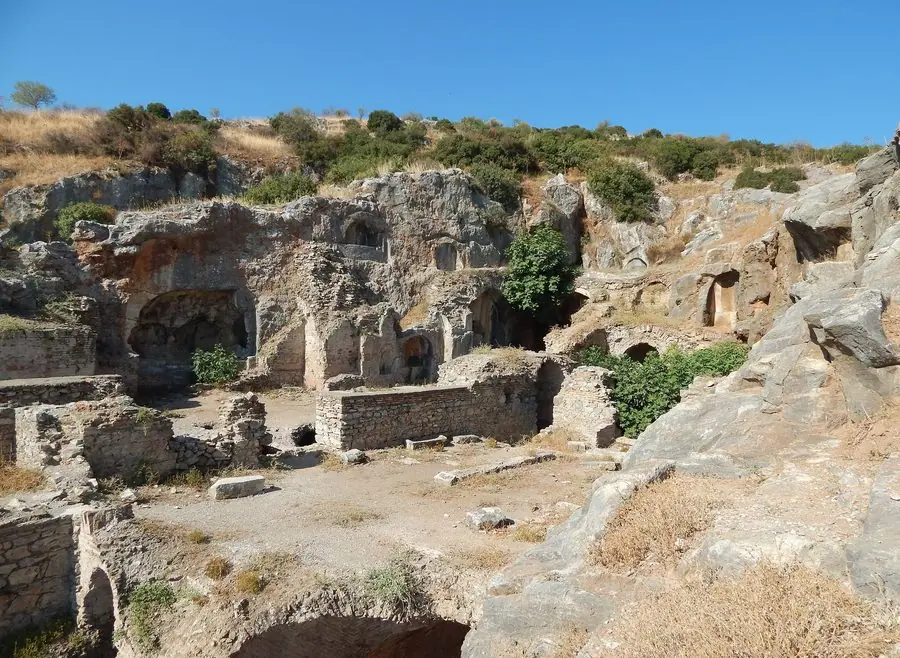
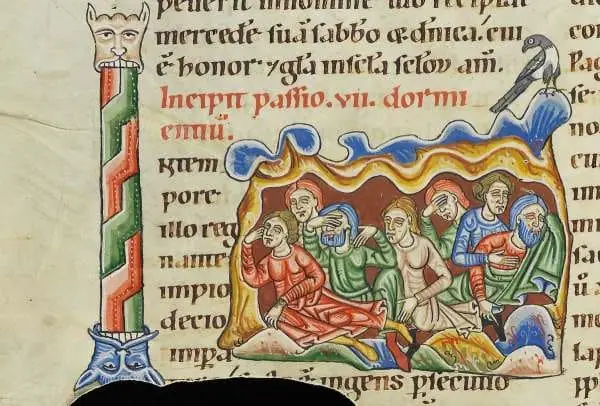
Around the year 250, under the emperor Decius, sacrificing to the gods became a test of loyalty and refusing it a capital crime. The legend tells of seven young Ephesian men who refused, fled to a cave on Mount Pion, and were walled inside. They fell asleep. When the wall was opened — nearly two hundred years later, under Theodosius II — they woke, sent one of their number into town for bread, and discovered the world had changed: the coins in his purse were two centuries out of date, and the city that had hunted them now bore crosses over its gates.
Why the story mattered
To the fifth century, the tale was more than a marvel — it was an argument. Debates about the resurrection of the body ran hot, and the sleepers were embraced as living proof that God could wake the long-dead flesh. Their fame spread astonishingly far: westward through Gregory of Tours into medieval Europe, and eastward into the Quran itself, where Surah al-Kahf — "The Cave" — honors the sleeping youths and their faithful dog. Christians and Muslims alike have venerated this hillside for well over a thousand years.
The ruins on the hillside
Excavations at the traditional site uncovered exactly what the legend's fame would predict: a rock-cut church and a sprawling necropolis of hundreds of tombs, as generations of the faithful paid to be buried near the sleepers — the ancient equivalent of wanting a grave beside the saints. Tradition even brings Mary Magdalene's grave to this hill in some accounts. The site is currently viewed from its fenced perimeter, and its story is a highlight of the drive between Ephesus and the House of Virgin Mary.

Sources & further reading
- Wikipedia: Seven Sleepers — the legend in Christian and Islamic tradition
- Britannica: Seven Sleepers of Ephesus — concise overview