
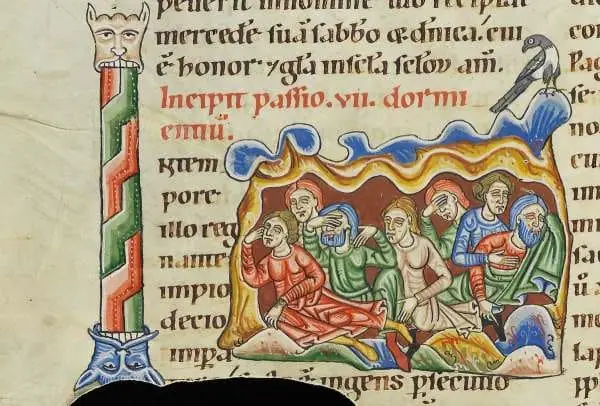
Around the year 250 the emperor Decius demanded sacrifice to the gods from every subject, on pain of death — the first empire-wide persecution of Christians. In Ephesus, the legend says, seven young men of good families refused. They gave their goods to the poor and withdrew to a cave on Mount Pion to pray. Decius, finding them, ordered the cave walled shut. Inside, the seven lay down together — and God, as the story tenderly puts it, took their souls into his keeping the way a mother lifts a sleeping child.
The awakening
Nearly two hundred years pass. Under Theodosius II, a landowner dismantles the old wall for building stone, daylight falls into the cave — and the seven wake, convinced they have slept one night. One of them, Iamblichus, slips into the city to buy bread; his troubles begin at the till. The baker stares at a silver coin of Decius, two centuries out of circulation, and concludes the young man has found buried treasure. Dragged before the authorities, Iamblichus tells his impossible story — and the astonished city climbs the mountain to find six more witnesses just waking. Having testified to a doubting age that the dead can indeed rise, the seven lay down once more and slept in peace.
Why the fifth century needed this story
The tale spread precisely when the Church argued fiercely over the resurrection of the body. The sleepers were the perfect parable: not ghosts, not metaphors — young men with working appetites and outdated pocket money, flesh preserved through time by the same power that promises to wake all flesh. Bishop Stephen of Ephesus promoted the miracle; Gregory of Tours carried it west; the Golden Legend made it medieval Europe's bedtime favorite.

The sleepers in the Quran
The story's most remarkable journey was eastward. Surah 18 of the Quran, al-Kahf — "The Cave" — honors the People of the Cave: young believers who fled persecution, slept by God's mercy for some three hundred years, guarded by their dog at the threshold. The surah famously declines to settle their number — "My Lord knows best" — a gentle rebuke to those who quarrel over details instead of hearing the point. To this day, Muslims recite al-Kahf every Friday; the Ephesian cave is venerated by Christian and Muslim visitors alike, one hillside sharing one hope.
Visiting the cave
The excavated complex — rock-cut church, chapels and a crowded necropolis of the faithful who paid to be buried near the sleepers — lies on the eastern slope of Mount Pion, minutes from the Ephesus gates, viewed from its perimeter. It folds naturally into our Full Day tour, and the story is told, of course, at the mouth of the cave itself.
Sources & further reading
- Britannica: Seven Sleepers of Ephesus — the legend summarized
- Wikipedia: Seven Sleepers — Christian and Islamic traditions